

For any specifier, the custom vs semi-custom vanity decision comes down to a project management equation, not just a design choice. You’re balancing the client’s vision against the hard realities of the budget and construction schedule. Choosing wrong doesn’t just mean an aesthetic compromise; it means potential timeline delays, unexpected labor costs for on-site fixes, and questions from the client when the final product doesn’t match the drawings.
The standard pitch is simple: semi-custom is 30-50% cheaper and ships in 4-8 weeks, while custom takes 10-16 weeks. That’s true, but it’s incomplete. Most spec sheets ignore that semi-custom often restricts drawer depths and hardware, forcing you to accept subpar function. They also don’t mention the hidden costs of using filler panels for non-standard layouts, which can inflate installation labor. This analysis moves past the catalog specs to compare the total project impact—from factory compliance to the final punch list.
Why Most Vanity Projects Fail: The Custom vs Semi-Custom Trap
Project failures aren’t about choosing the wrong vanity; they’re about misunderstanding the production constraints and hidden costs of your choice.
Most specifiers think the custom versus semi-custom debate is a simple trade-off between cost and design freedom. This is a surface-level view that leads to blown budgets and missed deadlines. The real failure point is a disconnect between the project’s specific requirements—scale, brand consistency, and physical layout—and the manufacturing realities of the chosen vanity type.
The appeal of semi-custom is obvious: unit costs are 30-50% lower and lead times are typically a brisk 4-8 weeks. This looks great on paper for large-scale projects. The trap is sprung when these modular units meet non-standard spaces. The “savings” are quickly eroded by the need for filler strips and on-site modifications, which can inflate installation labor by 10-20%.
Beyond budget, the design integrity is compromised. Many semi-custom lines lock you into standard drawer depths and hardware. If your design calls for specific internal dimensions or upgraded soft-close mechanisms, you’re often forced to accept a suboptimal solution that doesn’t align with the project’s quality standard.
Full custom offers the ultimate control—perfect fit for unique layouts, Pantone-matched finishes, and branded hardware. The stated lead time of 10-16 weeks is accepted as the cost of perfection. The trap here is the supplier’s actual production capacity. If your manufacturer lacks an efficient, high-capacity factory, your custom order can become a major bottleneck.
When vanity delivery is delayed, it holds up the entire finishing sequence for a project. Plumbers, electricians, and painters are put on standby, creating a domino effect of schedule overruns and cost escalations. The failure isn’t in choosing custom; it’s in choosing a custom supplier whose production line can’t keep pace with your project milestones.
The decision is not about which vanity type is superior, but which is appropriate for the job’s specific constraints. Forcing a semi-custom solution into a boutique project with asymmetrical rooms is a recipe for expensive rework. Conversely, tasking a small custom shop with a 500-unit hotel development risks catastrophic delays.
A savvy specifier mitigates this risk by partnering with a manufacturer that has proven mastery of both production paths. A supplier with the flexibility for low MOQ custom orders (10-20 units) allows for risk-free market testing, while also possessing the scaled capacity (5,000+ units/month) for large semi-custom rollouts. This ensures the vanity specification aligns with the project’s financial, timeline, and branding goals from day one.
Real Cost Breakdown: Custom vs Semi-Custom for Specifiers
In non-standard layouts, a fully custom vanity can be cheaper than semi-custom once you factor in the cost of fillers and wasted.
Specifiers often get trapped by looking only at the per-unit price. The real cost of a vanity project is a total calculation that includes unit price, engineering fees, and on-site labor. Here’s the professional breakdown that separates a smooth project from a budget disaster.
On paper, a semi-custom vanity from a factory catalog is 30-50% cheaper per unit than a fully custom piece. This is the number that gets most of the attention. However, this figure ignores the reality of the job site. The true cost emerges when you account for the additional expenses required to make each type fit perfectly.
Every project has costs beyond the unit price. The key is knowing which ones apply. Custom work front-loads its costs into design, while semi-custom back-loads them into installation.
-
- Custom Project Costs: Expect an additional 5-15% of the project total for engineering, CAD drawings, and pre-production approvals. This fee buys you precision, eliminating the need for on-site adjustments.
- Semi-Custom Project Costs: When layouts aren’t perfectly standard, you’ll need filler panels to close gaps. These materials, plus the skilled labor to cut and fit them seamlessly, can add 10-20% to the installation cost, eroding the initial unit savings.
The decision becomes clear when you analyze the layout. For a large hotel project with hundreds of identical, standard-sized bathrooms, semi-custom is the logical choice for speed and cost-efficiency. But for a boutique hotel, luxury residence, or a renovation with awkward corners and non-standard plumbing, a fully custom vanity often becomes cost-competitive, or even cheaper, by delivering a perfect fit that requires zero on-site modification.
The old model required a massive capital investment to test a new finish or custom size. Sourcing directly from a manufacturer that supports low minimum order quantities (MOQs) changes this dynamic. With MOQs as low as 10-20 units, specifiers can order a small batch of a new custom design to validate it in a real-world project or build a mockup for client approval. This allows for design innovation without the financial risk of a full container load.
| Factor | Semi-Custom Vanity | Fully Custom Vanity | Impact for Specifiers |
|---|---|---|---|
| Unit Cost per Vanity | 30–50% lower initial cost compared to fully custom. | Higher base price due to bespoke manufacturing. | Semi-custom offers immediate budget savings for projects with standard dimensions. |
| Design & Engineering Fees | Generally included in the unit price (no separate line item). | Adds 5–15% to total project cost for dedicated CAD drawings and engineering. | Custom fees are an upfront investment for guaranteed fit and unique design approval. |
| Hidden Installation Costs | High risk. Can add 10–20% in labor/material costs for fillers in non-standard layouts. | Zero. Built to exact room measurements, eliminating the need for fillers and extra labor. | Total project cost for semi-custom can unexpectedly inflate to match custom in complex spaces. |
| Minimum Order Quantity (MOQ) | Varies; often requires high volume. Factory-direct options (e.g., MFBATH) start at 10-20 units. | Traditionally requires large orders. MFBATH offers a low MOQ of 10–20 units. | Low MOQs enable cost-effective custom solutions for boutique hotels or high-end residential projects. |
Custom vs Semi-Custom: Lead Times, Material Options & Compliance
For specifiers, the decision between semi-custom and full custom is a direct trade-off between project velocity and design authority. Semi-custom leverages modular efficiency for speed, while custom provides complete control over every material, dimension, and finish, but requires a longer production timeline.
The difference in delivery timelines is not arbitrary; it’s a direct result of the manufacturing process. A semi-custom vanity, built from a library of pre-engineered components and finishes, moves through an optimized production line, resulting in a factory-to-port time of 4–8 weeks. A fully custom project resets the clock. It requires new CAD drawings, sourcing of unique materials, and potentially new jigs for CNC machines, extending the timeline to a more realistic 10–16 weeks. This buffer accounts for client approvals and procurement of non-standard items.
Both pathways offer a robust selection of core materials, including 100% waterproof PVC, moisture-resistant plywood, premium solid woods, and durable sintered stone. The divergence is in the finish and hardware. Semi-custom provides a curated catalog of proven finishes. Customization, in contrast, grants total control. This means precise Pantone color matching for brand consistency and the integration of specified or branded hardware—a non-negotiable for high-end hospitality and residential projects where every detail must align with the design intent.
-
- North America: Products must be UL/CSA compliant for any electrical components (like LED mirrors) and use CARB P2 certified boards to meet formaldehyde emission regulations.
- Europe: CE marking is mandatory, signifying conformity with health, safety, and environmental standards. Materials must also meet E1 grade for low formaldehyde emissions.
- Oceania: Vanities and fixtures must adhere to AS/NZS standards for safety and quality, while plumbing components require WELS certification for water efficiency.
While semi-custom lines are typically pre-certified, a fully custom design may require a new certification process, a factor that must be built into the project timeline and budget. Partnering with a factory that already holds these certifications simplifies the process immensely, especially for low MOQ custom orders of 10-20 units.
| Feature | Semi-Custom Vanity | Custom Vanity |
|---|---|---|
| Production Lead Time | 4–8 weeks (Based on modular production) | 10–16 weeks (Made-to-order engineering & build) |
| Design & Dimensions | Based on pre-set catalog sizes; limited modifications. Ideal for standard layouts. | Unlimited. Built to exact project specifications, including non-standard dimensions and internal configurations. |
| Material & Finish Options | Select from a curated catalog of high-demand materials like moisture-resistant Plywood and 100% waterproof PVC. | Full range including Solid Wood, Sintered Stone, and over 40,000 combinations with Pantone color matching. |
| Hardware & Branding | Standard high-quality hardware from a pre-selected catalog. | Fully customizable. Supports branded hardware, logo engraving on mirrors, and custom packaging. |
| Regional Compliance | Available with pre-certified materials for major markets (e.g., CE, E1 Grade). | Engineered-to-order to meet specific regional standards (UL/CSA, ADA, AS/NZS, WELS). |
| Minimum Order Quantity (MOQ) | Low MOQ support (10–20 units), enabling cost-effective procurement for smaller projects. | Low MOQ support (10–20 units), allowing designers to test unique concepts risk-free. |
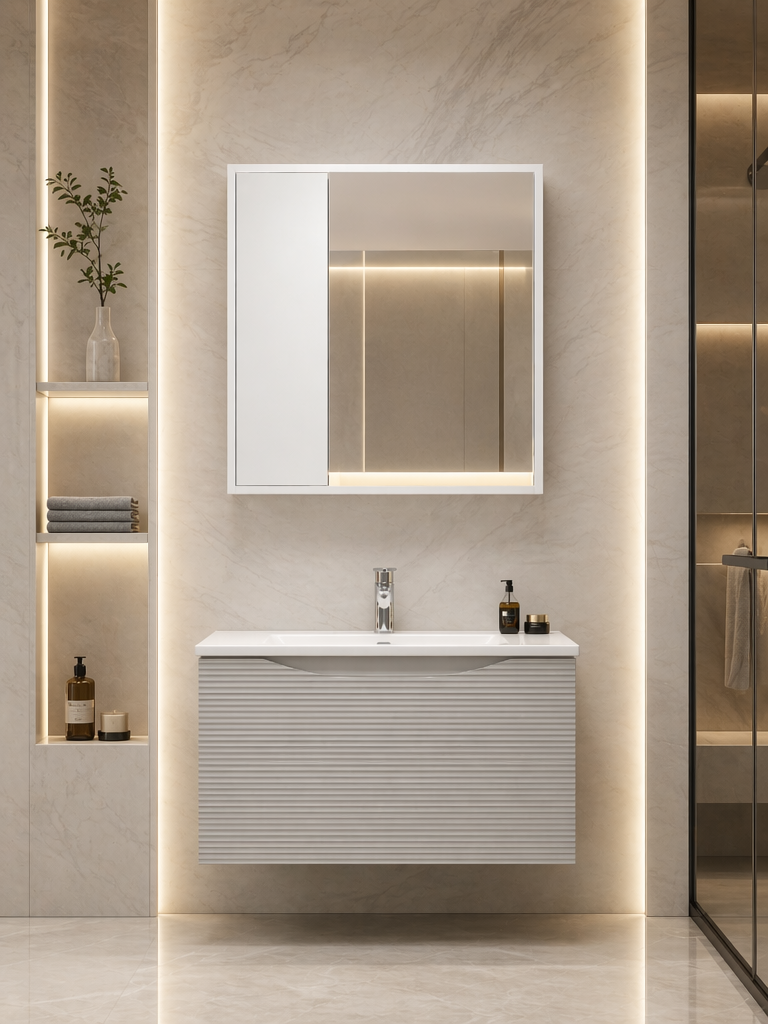
How to Choose the Right Vanity Type for Your Next Project
The decision between semi-custom and custom isn’t about which is “better”—it’s a strategic choice that aligns with your project’s financial, branding, and timeline constraints. Getting it wrong leads to budget creep from on-site modifications or timeline delays that kill client confidence. The right choice is based on project type and scale.
Semi-custom is the workhorse for projects demanding consistency, speed, and cost-efficiency. Think large-scale hotel chains, multi-family residential developments, or commercial restrooms where room layouts are standardized. The core benefit is leveraging a manufacturer’s optimized production line for modular components, which significantly cuts down lead times and per-unit costs. This path is ideal when your design can be satisfied by a curated catalog of finishes and standard dimension increments.
Full custom is non-negotiable for signature projects. This includes luxury hotel suites, flagship retail spaces, or high-end residential homes where the vanity is a centerpiece. It’s the only solution for navigating odd-shaped spaces, accommodating non-standard plumbing, or meeting strict corporate branding guidelines that require specific Pantone-matched colors or proprietary hardware. While lead times are longer, the investment eliminates the need for costly on-site fillers and guarantees a perfect fit that reinforces a premium brand identity.
The most effective strategy isn’t choosing one type, but partnering with a manufacturer that excels at both. A supplier with dual capabilities can provide cost-effective semi-custom units for the bulk of a project while producing a handful of fully custom pieces for executive suites or ADA-compliant rooms. This blended approach optimizes budget and timeline without sacrificing design integrity. Look for partners who offer this flexibility with low MOQs—our internal standard supports custom orders as low as 10 to 20 units, allowing you to test market-specific designs without high risk.
Before signing any purchase order, protect your project and reputation by demanding proof. Any credible manufacturer will readily provide these items. Refusal is a major red flag.
-
- Physical Samples: Request samples of the exact material, finish, and hardware specified for your project. Do not accept “similar” alternatives.
- Factory Audit Reports: Ask for current, unredacted copies of third-party audits like ISO 9001 (quality management) or BSCI (social compliance). These verify the factory’s operational claims.
- In-Production Proof: Require your supplier to provide time-stamped photographs or short videos of your specific order moving through key production stages—cutting, assembly, finishing, and packing. This confirms your order is being made as specified and isn’t just being pulled from old stock.
| Vanity Material | Primary Benefit | Optimal Climate/Use Case | Project Suitability | Design & Compliance Note |
|---|---|---|---|---|
| PVC (Polyvinyl Chloride) | 100% Waterproof & Highly Durable | High-humidity, coastal, and damp areas (e.g., Oceania, South America) | Commercial spaces, hotels, and family bathrooms requiring maximum water resistance. | Excellent for meeting water-efficiency (WELS) and coastal durability (AS/NZS) standards. |
| Plywood | Cost-Effective & Moisture-Resistant | Temperate climates; projects balancing budget and performance. | Multi-unit residential projects, mid-range hotels, and cost-sensitive developments. | Available with E1 grade low-formaldehyde materials for European CE compliance. |
| Solid Wood (Oak/Walnut) | Premium Aesthetic & Natural Texture | Climate-controlled interiors where luxury is the primary driver. | Luxury homes, boutique hotels, and executive suites seeking a high-end, classic look. | Material authenticity is key. Can be specified for ADA-compliant designs in North America. |
| Sintered Stone | Extreme Durability (Scratch/Heat/Stain-Resistant) | Hot, arid regions (up to 50°C) and high-traffic areas (e.g., Middle East, Asia). | Modern architectural projects, compact urban spaces (floating designs), and high-end commercial properties. | Non-porous and tested for 10,000+ cleaning cycles, ensuring long-term aesthetic perfection. |
Conclusion
The choice between custom and semi-custom is a strategic decision that pits project speed against design integrity. Semi-custom offers a 4–8 week lead time for standard projects, cutting upfront unit costs by 30-50%. Custom, however, eliminates the hidden labor and material costs of on-site fillers for non-standard layouts, ensuring a perfect fit and full material control.
Evaluate your project’s specific layout, compliance needs, and branding requirements against these trade-offs. To see how a factory-direct approach can accommodate both paths with low minimums and certified materials, explore the full range of available vanity solutions.
Frequently Asked Questions
What is the main difference between custom and semi-custom cabinets?
The main difference is design freedom; custom vanities are built from scratch to any specification, while semi-custom vanities modify pre-set designs with a limited selection of finishes and sizes. Choose custom for unique spaces and semi-custom for projects prioritizing speed and cost-efficiency.
Are custom vanities worth the investment?
Yes, custom vanities are worth the investment for non-standard layouts or when specific branding and material compliance are required. They eliminate the need for costly on-site modifications and. Evaluate the total project cost, not just unit price, to determine the true value.
How long does it take to get custom or semi-custom vanities installed?
Factory production lead times are typically 4–8 weeks for semi-custom and 12–16 weeks for full custom orders. This does not include international shipping, customs clearance, or on-site installation. Always add 4-6 weeks for ocean freight and port processing to your project timeline.
Can I get custom vanities with a low MOQ?
Yes, MFBATH supports fully custom orders with a low Minimum Order Quantity (MOQ) of just 10 to 20 units. This allows contractors and distributors to test new designs or. This low threshold is ideal for outfitting boutique projects or testing market-specific designs.
Do semi-custom vanities meet EU compliance standards?
Yes, semi-custom vanities can meet EU standards when sourced from a factory engineered for regional compliance. MFBATH ensures its European-bound products are CE compliant and use low-formaldehyde. Always verify the specific certifications for the product line you are specifying for your project.





0 Comments