

Specifying bathroom vanities is a balancing act between aesthetic fidelity and the relentless reality of local building codes. When a project moves from the drawing board to the factory floor, the difference between a smooth installation and a delayed opening weekend often comes down to material selection. Over the last decade, over 1,000 distributors across 20+ countries have been outfitted, and the pattern is clear: generic materials fail when they ignore regional climate and compliance requirements.
The choice between PVC, plywood, and MDF is not just about price per unit; it is about dimensional stability under thermal cycling and resistance to local humidity levels. Standard MDF swells more than 5mm in 24 hours of moisture exposure, whereas high-density PVC with a 0.55 g/cm³ density provides structural integrity for heavy stone basins without sagging. Marine-grade plywood offers superior screw retention for high-traffic commercial projects, but requires precise moisture sealing to prevent edge failure. Understanding these technical gaps ensures your designs survive the warranty period intact.
PVC vs MDF vs Plywood: Core Differences
PVC wins on waterproofing, MDF on finish quality, and Plywood on structural load-bearing capacity.
Specifying bathroom vanities requires moving beyond aesthetic preferences to address the physical realities of the environment. In global manufacturing, materials fall into three distinct archetypes: PVC for absolute moisture resistance, MDF for flawless painted finishes, and Plywood for structural integrity. Selecting the wrong core material is the primary driver of post-installation warranty claims, particularly in high-humidity commercial zones.
The decision matrix depends on the specific project constraints. PVC is the only 100% waterproof option, making it mandatory for coastal regions or high-traffic wet areas. MDF offers a perfectly smooth, knot-free surface ideal for high-gloss automotive lacquers, provided the installation environment is controlled. Plywood provides the highest screw-holding power and impact resistance, serving as the baseline for heavy stone basins and luxury residential builds.
-
- PVC (Polyvinyl Chloride): Micro-foam PVC with a density of 0.55 g/cm³ is structurally rigid enough to support heavy sintered stone basins without sagging. It is 100% waterproof, eliminating the risk of mold or swelling in high-humidity climates like the Middle East or coastal Australia.
- MDF (Medium Density Fiberboard):Standard MDF swells over 5mm in 24 hours of moisture exposure. However, the factory uses marine-grade MDF treated with a fully sealed edge process and automotive-grade baking finishes. This allows the paint to flex during thermal cycles, preventing the micro-cracking common in cheaper painted vanities.
- Plywood: Cross-laminated marine-grade plywood offers superior structural longevity and impact resistance. It commands a 15-20% premium over MDF due to its ability to withstand heavy physical loads and maintain dimensional stability, making it the preferred choice for luxury residential and high-end hotel projects.
For specifiers, the trade-off is clear: PVC guarantees zero moisture failure but limits high-gloss aesthetic options. MDF provides the highest aesthetic fidelity for complex painted designs but requires perfect edge-sealing to prevent swelling. Plywood bridges the gap, offering robust structural strength and a natural wood aesthetic that can be painted or stained.
To mitigate the risk of aesthetic mismatch between samples and final batches, the factory supports low MOQs of 10 to 20 units for custom material and color prototypes. This allows designers to validate finishes and structural performance before committing to large-scale production runs, ensuring design fidelity and supply chain reliability.

Waterproof Ratings: PVC vs Moisture-Resistant MDF
Standard MDF swells >5mm in 24h; high-density PVC (0.55g/cm³) eliminates swelling risks entirely.
Moisture is the primary cause of premature warranty claims in bathroom installations. While most suppliers market MDF as “moisture-resistant,” this classification is misleading for high-humidity environments. MDF is essentially compressed wood fibers; without perfect, factory-applied edge-sealing, it absorbs ambient water vapor and swells. Once the core swells, the laminate delaminates, rendering the cabinet unsalvageable.
In contrast, high-density PVC (0.55g/cm³ micro-foam) is inherently 100% waterproof. It does not absorb water, meaning it completely eliminates the risk of core swelling and mold growth. For coastal properties or commercial projects with poor ventilation, PVC is the only material that guarantees zero moisture-related degradation over the building’s lifecycle.
-
- Material Composition: PVC is a synthetic polymer offering total impermeability, whereas MDF relies on chemical binders that remain vulnerable to liquid water ingress.
- Edge-Sealing Dependency: MDF performance is strictly limited by the installer’s ability to seal edges perfectly. PVC requires no edge treatment to maintain structural integrity in wet zones.
- Dimensional Stability: Testing confirms standard MDF swells >5mm within 24 hours of moisture exposure. High-density PVC maintains absolute dimensional stability regardless of humidity levels.
Structural Load: Plywood Strength and Screw Retention
Plywood’s cross-laminated structure provides superior screw retention compared to MDF, preventing structural failure under heavy loads.
When specifying bathroom vanities for high-traffic commercial environments like hotels, the structural integrity of the cabinet carcass is a critical engineering parameter. Plywood is constructed from thin layers of wood veneer glued together with adjacent layers having their grain rotated up to 90 degrees. This cross-laminated structure creates a material with exceptional dimensional stability and mechanical strength.
The primary advantage of plywood in bathroom vanities is its superior screw-holding power. The layered composition allows screws to grip tightly into the wood fibers without tearing out, even after repeated tightening or slight adjustments during installation. This makes plywood the preferred choice for supporting heavy fixtures, such as sintered stone basins or thick quartz countertops, without the risk of the cabinet pulling away from the wall.
In contrast, Medium Density Fiberboard (MDF) is composed of fine wood fibers bonded with resin under high pressure. While MDF offers a smooth surface for painting, its homogeneous structure lacks the fibrous grip of plywood. Over time, and especially in the humid environment of a bathroom, the screws holding heavy vanities can loosen or strip within the MDF, leading to sagging doors, misaligned drawers, or in severe cases, the entire cabinet detaching from the wall.
For specifiers managing large-scale projects, this distinction is vital for long-term maintenance costs. A vanity that fails structurally due to stripped screws requires costly callbacks and potential liability issues. By specifying marine-grade plywood or high-density plywood for the carcass, you ensure that the vanity can withstand the dynamic loads of daily use and the static weight of premium stone surfaces.
-
- Structural Integrity: Cross-laminated layers distribute weight evenly, preventing sagging under heavy sintered stone basins (often exceeding 20kg).
- Screw Retention: Superior grip compared to MDF, ensuring hardware remains secure despite humidity-induced expansion/contraction cycles.
- Commercial Durability: Withstands the frequent opening/closing of drawers and doors in hotel settings without loosening joints.
- Moisture Resistance: Marine-grade plywood options provide resistance to swelling and delamination in high-humidity environments.
Finish Quality: Why MDF Wins for High-Gloss Designs
MDF is the only substrate capable of delivering flawless high-gloss automotive finishes without texture transmission.
When specifying high-gloss lacquers or automotive-style paints for luxury residential projects, MDF is the superior substrate. Unlike PVC, which carries a inherent surface texture that telegraphs through glossy finishes, MDF provides a perfectly smooth, knot-free surface. This uniformity allows for a mirror-like reflection that PVC simply cannot replicate, regardless of the paint quality.
The critical engineering challenge with MDF is not the core material, but the finish application. Standard low-cost vanities use rigid paints that crack when the wood fibers expand and contract. The factory utilizes an automotive-grade baking process. This cures the paint to form a flexible film that moves with the substrate during thermal cycles, preventing the micro-cracking that ruins the aesthetic of cheaper painted vanities.
-
- Surface Integrity: MDF offers a homogenous, knot-free core that eliminates the wood grain telegraphing seen in plywood and the micro-texture of PVC.
- Finish Compatibility: High-gloss lacquers require a perfectly flat substrate; MDF absorbs the paint evenly to create a deep, mirror-like gloss.
- Thermal Stability: Automotive-grade baking finishes flex with the MDF during temperature changes, preventing the paint cracking common in rigid, low-cost paints.
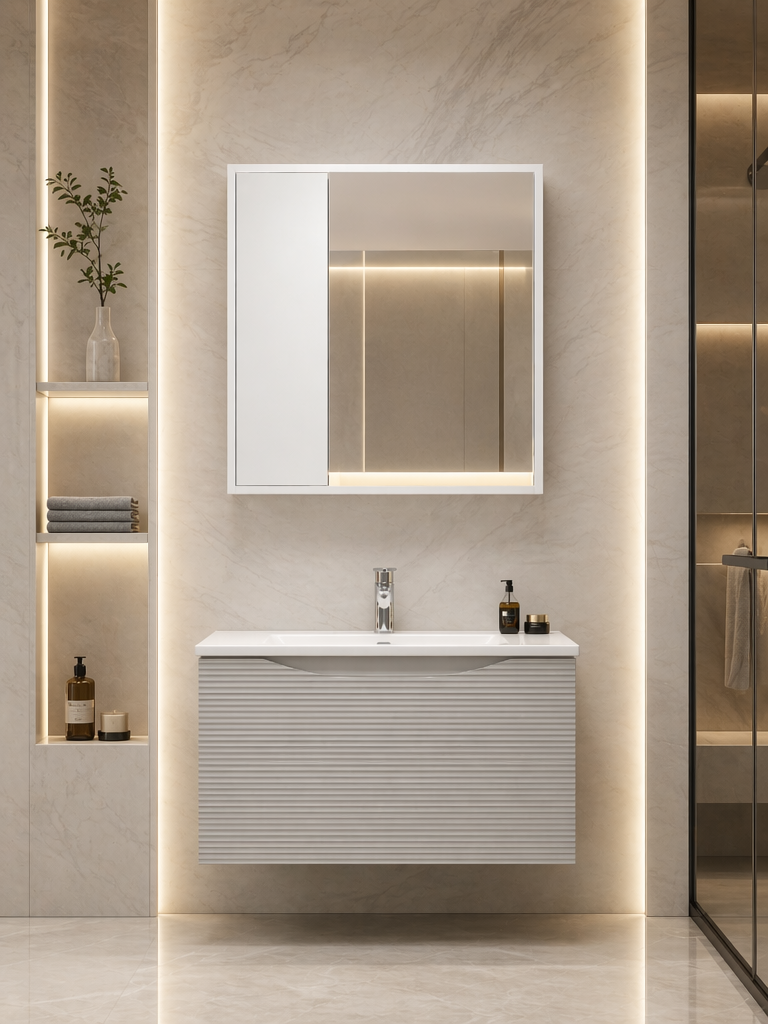
Sourcing Strategy: Low MOQs and Regional Compliance
Factory-direct sourcing allows 10–20 unit prototypes and strict regional compliance, eliminating capital lock-in.
Traditional OEM factories demand 200-unit minimums that tie up capital and prevent accurate prototyping. MFBATH operates a flexible CNC production line that accommodates low MOQs of 10 to 20 units for custom material and color testing. This structural flexibility allows designers to validate finishes and dimensions before committing to full-scale commercial production.
Material selection directly dictates regional compliance and structural performance. We provide four distinct manufacturing paths tailored to specific project environments. High-density PVC (0.55 g/cm³) is utilized for 100% waterproofing in high-humidity zones. Marine-grade plywood is selected for structural longevity and premium acoustic properties. High-density MDF with automotive baking finishes is reserved for flawless, high-gloss painted surfaces. Sintered stone is deployed for scratch-resistant, non-porous commercial applications.
-
- Prototype Agility: The 10–20 unit MOQ threshold allows risk-free material testing, preventing costly aesthetic mismatches in final batches.
- European Compliance: Products utilize E1 grade formaldehyde emissions and ISO 14001-certified materials to meet strict CE compliance standards.
- North American Safety: Electrical components meet UL/CSA standards, while structural designs comply with ADA accessibility requirements.
- Australasian Standards: Compliance with AS/NZS and WELS water efficiency standards ensures suitability for coastal and regulated markets.
- Production Transparency: Operating a direct 10,000㎡ facility ensures complete visibility into the five-stage quality control process.
Direct factory engagement removes the opacity of trading companies. Buyers receive unfiltered access to raw material sourcing and manufacturing timelines. With a verified monthly capacity of 5,000 units, the facility guarantees on-time delivery for large-scale developments. This direct channel ensures that your project specifications are executed with precision, protecting both ROI and design fidelity.
Conclusion
Specifying bathroom vanities requires balancing structural integrity with regional compliance. High-density PVC (0.55 g/cm³) eliminates moisture risks in humid zones, while marine-grade plywood and automotive-finished MDF deliver the dimensional stability and aesthetic precision needed for luxury residential projects. Prioritize these material specifications to prevent warranty claims and ensure long-term design fidelity.
Frequently Asked Questions
What is the best material for a bathroom vanity cabinet?
PVC is the best material for high-humidity or coastal projects due to its 100% waterproof nature. For luxury residential applications requiring complex painted finishes, marine-grade plywood or high-density MDF is. Select PVC for wet zones and plywood/MDF for dry, high-end aesthetic projects.
Is plywood or MDF better for bathroom vanity?
Plywood is better for structural integrity and screw retention, making it ideal for heavy stone basins. MDF is better for achieving flawless painted finishes but lacks the same load-bearing strength. Choose plywood for durability and MDF for finish quality.
What is better for a bathroom vanity, plywood or MDF?
Plywood offers superior moisture resistance and structural longevity compared to standard MDF. MDF is a viable option only if it is high-density and properly sealed to prevent swelling in. Opt for plywood in humid climates and sealed MDF for dry, aesthetic-focused designs.
What are 5 disadvantages of MDF?
MDF is prone to swelling when exposed to moisture, has lower screw retention than plywood, and is heavier. It also lacks natural grain aesthetics and can emit formaldehyde if not E1 grade. Avoid standard MDF in wet areas without rigorous sealing.
What is the current trend for bathroom vanities?
Current trends favor floating vanities for compact spaces and sintered stone for scratch-resistant modern aesthetics. Smart LED mirrors with voice activation and anti-fog technology are also highly demanded. Focus on floating designs and smart tech for modern projects.





0 Comments