
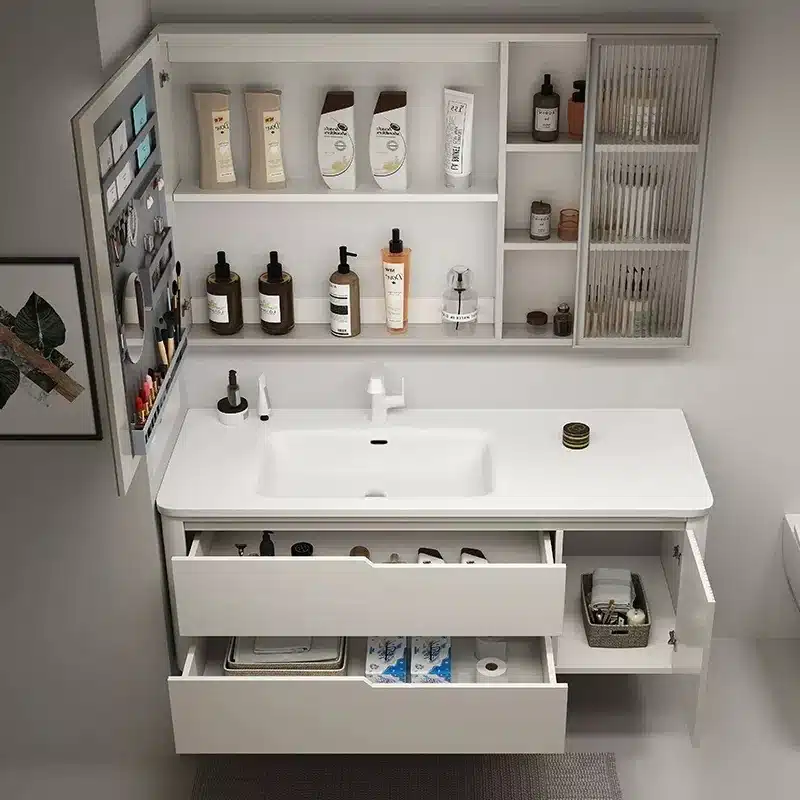
A vanity that fails its first winter in a luxury hotel is a quality failure, and the replacement bill lands on the developer, not the manufacturer. MFBATH supplies more than 1,000 distributors worldwide, but the durability comes from region-specific engineering, with construction specs adjusted for local humidity, temperature extremes, and regulatory standards.
Material choice matters more than surface finish. PVC shrugs off water damage in high-humidity zones, while marine-grade plywood adds structural stability in premium residential projects. Standard MDF swells once relative humidity passes 60%, which is why automotive-grade adhesives and a five-stage quality control process are non-negotiable for keeping edges bonded and panels flat.marine-grade plywood
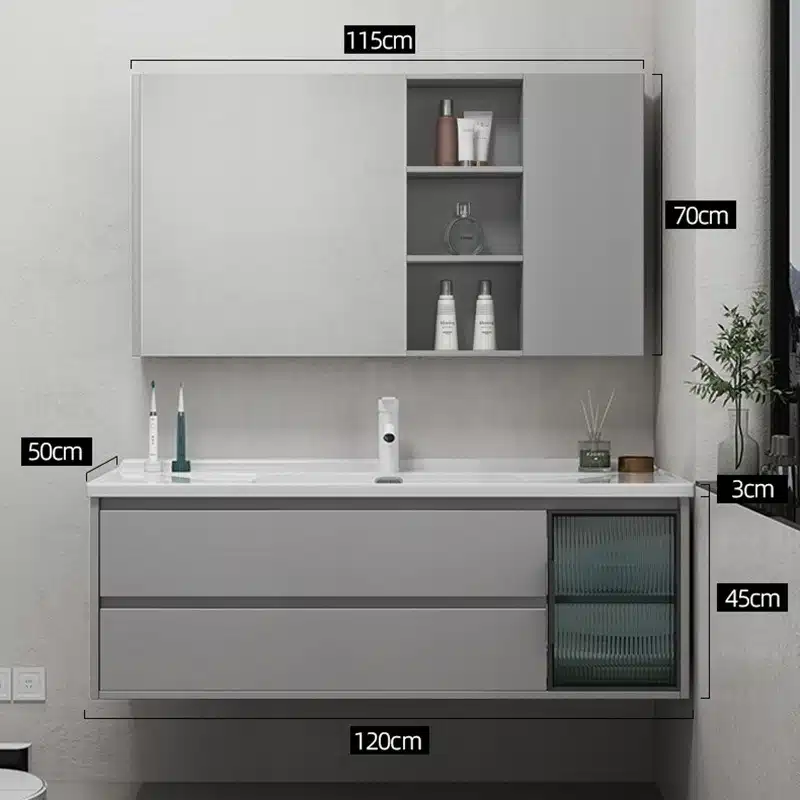
The Hidden Cost of Moisture Failure in Vanities
Moisture failure in vanities is a structural risk that drives warranty claims, not just an aesthetic issue.
No room in a building punishes cabinetry like a bathroom. Relative humidity stays between 60% and 90% for most of the day, and that moisture works on the weakest point of the vanity, the bond between the core board and the surface finish. Water gets in through edge banding and seams, the substrate swells, the layers separate, and the structure fails. Specify for material survival before you specify for looks.
A warped cabinet door is only the visible symptom. Moisture failure also triggers warranty claims, construction delays, and reputational damage for the architect and developer. Replacing a single vanity in a finished hotel or luxury home means dismantling the whole bathroom suite, so labor costs run far beyond the money saved on the cabinet. Durability is the cost-effective choice here; cheap boards with poor humidity resistance destroy the project’s ROI.
- Humidity threat: standard MDF and unsealed wood swell quickly above 60% RH, with delamination and mold appearing within months. Structural integrity: PVC and marine-grade plywood offer the best resistance to swelling, keeping the vanity stable in high-humidity zones. Lifecycle cost: PVC never needs refinishing, cutting long-term maintenance costs by 15-20% compared with solid wood.
- Moisture-driven material failure is the leading cause of warranty claims in commercial bathroom projects. Specify the wrong substrate and that claim comes back to you.
| Feature | Specification | Advantage |
|---|---|---|
| Core Material | 100% Waterproof PVC / Marine-Grade Plywood | Eliminates swelling and delamination in >70% RH environments |
| Adhesive Technology | Automotive-Grade Bonding Agents | Prevents edge failure even if surface finish is compromised |
| Quality Assurance | 5-Stage Rigorous Inspection Protocol | Ensures structural integrity and zero mold growth risk |
| Lifecycle Maintenance | Zero Refinishing Required (PVC) | Reduces long-term operational costs by 15-20% vs. solid wood |
| Regional Compliance | UL/CSA (NA), CE/E1 (EU), WELS (Oceania) | Guarantees regulatory adherence and project approval globally |
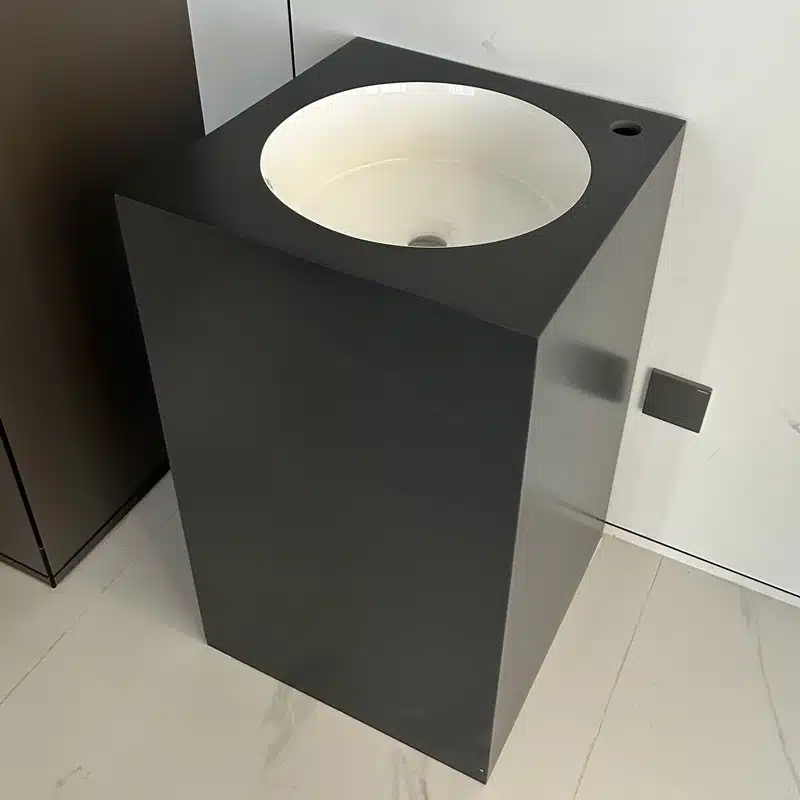
Real Cost Breakdown: PVC vs. Plywood vs. Solid Wood
PVC offers the lowest lifecycle cost for high-humidity projects due to near-zero maintenance, while solid wood demands 20% more upkeep.
Bathroom air pushes past 70-80% relative humidity for most of the day. That moisture works its way into the substrate, and the wrong material ends in delamination, mold growth, and warranty claims. Replacing warped cabinets costs far more than the small upfront saving from buying a cheaper board.warranty claims
PVC is 100% waterproof. It holds its structural integrity even in standing water, which is more than any wood product can claim. Spas and high-humidity commercial zones specify PVC because it needs no refinishing and no maintenance schedule. Lifecycle costs typically land 15-20% below solid wood.Lifecycle maintenance costs
Plywood balances cost with structural strength, provided the edges are sealed properly. Standard MDF breaks down fast once humidity tops 60%, while marine-grade plywood stays stable without swelling. The weak points are the seams. If edge banding gets compromised, moisture finds its way in, so factory quality control has to be strict.
- Solid wood (oak or walnut) is a different animal. It expands and contracts with humidity changes, and if the seal isn’t perfect, warping is almost guaranteed. Budget for annual resealing plus regular moisture checks. That is the real maintenance burden.
- Cost: higher initial procurement cost, and lifetime maintenance runs about 20% more than PVC. For buyers tracking total spend, that makes PVC the cost-effective route.
Moisture resistance is a quality issue, not just a material spec. Adhesive and edge banding matter as much as the core board. Automotive-grade adhesive holds the edge banding in place even after the surface finish gets scratched, which is the exact failure point on low-end cabinets. The five-stage QC inspection at material, cutting, assembly, finishing, and packing prevents swelling during transit or installation. That is where durability gets decided.
A 10-20 unit trial run lets you verify quality before the big order. Designers use it to test custom moisture-resistant finishes in the project’s actual climate, whether that’s a coastal resort or a dry urban apartment, before committing to full-scale procurement. The financial exposure stays small, and the performance data becomes real.
| Feature | Specification | Advantage |
|---|---|---|
| Material Core | 100% Solid PVC / Marine-Grade Plywood / Solid Oak/Walnut | PVC offers zero water absorption; Plywood provides structural stability; Solid Wood delivers premium luxury aesthetics. |
| Moisture Resistance | PVC: Impervious | Plywood: High (MR-Core) | Solid Wood: Moderate (Requires Sealing) | Eliminates warping and mold risk in >70% RH environments, ensuring long-term structural integrity. |
| Lifecycle Maintenance | PVC: Zero Maintenance | Plywood: Low | Solid Wood: High (20% more upkeep) | PVC reduces total cost of ownership by 15-20% compared to solid wood due to no refinishing needs. |
| Regional Adaptation | Heat-Resistant PVC (50°C) for Middle East; UV-Resistant Finishes for Oceania | Prevents material degradation in extreme climates, ensuring compliance with local environmental stresses. |
| Quality Assurance | 5-Stage QC with Automotive-Grade Adhesives | Prevents delamination and swelling even if surface finishes are scratched, guaranteeing durability. |
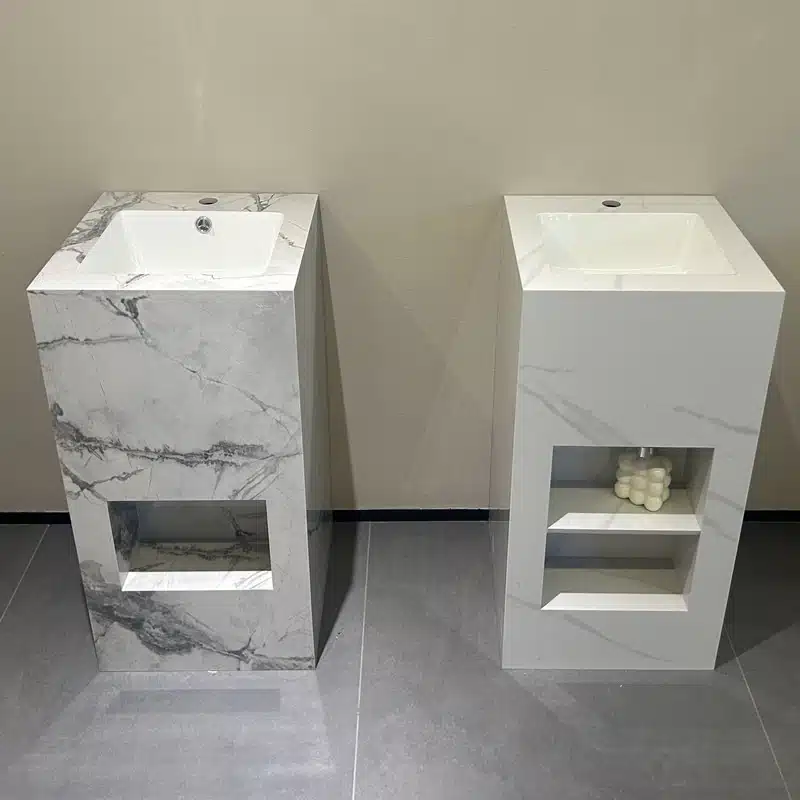
Material Comparison: Which Suits Your Climate?
Moisture resistance depends on the core material, the adhesive, and the edge banding process.
Bathroom air routinely sits at 70-80% relative humidity. Standard MDF swells and delaminates within months in those conditions. A flawless surface finish means little if the core has already failed, so durability starts with the substrate, not the top coat.
- PVC is 100% waterproof and immune to mold growth, making it the preferred material for coastal, tropical, and high-humidity zones. Its lifecycle maintenance runs 15-20% cheaper than solid wood, because nothing ever needs refinishing. Marine-grade plywood delivers strong moisture resistance and structural rigidity, but only when edges are rigorously sealed against water ingress; it suits luxury residential work where wood grain aesthetics outweigh total waterproofing. Solid wood expands and contracts with humidity swings, requires 20% more upkeep plus rigorous sealing against warping, and generally has no place in high-traffic commercial spas without an extensive maintenance contract.PVC (Polyvinyl Chloride)Marine-Grade Plywood
The adhesive and edge banding process are as critical as the core material. Automotive-grade adhesives prevent delamination even if the surface is scratched. Without this engineering, moisture will penetrate the seams and destroy the cabinet structure.
-
- Regional Climate Match: Use heat-resistant PVC for the Middle East (up to 50°C) and UV-resistant finishes for Oceania. Match the material to the local weather to ensure longevity.
- Compliance & Standards: North American projects require UL/CSA compliance. European projects need CE/E1 grade emissions standards. Oceania adheres to AS/NZS and WELS standards for water efficiency.
- Quality Control: Rigorous 5-stage inspection at material, cutting, assembly, finishing, and packing stages ensures no swelling or delamination occurs before shipping.
| Material | Climate Suitability | Key Benefit | Regional Application |
|---|---|---|---|
| PVC | High Humidity & Tropical | 100% Waterproof; Impervious to mold and swelling | Southeast Asia, Coastal Zones, Spas |
| Marine Plywood | Variable Humidity | Structural stability; Low swelling rate under stress | Europe (CE Compliant), Luxury Residential |
| Solid Wood | Dry & Temperate | Premium aesthetic; Requires rigorous sealing | North America (UL/CSA), Dry Climates |
| Sintered Stone | Extreme Heat & UV | Non-porous; Heat-resistant up to 50°C+ | Middle East, Oceania (UV Resistant) |

How to Specify Vanities for High-Humidity Projects
Moisture resistance fails at the seams, not the surface.
A bathroom naturally runs at 70 to 80 percent relative humidity. Standard MDF and particle board break down fast in those conditions. You don’t just need a panel that survives a splash. You need a core that handles the daily expansion and contraction cycles without warping, molding, or separating. Surface finish protects the look. Internal bond strength and edge sealing protect the structure. If the design skips over that, moisture finds its way in, and the cabinet fails from the inside out long before the door fronts show wear.
The real indicator of cabinet lifespan isn’t the board. It’s the adhesive and the edge banding. A weak edge bond turns a tiny scratch into a water entry point. We use an automotive-grade sealing glue that locks the banding to the substrate under thermal and humidity stress. Even if the surface gets scuffed or splashed directly, the seal stays tight. In a standard commercial installation, this is where most units fail first. Not the panel core. The edge. Fix the edge, and you buy years of extra service life in a high-moisture bathroom.
- Automotive-Grade Adhesives Heat and humidity cycling slowly works standard glues loose. The visible gap that forms between the banding and the body lets moisture crawl inside. The automotive-grade adhesive we use stays bonded through those cycles. Edge banding stays sealed. No peeling. No hidden water damage. 5-Stage QC Process Every unit passes through five checkpoints. Raw material. Cutting. Assembly. Finishing. Packing. At each stage, the job is to catch swelling, delamination, or edge failure before the item ships. By the time a cabinet leaves the 10,000 square meter facility, it has been inspected at every point where moisture-related defects tend to start.
- Pantone Color Matching Moisture-resistant substrates like PVC and marine plywood accept exact Pantone matches without sacrificing the waterproof core. The design team doesn’t have to choose between the correct brand color and structural reliability. The finish stays precise, while the base material stays stable under humidity.
You can test custom finishes and Pantone colors on an order as small as 10 units. MFBATH’s low MOQ lets designers validate moisture resistance before committing to full stock. That removes financial risk and keeps your installs from failing a compliance inspection later.
Conclusion
Solid wood swells and delaminates in high-humidity settings. PVC or marine plywood won’t. Even at 80% relative humidity, these materials hold their shape. Pair them with automotive-grade adhesives and five-stage QC, and you get a finish that stays true to Pantone specs, without ongoing timber maintenance bills. That’s the cost-effective durability most commercial projects need.regional compliance
Review the full range of moisture-resistant vanities and OEM specs on the custom solutions page before locking in your material choice.
Frequently Asked Questions
What is the best material for a bathroom vanity unit?
PVC is the best material for maximum moisture resistance as it is 100% waterproof and immune to warping. Plywood is a strong alternative for projects requiring a balance of structural rigidity and. Select PVC for high-humidity zones and plywood for balanced durability.
What’s the best material for a bathroom vanity countertop?
Sintered stone is the best countertop material due to its non-porous surface and extreme heat resistance. It withstands harsh cleaning cycles without staining or degrading in humid environments. Choose sintered stone for superior stain and heat resistance.
What is the most durable material for a vanity sink?
Sintered stone basins are the most durable option, tested for over 10,000 cleaning cycles. Their fused mineral composition ensures they remain scratch-resistant and non-porous under heavy use. Opt for sintered stone basins for long-term durability.
Who makes the highest quality bathroom vanities?
MFBATH produces high-quality vanities using a five-stage quality control process and advanced CNC manufacturing. Their ISO-certified facilities ensure consistent precision and compliance with global standards. Verify manufacturer certifications and quality control protocols.
Which countertop materials do kitchen designers recommend avoiding?
Designers typically avoid standard MDF and unsealed natural stone due to their vulnerability to moisture and staining. These materials often fail in high-humidity bathroom environments, leading to swelling or discoloration. Avoid standard MDF and unsealed stone in wet areas.




0 Comments