

Before you hand over a deposit, verify the load path. A 48-inch sintered stone vanity weighs 70-90kg. Standard plastic drywall anchors fail at 15kg. That is not close. Use structural wood studs or steel toggle bolts. Never rely on the cheap mounting kits included with generic imports.sintered stone basinplastic drywall anchorsstructural wood studs
The weak point is the cabinet back panel. Budget vanities use MDF. Lag screws strip right out. MFBATH solves this by gluing 10mm marine plywood reinforcement plates to the back of every unit. This creates a wood-to-wood grip for the hardware. The cabinet stays flush for decades. Seasonal humidity changes do not matter.

Why Generic Wall Anchors Will Fail
Plastic drywall anchors fail under creep stress; MFBATH vanities require structural stud anchoring with 10mm plywood reinforcement.
Load the math. A 48-inch vanity with ceramic basins weighs 70-90kg. Generic big-box anchors max out at 15kg each. Four anchors give you a theoretical 60kg capacity. That is not enough. It ignores the dynamic shear forces from daily use.
This is creep failure. Standard plastic anchors embrittle under seasonal humidity swings. Tensile strength drops. The vanity pulls away from the wall. Eventually, it punches through the drywall. Ruptured water lines. Property damage. This is not a repair; it is a catastrophic failure.creep failure
Bypass drywall anchors. Anchor directly into wooden wall studs. The gold standard is the 3-point method. Secure the top-left, top-right, and bottom-center of the cabinet back. This triangulation stops the bottom corners from swinging outward. It accounts for vibration and thermal expansion.
-
- Use stainless steel lag screws. Minimum penetration must be 1.5 inches into the wood stud. If you lack studs and must use drywall, heavy-duty metal toggle bolts are the only code-compliant alternative. Rate them for the specific unit weight. —
- Standard MDF back panels offer zero structural integrity. Drive a screw through one, and it crumbles instantly. The fix is simple: we glue a 100x100mm marine plywood patch behind every mounting point. This creates actual wood-to-wood grip. The result is long-term durability for units that handle heavy loads daily.
- Rust destroys vanity units faster than buyers expect. Seal every screw head with a 5mm rubber washer. This blocks the thread and stops moisture from wicking into the joinery. Keep the cabinetry rot-free, even in high-steam environments. This small step protects the quality of the finish for years.

The 3-Point Mounting Method (Gold Standard)
A 3-point anchor system prevents cantilever torque that causes 80kg vanities to detach from drywall.
Vanities don’t just “fall”—they tip. A loaded 48-inch unit weighs 70-80 kg and acts as a heavy lever. Two-point top mounts fail first. When top screws loosen, the bottom corners swing outward. That’s why proper anchoring is critical for safety and cost-effective installation.
Triangulation is mandatory, not optional. The 3-point method locks the cabinet’s center of gravity against the wall. It neutralizes the forward pull from both the sink weight and the user standing at the counter. This setup is the only way to clear liability on high-end projects.
-
- Skipping wall studs is pure gambling. Locate two vertical wood studs and drill 8mm pilot holes at the top-left, top-right, and bottom-center. This spacing spreads the shear load across the wall’s strongest structure. It ensures the vanity stays secure, which is essential for maintaining product quality over time.
- Cheap plastic anchors are liabilities waiting to happen. Use stainless steel lag screws that penetrate at least 1.5 inches into the stud. If studs aren’t aligned, switch to heavy-duty metal toggles. Plastic drywall anchors crush under 70kg of constant stress in under two years. Don’t risk it.plastic drywall anchors
- Insert a 5mm rubber washer between the screw head and the cabinet. It blocks moisture from wicking up the threads. This keeps the internal wood from rotting and prevents rust stains from ruining the finish.
Generic imports use MDF backs. The screws strip out when tightened. MFBATH fixes this by gluing a 10mm thick, 100mm x 100mm marine plywood plate to the interior back panel at every mounting point. The screw grips solid wood-to-wood. Zero pull-out risk.

Factory-Reinforced Back Panels (The Real Difference)
Generic MDF backs strip under torque; MFBATH uses 10mm marine plywood patches for structural integrity.
Bathroom vanities fail at the back panel, not the countertop. Generic manufacturers use Medium Density Fiberboard (MDF) for backs. It looks cheap because it is. MDF is just compressed sawdust and resin. It has no grain structure. Tighten a lag screw into it, and the fibers crush. The screw strips. The vanity hangs by a thread.
MFBATH engineers vanities to stop this specific failure. Our 10,000㎡ factory uses high-strength PU glue to attach a 10mm thick marine plywood plate to the back panel. We position it exactly where the hardware engages. The screw grip is solid wood-to-wood. It provides the tensile strength to support the full 70-80 kg load of a loaded vanity.
-
- Material Integrity: Marine plywood patches do not split. They do not strip under the 1.5-inch lag screw penetration required for stud mounting.
- Load Distribution: The 10mm thickness of the reinforcement plate spreads the shear force across a wider area of the cabinet carcass.
- They drill 8mm pilot holes in the reinforcement zones first. This keeps everything aligned. More importantly, it stops the wood from splitting when you drive the screws home.

Floating Vanity Structural Requirements
Floating vanities require continuous steel support bars or 3-stud mounting to prevent catastrophic drywall failure.
A loaded 48-inch vanity tips the scales at 70 to 90 kg. Standard drywall anchors? They won’t cut it. Cheap imports skip internal bracing to save pennies. The result is a cabinet ripping out of the wall and a liability nightmare for the specifier.
-
- Floating units demand a continuous horizontal steel bar behind the drywall or a three-stud mounting pattern. Never trust point-load anchors. You need that weight distributed across the whole wall plane.
- MFBATH vanities feature a 10mm marine plywood plate bonded to the back panel. This gives lag screws a solid wood-to-wood bite. It eliminates the MDF strip-outs common in budget imports.
- These heavy, flat-packed floating units are engineered to maximize 40HQ container density. That structural tightness cuts shipping costs per unit. It also ensures the cabinet arrives intact and ready for install.shipping costs
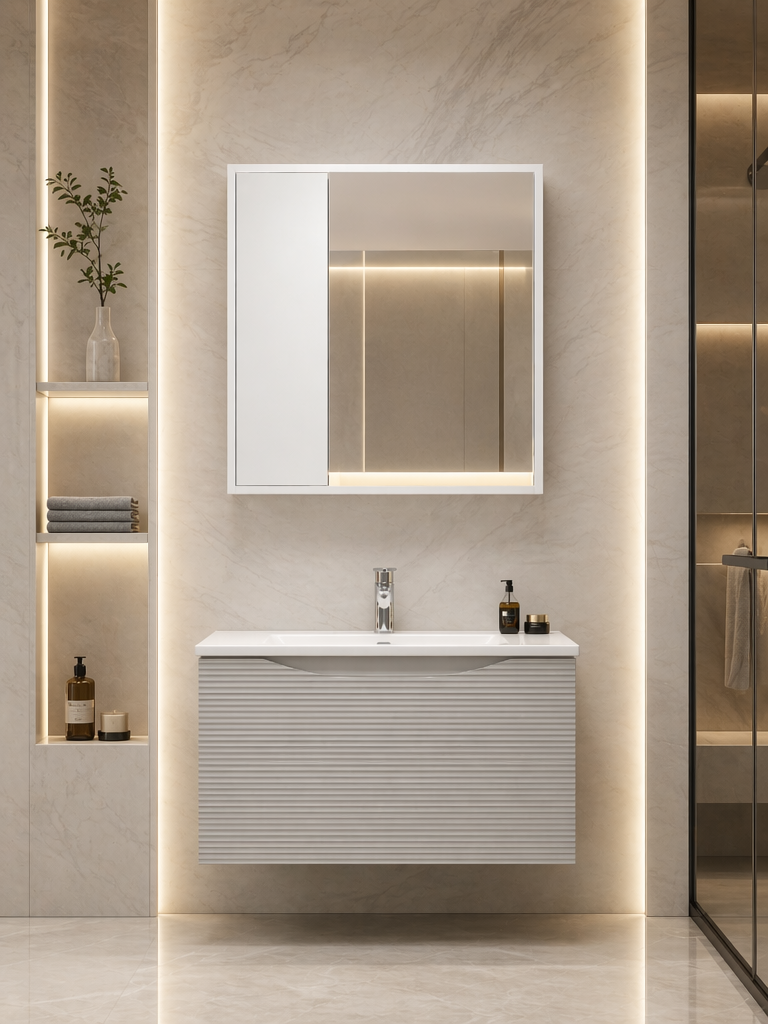
Custom Vanity Installation Checklist
Verify wall level, plumbing rough-in, hardware, and silicone sealing before mounting.
Floating vanity installs fail when site conditions are ignored. The cabinet is built for structural integrity, but the wall must bear the 70-90 kg load. Contractors need to check four critical points before drilling.
-
- Verify the wall is flat before you even think about drilling. If the wall bows out by more than 2mm, you leave gaps behind the cabinet. That gap puts uneven stress on the frame. Use a laser level to confirm the surface is truly flat.
- Confirm the water lines and drains sit between 17 and 20 inches from the floor. Miss this measurement, and the cabinet won’t sit flush against the wall. That misalignment compromises your anchor points and risks kinking the plumbing.
- Inspect the hardware bag before installation. It must contain stainless steel lag screws and heavy-duty toggle bolts. Generic plastic anchors will fail with solid wood or sintered stone models. The kit also includes 10mm marine plywood reinforcement patches to ensure a solid grip on drywall.10mm marine plywood reinforcement
- Apply a continuous bead of silicone caulk along the vanity top’s back edge and the mounting rail. This creates a moisture barrier. It stops water from wicking into the cabinet, protecting the internal structure from rot and mold.
Conclusion
A 48-inch vanity loaded with fixtures and water weighs 70 to 80 kg. That far exceeds the 15 kg limit of standard plastic anchors. You eliminate liability by anchoring directly into wood studs or using 200 kg-rated steel brackets. MFBATH prevents installation failure by including 10mm marine plywood reinforcement plates and pre-drilled 8mm pilot holes, ensuring the screws grip solid wood rather than crumbling MDF.marine plywood reinforcement plateMDF
Review the custom vanity OEM services to see how we engineer mounting-ready solutions for your specific project loads.
Frequently Asked Questions
Should you anchor a vanity to a wall?
Yes, anchoring is mandatory for any vanity over 40kg to prevent catastrophic failure. Standard plastic anchors cannot support the dynamic load of a loaded sintered stone basin. Always anchor into structural studs or use rated steel brackets.
How do you attach a bathroom vanity to the wall?
Use the factory-pre-drilled 8mm pilot holes and stainless steel lag screws to secure the unit directly into wall studs. This method distributes the 70-90kg load safely without stripping the back panel. Ensure screws penetrate at least 1.5 inches into the stud.
How to secure a vanity to a wall without drilling?
You cannot safely secure a heavy vanity without drilling into structural elements. Non-drilling adhesive solutions lack the shear strength to hold a 70kg load and pose a significant liability risk. Drilling is the only code-compliant method for heavy units.
How to secure a freestanding vanity?
Even freestanding units must be anchored to the wall to prevent tipping hazards. Use the included marine plywood reinforcement plate and heavy-duty brackets to lock the cabinet in place. Anchor regardless of style to ensure stability and safety.
How much do plumbers charge to install a bathroom vanity?
Plumber installation costs vary significantly by region and project complexity, typically ranging from $200 to $500 for standard hookups. This fee covers water line connections and leak testing but excludes structural wall reinforcement. Verify if the quote includes wall anchoring services.





0 Comments