

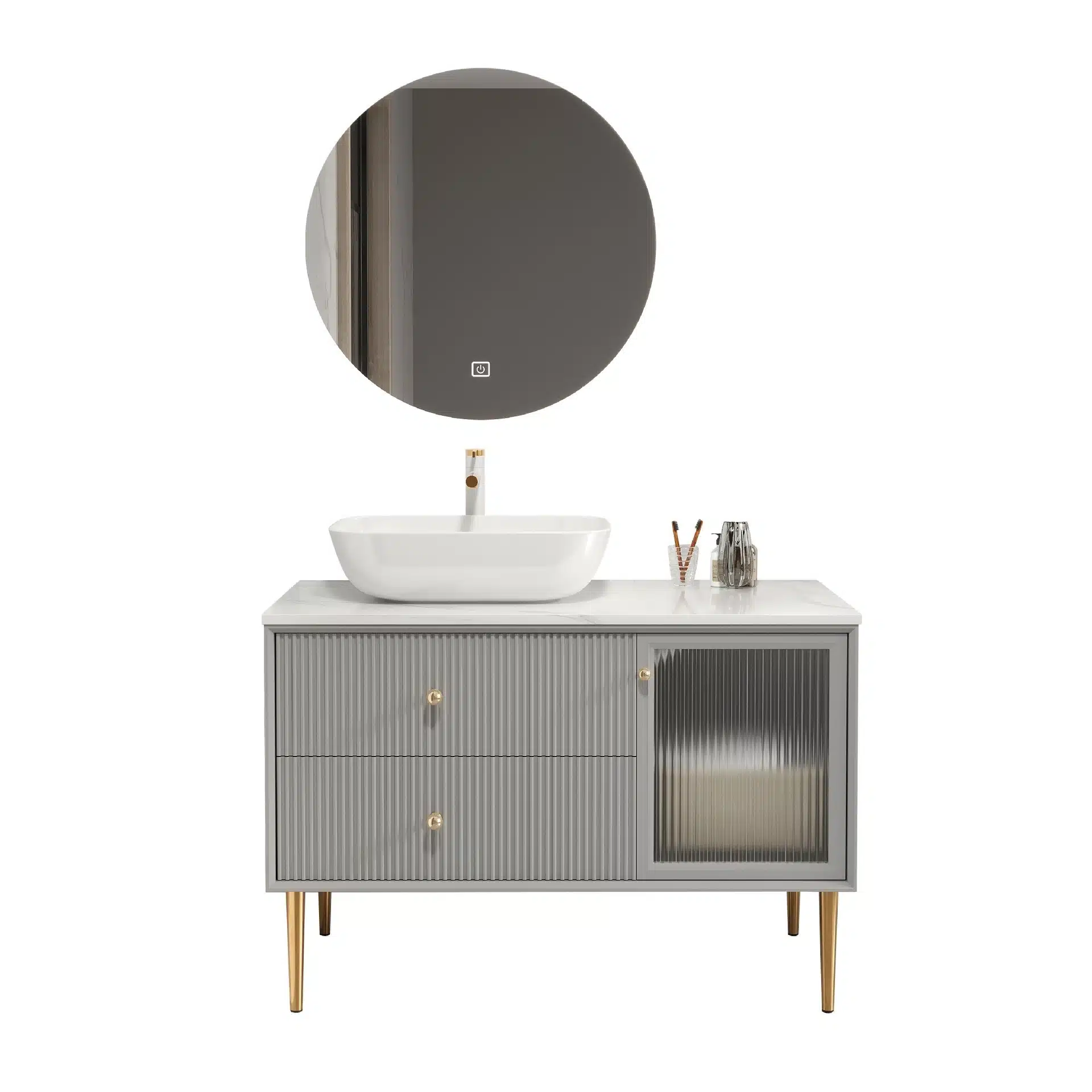
factory vs trading company is the first checkpoint buyers should lock before they approve a supplier, budget, or production slot. Every importer who has been in the game for a few years has a story about a trading company. The one that promised a 10,000-square-meter factory, sent photos of a shiny CNC line, and delivered boxes that looked nothing like the samples. The factory vs trading company decision for bathroom vanities in 2026 is less about finding a supplier and more about avoiding a margin leak. You are not just buying a cabinet. You are buying a production chain, a compliance dossier, and a warranty that either holds up at customs or falls apart when the container lands.
The math is straightforward. A direct OEM with a 10,000-square-meter facility and a five-stage QC process cuts out the 15 to 20 percent middleman markup that trading companies layer on top of raw material costs. That markup is not a service fee. It is a tax on opacity. Trading companies cannot show you work-in-progress photos because they do not control the factory floor. They cannot offer 40,000 customization combinations because they work from a catalog, not a production line. For a veteran importer whose KPIs are FOB margin and defect-free delivery, that gap is the difference between a sustainable margin and a slow bleed.
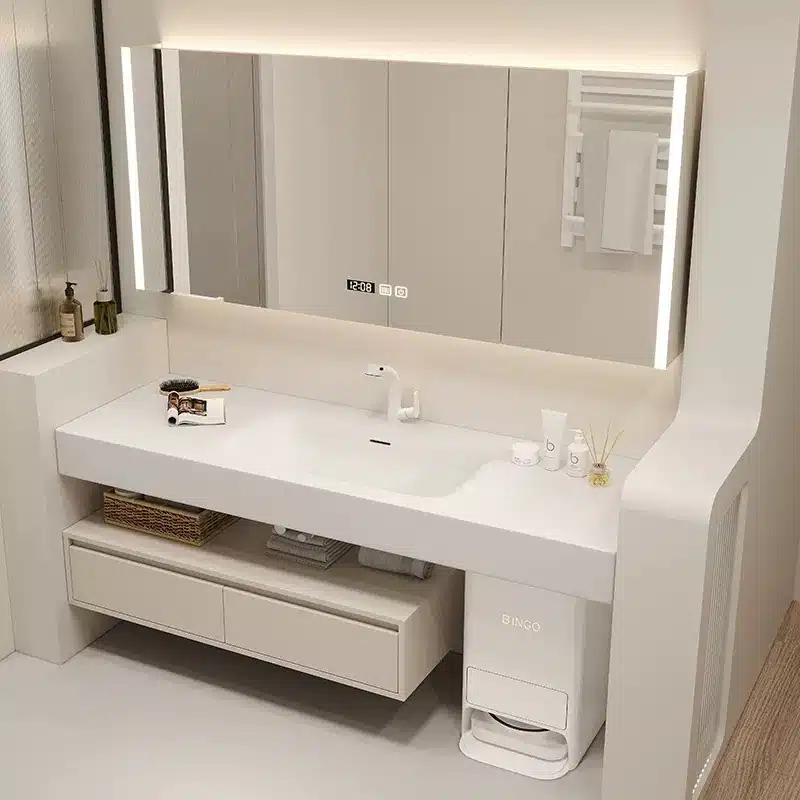
Factory vs Trading Company: Cost Realities
Trading companies add 15–20% hidden markups to FOB costs.
Trading companies don’t own production lines. They source from multiple factories, add a 10–15% service fee, and often mark up raw materials by another 5–10%. The result: you pay 15–20% more than the factory gate price without any control over quality or lead times. Direct OEMs like MFBATH operate a 10,000㎡ plant with automated CNC machines. That automation cuts labor waste and material scrap, savings that go straight to your FOB margin, not a middleman’s pocket.
On high-volume batches of 500+ units, the cost gap widens. A trading company’s margin is percentage-based, so the larger the order, the more you overpay. A direct factory, by contrast, spreads fixed costs (CNC maintenance, QC labor, tooling) across the batch. At MFBATH’s scale — 5,000 vanities per month — the per-unit overhead drops sharply. For a 500-unit order of PVC bathroom vanities, direct sourcing typically saves $8–12 per unit compared to a trading company quote. That’s $4,000–6,000 per container.
There’s also the hidden cost of opacity. Trading companies cannot show you real-time work-in-progress photos because they don’t control the floor. When a shipment arrives with off-spec dimensions or wrong finishes, the trading company blames the factory, and you absorb the return cost. A direct OEM provides stage-by-stage visual audits and a five-stage QC checklist. You see the cabinet before it’s packed, not after it’s docked.
| Feature | Direct Factory (e.g., MFBATH) | Trading Company | Why It Matters for Your Bottom Line |
|---|---|---|---|
| FOB Pricing | 0% – Manufacturer sells at production cost plus margin | 15–20% – Markup added for middleman service fees | Direct sourcing maximizes FOB margin; trading companies erode profitability |
| Production Capacity | 5,000 units/month from 10,000m² facility | No owned capacity; relies on subcontractors with variable lead times | Factory-direct ensures reliable supply for large-scale projects; trading companies risk delays |
| Quality Control | 5-stage inspection with real-time WIP photo audits | No direct control; QC outsourced to third-party, no audit trail | Direct factories guarantee defect-free delivery; trading companies increase compliance failure risk |
| Customization Options | 40,000+ combos including Pantone colors, branded hardware, material swaps | Limited to standard catalog; no production line adaptation | Direct OEM enables regional niche targeting (e.g., -30°C cold-tested for North America) |
| Regional Compliance | UL/CSA, CE, WELS, E1 – batch-specific certificates from factory | Generic documentation; certificates often misaligned with actual shipment | Direct sourcing ensures 100% compliance at destination; trading companies cause costly seizures |
| Production Transparency | Stage-by-stage photographic proof of work-in-progress (WIP) | No real-time visibility; stock photos or stolen factory images | Direct OEM builds trust through transparency; trading companies obscure supply chain risk |
| Tariff & HS Code Accuracy | Factory provides precise HS codes to avoid misclassification tariffs | Third-party paperwork often inaccurate, leading to tariff penalties | Direct documentation reduces tariff evasion risk; trading companies expose buyers to fines |
| Minimum Order Quantity (MOQ) | Low MOQ 10–20 units for market testing | High MOQ due to middleman inventory risk | Direct factory allows risk-free market entry; trading companies lock buyers into large orders |
| Automation & Precision | CNC machines, automated lines for consistent quality | No own equipment; production variability across different subcontractors | Direct manufacturing delivers repeatable, high-precision results; trading companies rely on inconsistent manual work |
Sourcing Risks: Identifying Trading Companies
Trading companies sell photos.
The most common sourcing trap in China’s bathroom vanity industry is the trading company masquerading as a factory. These intermediaries have no CNC machines, no raw material inventory, and no QC floor. They scrape product images from real manufacturers, build a polished Alibaba storefront, and mark up your FOB price by 15–20% for the privilege of forwarding your order to an actual factory they found on 1688. You pay a middleman fee for zero value-add.
How do you spot them? Start with reverse image search on their product photos. If the same vanity shows up on three different ‘factory’ websites, none of them own the tooling. Next, demand a live video call inside their production hall — not a pre-recorded tour. A real 10,000㎡ facility like MFBATH can show you CNC lines running, sintered stone presses operating, and five-stage QC stations in real time. A trading company will deflect with excuses about ‘client confidentiality’ or send you a generic factory tour video they downloaded from YouTube.
-
- Import record check: Run the supplier name through customs databases (Panjiva, ImportGenius). A genuine manufacturer will show consistent HS code 940340 (wooden furniture) or 691090 (ceramic basins) with container volumes matching a 5,000-unit monthly capacity. Trading companies show erratic, small-volume shipments under vague commodity codes.
- R&D dead end: Ask for the engineering team’s CAD revision history. A direct OEM with 40,000+ customization combinations can produce the last 10 modification requests for a similar vanity model. A trading firm has no design files — they can only offer you what’s in their supplier’s catalog, with zero ability to adjust dimensions, add branded hardware, or change material grades.
- Compliance dilution: Trading companies often bundle orders from multiple factories into one container to hit your MOQ. This means your UL/CSA-certified vanities may share a container with uncertified units from a different factory. When customs audits the batch, the entire shipment risks detention. Direct OEMs issue batch-specific compliance certificates tied to a single production line.
The real cost of a trading company isn’t just the 15–20% markup — it’s the production opacity. You cannot verify work-in-progress (WIP) because they don’t control the floor. You cannot audit the five-stage QC because they don’t employ the inspectors. And when a shipment fails compliance at your port, the trading company disappears behind a shell company. Direct OEMs like MFBATH offer stage-by-stage photographic audits and a physical address you can visit. That transparency is the only insurance that matters in the 2026–2026 tariff environment.
40,000 Combinations: Why Direct OEM Wins
Trading companies sell catalogs; direct OEMs sell production lines.
A trading company’s catalog is a fixed menu. You pick from what they have on hand — typically generic sizes, standard finishes, and no option to tweak the hardware. If you need a vanity in Pantone 19-4052 Classic Blue with brushed brass pulls and a left-hand drawer configuration, the trading company says ‘not available.’ That’s because they don’t own a CNC line; they buy finished goods from whichever factory offers the lowest price that week.
A direct OEM with a 10,000㎡ facility and automated CNC machines treats your order as a production job, not a pick-and-pack task. The difference is structural: trading companies operate on a 15-20% markup over factory cost, which means they have zero incentive to invest in tooling changes or material swaps. Every customization they offer is limited to what their current supplier already stocks.
-
- Color matching: Direct OEMs can match any Pantone code by adjusting the UV-cured paint line. Trading companies offer 5-10 preset colors — all from the same sub-supplier.
- Hardware branding: A direct OEM stamps or engraves your logo on hinges, handles, and drawer slides. Trading companies can only stick a label on the box.
- Material substitution: Need PVC for a Bangkok distributor (high humidity) but plywood for a Calgary distributor (dry cold)? A direct OEM switches material per batch. A trading company quotes you the cheapest option and ships whatever their factory had in stock.
This is not a minor convenience. Regional markets punish the wrong material choice. A vanity built for coastal Australia needs moisture-resistant plywood with a UV-blocking topcoat. The same design sent to a Middle Eastern market needs heat-resistant PVC that won’t warp at 50°C. A trading company cannot pivot between these specs because they don’t control the production line. A direct OEM reconfigures the CNC program and changes the raw material feed in under 30 minutes.
The 40,000+ combination figure is not marketing fluff — it’s a mathematical product of 4 material types × 20+ finishes × 30+ hardware options × 15+ sizes × 4 door styles. Each combination is a real production recipe stored in the factory’s ERP system. When you place a custom order, the line pulls that exact recipe, not a ‘close enough’ substitute.
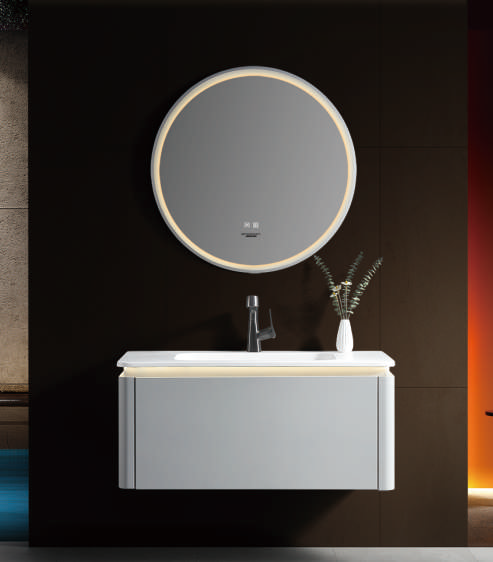
Verify Compliance: UL/CE Direct from Factory
A trading company’s certificate is a PDF.
Every veteran importer has seen the same trick: a trading company flashes a UL or CE certificate during negotiations, but when the container arrives, the compliance sticker is missing, the wiring doesn’t match the standard, or the paperwork references a different manufacturer entirely. That gap exists because trading companies don’t own the production line. They can’t guarantee that the certificate they show you applies to the actual units being loaded into your container.
A direct OEM like MFBATH ties every compliance certificate to a specific production batch. When we ship UL/CSA-compliant vanities to North America, the certification covers the exact cabinet model, mirror driver, and wiring harness leaving our 10,000㎡ floor. Our five-stage inspection process — raw material check, in-process CNC verification, assembly audit, electrical safety test, and final packaging review — ensures that what was certified in the lab is what gets sealed in the carton.
For European buyers, CE compliance isn’t just a stamp. It requiresE1-grade formaldehyde emissions(≤0.124 mg/m³) and documented material traceability. Trading companies source from multiple sub-suppliers, making it nearly impossible to guarantee consistent emission levels across a 500-unit order. A direct factory controls the plywood supplier, the glue formulation, and the curing time. The batch-specific test report can be provided for every container.
Regional adaptation is where the gap widens further. Oceania requires WELS water-efficiency ratings for basins and tapware. A trading company’s standard catalog rarely includes WELS-tested components. A direct OEM, on the other hand, can fit a 3-star WELS-rated basin into the same vanity design, then adjust the cabinet finish for UV resistance and coastal humidity. The compliance isn’t bolted on after the fact — it’s engineered into the product from the first CNC cut.
-
- Batch-Linked Certificates: Every UL/CSA or CE document references a specific production order number and date range. You can cross-check the certificate against the container packing list.
- Five-Stage QC Audit Trail: Direct factories provide stage-by-stage photographic proof of work-in-progress (WIP). Trading companies cannot offer this because they don’t control the factory floor.
- CNC Precision Verification: CNC machines cut to ±0.2mm tolerance. A direct factory can share the calibration logs for the specific machine that produced your order. A trading company cannot.
- Regional Standard Adaptation: For North America: -30°C cold-tested materials and ADA-compliant heights. For Europe: E1 formaldehyde and CE-marked electricals. For Oceania: WELS-rated basins and AS/NZS wiring. Direct factories adjust the production line. Trading companies adjust the price.
- HS Code Accuracy: Direct factory documentation reduces the risk of tariff misclassification. Trading company paperwork often uses generic codes that trigger customs holds or penalty duties.
When you source from a direct OEM, you are not buying a promise. You are buying a production record, a test result, and a compliance chain that starts at the raw material intake and ends at your warehouse. That is the difference between a certificate you can trust and a certificate that is just a sales tool.
Conclusion
The margin between a profitable container and a loss-making one is often just the middleman. A trading company adds 15-20% to your FOB cost, offers zero production visibility, and cannot guarantee the UL or CE stamp on your specific batch. A direct OEM with a 10,000㎡ facility and five-stage QC eliminates that opacity and the cost bloat.
Review the factory capabilities and material options available for your next project. Compare the 40,000 customization combinations against the standard catalog you are currently offered.
Frequently Asked Questions
Are there tariffs on bathroom vanities?
Yes, bathroom vanities imported into the US from China are subject to Section 301 tariffs, typically around 25%, plus any applicable anti-dumping duties. The exact rate depends on the material classification. Verify the current HTSUS classification with a customs broker before quoting.
Who has better quality bathroom vanities, Lowes or Home Depot?
Both Lowe’s and Home Depot source from a mix of domestic and overseas suppliers, so quality varies by brand and price point, not the store itself. For consistent commercial-grade quality. For bulk orders, compare factory-direct specs against retail brands, not store names.
What should not be stored in a bathroom?
Do not store medications, electronics, or important documents in a bathroom due to humidity and temperature swings that can degrade them. Even in a waterproof vanity, moisture from steam can seep. Use sealed containers or store these items in a climate-controlled area.
Who makes the highest quality bathroom vanities?
The highest quality comes from direct OEM manufacturers with in-house QC and material control, not trading companies or big-box retailers. A factory like MFBATH, with a 10,000m² facility, five-stage inspections, and. Ask for a factory audit report and material certification before ordering.
Who is the best supplier for bathroom vanities?
The best supplier is a direct OEM manufacturer that can provide factory-direct pricing, verifiable QC, and regional compliance for your target market. For example, MFBATH offers over 40,000 customization options, low. Match the supplier’s compliance list to your market’s import requirements first.




0 Comments