
Vanity mirror electrical safety certification is the spec line most importers check after the container lands. A hotel project asks for proof, the supplier emails a logo, and the conversation stalls because no one verified the document behind it. A logo on a webpage is marketing; a certificate is a record with a model number, a date, and an issuer. This guide covers what the marks mean, which documents to request, and where bulk orders usually fail.
MFBATH, also known as Main Focus Cabinet (MFBATH), has built bathroom mirrors in Changge, Henan, since 2015. The factory covers 10,000 square meters, employs 95 people, and produces up to 5,000 sets a month with 5 quality checks per product. MFBATH holds CE and UL for applicable lines, and free samples leave within 10 working days. That window is enough to verify certification documents before bulk production starts.
Key Takeaways
- MFBATH holds CE and UL for applicable product lines; CSA, NOM, and ADA are design targets, so name them in the PO when your market needs them.
- Certificates are searchable: UL file numbers and CE declarations sit in issuer databases you can check before production starts.
- MFBATH smart mirrors run on low-voltage DC drivers, the industry convention for LED mirrors, and the driver brand belongs in your spec sheet.
- Free samples ship within 10 working days; use that window to check the certificate set against the sample’s model number.
- The MOQ is 15 sets per model, color, and size, and custom sizes and frame colors start at the same 15 sets.
- ISO 9001 and ISO 14001 have been held since 2017 with validity confirmed in 2025; SGS or TÜV inspection requires advance notice.
Table of Contents
- What “Certified” Means for a Mirror You Import
- CE and UL: The Two Marks That Matter Most
- The Electrical Anatomy of a Smart Mirror
- IP Ratings and Bathroom Zones
- Regional Rules: CSA, NOM, ADA and Beyond
- Documents to Request Before You Order
- Frequently Asked Questions
- The Bottom Line
What “Certified” Means for a Mirror You Import
Three words get mixed up in sourcing emails: certified, compliant, and marketed. Certified means an independent body tested the product and issued a record. Compliant means the product meets a standard’s requirements, stated in a declaration or proven by design. Marketed means the claim appears in a brochure with no documents behind it. Vanity mirror electrical safety certification only works when you can trace it to a record.
Different marks come from different issuers, and the issuer changes how you verify. UL marks come from Underwriters Laboratories after its engineers test a product against published standards. CE marking follows a different route: the manufacturer assesses its own product against EU directives and, where required, works with a notified body. The pattern holds across every mark: a named issuer, a published standard, and a record you can request.
Marketing claims skip all three. A supplier page that shows a certificate photo without a file number, a model name, or an issuer name is decoration, not evidence. Ask for the document itself, in PDF, with the factory’s name on it. A factory that cannot produce the record behind its own logo has a gap you will discover at customs.
MFBATH holds CE and UL for applicable product lines, and its factory runs ISO 9001 and ISO 14001 systems certified in 2017, with validity confirmed in 2025. The compliance files behind the mirrors sit in the same compliance and certification archive as the cabinet records. When the factory’s own documents exist and match the model, the mark stops being a claim and becomes a fact.
CE and UL: The Two Marks That Matter Most
Two marks cover most export markets for LED mirrors. CE is the legal gateway to the European Union. A product in scope must carry it before it can be sold there, and the European Commission’s official CE marking page explains the process. UL is the North American reference, and UL safety resources describe how its testing works. Together, the two marks answer most electrical safety questions a buyer will meet.
What a valid mark includes matters as much as the mark itself. A UL listing carries a file number tied to a company and a model range, and the certificate names the standards tested. A CE Declaration of Conformity names the directives applied, the harmonized standards used, and the model it covers. The certificate without a model number is a decoration.
CE is not one test; it is a family of directives. An LED mirror touches the Low Voltage Directive, the EMC Directive, and RoHS restrictions on hazardous substances, each with its own standards. The declaration should list the ones that apply to a product with a power supply, a heater, and electronics. A declaration that names no directives is an empty page.
For a bulk buyer, vanity mirror electrical safety certification starts with these two marks, because both are searchable. UL’s online directory lets you look up a file number and see the company and product range behind it. The CE declaration should name the same model number you order. When the document names a trading company in another country instead of the factory, ask why before you pay.
Verifying a Certificate Is Real
Verification takes ten minutes once you know where to look. Search the issuer’s directory with the file number, confirm the company name matches the factory, and confirm the model range includes your model. Compare the certificate date with the production date of your order. A certificate issued after your container shipped tells you nothing about that container.
Keep the verification results with the PO. The file number, the standards named, and the search date become part of your own compliance record, which your customers’ inspectors may ask to see. A buyer who can hand over a verified certificate answers the hardest question before it is asked.
The Electrical Anatomy of a Smart Mirror
A smart mirror is a small electrical system behind a reflective surface. The LED panel provides light, the touch switch controls it, the anti-fog heater keeps the glass clear, and a digital display shows time, date, or weather. At MFBATH, these functions include adjustable brightness and color temperature, touch control, anti-fog heating, and an energy-saving auto-off, with voice control and Bluetooth as options. Every function sits behind the same glass your customers look into each morning.
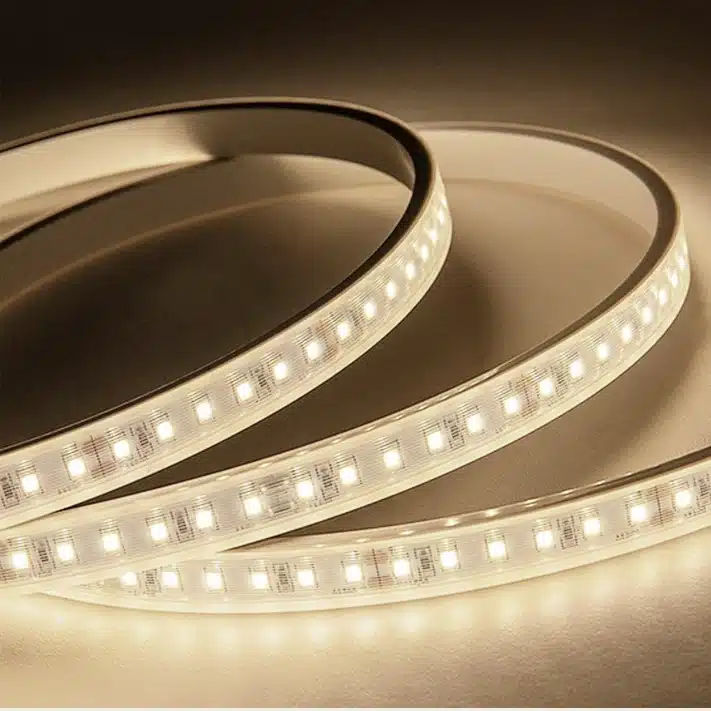
The low-voltage DC driver is the convention for LED mirrors, and it is also the part that fails first. The driver converts mains power to the low voltage the LED strip needs, and its quality sets the mirror’s usable life. Ask for the driver brand and model in writing, because the driver in the sample and the driver in bulk production should match. Driver failures top the service call list on smart mirrors.
The anti-fog heater is the second risk point. It draws power behind the glass and generates heat in a humid room, so thermal management decides how long the mirror survives. A heater without a cutoff wastes energy and shortens the life of nearby components. MFBATH’s energy-saving auto-off addresses that pattern by switching the system down when no one is in front of the mirror.
Driver quality is where mirrors lose their light output, and the LED mirror lifespan and L70 rating guide explains how overdriven LEDs and weak drivers shorten the useful life. A mirror that dims within a year usually fails at the driver, not at the glass. That is why the certificate file should name the electrical components, not just the finished product.
The wiring itself belongs on the document list. A clean wiring diagram shows the power supply path, the grounding point, and the driver position behind the mirror. Request it with the sample, and compare the production unit against it later. Wiring that changes between sample and bulk is a defect you cannot see from the front.
The digital display adds a second load to the system. A mirror showing time, date, or weather runs a small board behind the glass, and voice control and Bluetooth add antennas to the same enclosure. Each addition changes the electrical file, because each one draws power and generates heat. Ask the factory which functions the certificate file covers, and keep that list in the PO.
IP Ratings and Bathroom Zones
Bathrooms are wet rooms, and water and electricity share the same walls. The IP classification system, defined by the International Electrotechnical Commission (IEC), rates how well an enclosure resists solids and moisture. IP ratings belong inside any vanity mirror electrical safety certification file, because moisture is the main threat a bathroom mirror faces. A mirror above a sink sits inside the wet zone, so moisture sealing is not optional.
An IP value only means something when the test standard sits behind it. The IEC defines the classification, and a spec sheet that quotes a rating should name the standard and the zone the mirror was designed for. Ask for that statement in writing for every model you quote. A spec sheet without one leaves the decision to your inspector, and that is a late surprise.
Sealing shows up in the sample. Check the edges where the LED strip enters the frame, the gasket behind the glass, and the hole where the cable exits. Water finds the path of least resistance, so a sample with bare wiring at the cable exit tells you what the bulk run will do. Ask for photos of those three points during the factory’s 5 quality checks.
The zone question changes what you specify. A mirror near a hotel shower head faces different moisture loads than one in a powder room, even at the same price. State the installation zone in the order, and let the factory design the sealing to match. MFBATH offers round, rectangular, and oval mirrors from 24×36 to 48×72 inches (61×91 to 122×183 cm), and the mirror product range shows how each frame carries the electrical options.
The verification file for the electrical side of a mirror order has five documents, and each one answers a question before production starts. Fill the table with the quote, not after the container loads. A missing cell is a decision you made by default.
| Document | What It Proves | Red Flag |
|---|---|---|
| CE Declaration of Conformity | Names the directives, the standards, and the model covered | Names a trading company instead of the factory |
| UL certificate or listing file | Confirms the model range passed UL testing | File number belongs to another company or model |
| Test report from an accredited lab | Records model number, test date, and standards applied | Model number on the report differs from the PO |
| IP rating statement on the spec sheet | States moisture protection and the standard behind it | Rating quoted without a test standard or design zone |
| Wiring diagram and driver spec | Shows the low-voltage DC layout and driver identity | Driver brand changes between sample and bulk |
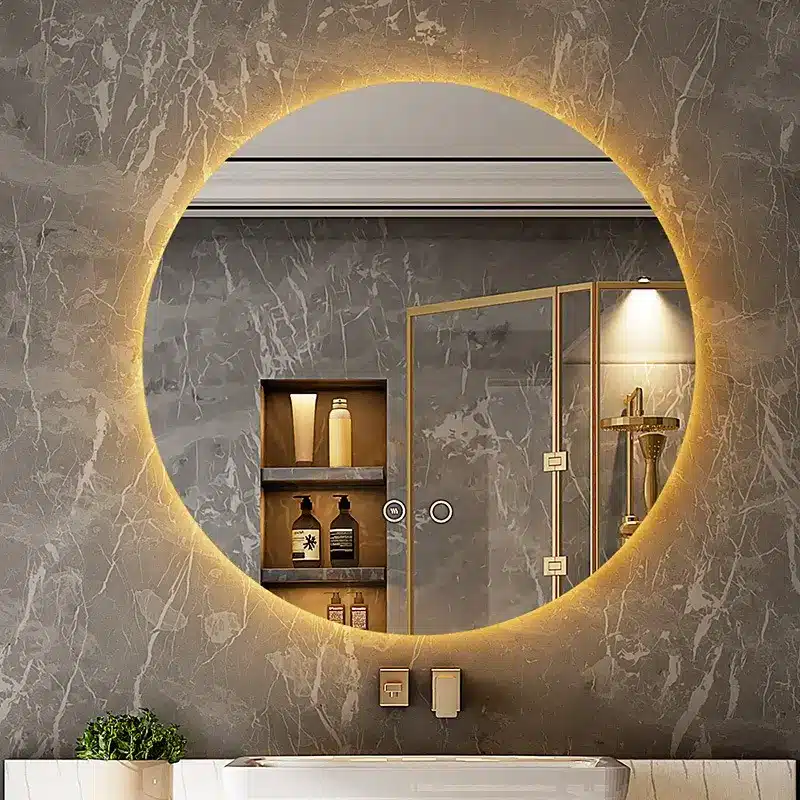
Mirrors Wired for Safety and Compliance
Browse this product, solution, or service page to explore relevant offerings.
Regional Rules: CSA, NOM, ADA and Beyond
CE and UL cover the two largest markets, but regional rules change the file. Canada uses CSA marks across many provinces, Mexico requires NOM, and the United States applies ADA requirements to commercial bathrooms. MFBATH designs its mirrors to meet CSA, NOM, and ADA requirements when a buyer specifies them; those are compliance targets, not certificates the factory claims to hold. Read that difference carefully in every quote you receive.
Regional rules change the specification, not just the paperwork. A mirror for a US commercial bathroom may need ADA mounting heights and clearances. A cabinet for Great Britain follows CE today, and the CE versus UKCA comparison explains how the rules diverge for that market. California adds Proposition 65 labeling duties for listed chemicals, which affects finish and packaging choices.
Name every regional rule in the PO before sampling starts. Each rule the factory designs to becomes part of the 5 quality checks and the sample verification, so a rule added later means a rework cycle and a new timeline. Custom sizes, Pantone frame colors, and added functions all start from the same 15-set MOQ per configuration. The earlier the rule enters the file, the cheaper it is to meet.
Verify the design-to-meet claim on the sample, not in the email. Ask which specific dimensions or clearances changed for ADA, and which components were re-sealed for CSA or NOM. A written list of design changes turns a claim into a spec. Keep that list next to the certificate file, because your inspector will want the same answer.
Ask what happens to the certificate file when the market rule changes. A mirror designed for one region can usually be adapted, but the adaptation must be documented and re-verified. A factory that designs to meet a standard, and says so in writing, gives you a spec you can hold it to. The sample is the proof that the design choices actually shipped.
Documents to Request Before You Order
The vanity mirror electrical safety certification file has seven items, and each one answers a question your inspector or your customer will ask. Collect them with the quote, not after the container loads. Work through the list in order, and keep every document with the model number it covers.
- CE Declaration of Conformity and UL certificate copies for the exact model you order
- Test reports naming the model number, the standards, and the test date
- Driver brand and model with the low-voltage DC specification
- IP rating statement with the test standard and the design zone
- Wiring diagram showing the power supply path and the grounding point
- QC photos from the factory’s 5 quality checks
- Third-party inspection arrangement with SGS or TÜV, booked with advance notice
Ask for the file with the quote so it exists before your free sample ships. MFBATH sends samples within 10 working days, and bulk production runs 20–30 days after approval. The gap between sample arrival and production start is the time to check every document against the sample’s model number.
Certificate copies lose value if the factory changes suppliers mid-run. The ISO 9001 factory audit guide shows how to verify the quality system behind the documents and the floor behind the certificates. Verification is a habit, not a one-time event, and it applies to every order, not just the first.
MFBATH backs the finished product with a 2-year full-cabinet warranty and reports a return rate below 1%. Those numbers describe what the factory expects from its own process. Your document file is what protects your share of that record.
Frequently Asked Questions
How do I verify the CE mark on a mirror before I order?
Ask for the Declaration of Conformity and check that the model number matches your order. Confirm the directives and standards named on it, then compare the issuing company with the factory on your PO. CE verification follows the European Commission’s published process, so the check is standard and fast.
Why does my customer request UL when the mirror will not be sold in North America?
UL testing is recognized beyond North America, so many project specifiers treat it as a baseline for electrical safety. MFBATH holds UL for applicable product lines and provides the certificate on request. Confirm the file covers your model range before you promise it in a bid.
Can one mirror be designed to meet CSA, NOM, and ADA at the same time?
It can. CSA and NOM follow Canadian and Mexican frameworks, and ADA governs accessibility in US commercial bathrooms. MFBATH designs mirrors to meet these requirements when a buyer specifies them, and the sample should prove the design choices. Name every rule in the PO, because each one changes the spec.
The Bottom Line
Vanity mirror electrical safety certification is a document set you verify before production, not a logo you collect after. Check the CE declaration and the UL certificate against the exact model number, request the driver and IP statements in writing, and confirm every regional rule in the PO. MFBATH holds CE and UL, designs to CSA, NOM, and ADA on request, and ships free samples within 10 working days. Use that window to build the file that protects the whole container.


0 Comments