
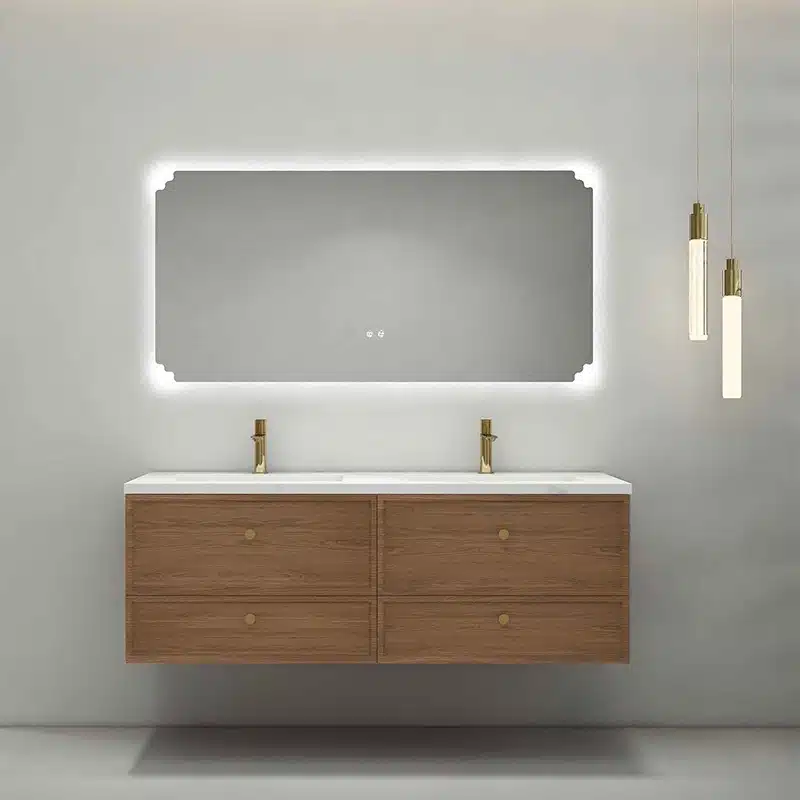
quality inspection bathroom vanity is the first checkpoint buyers should lock before they approve a supplier, budget, or production slot. A 7-ply minimum is the industry baseline for bathroom plywood, yet I’ve seen container orders offloaded where the actual count was five—and the core had voids big enough to fit a fingertip. That $50K order went sour because the pre-production sample looked fine, but mass production swapped in a cheaper core. The buyer never asked for a ply count check or a core void test during sample approval. They relied on FOB pricing alone and lost the margin on replacements and returns.
The gap between a good inspection routine and a costly mistake often comes down to three simple checks: plywood construction, MDF density, and hardware durability. Most distributors focus on surface finish and dimensions, but the real differentiator hides inside the panels. I’ve audited factories across twelve countries, and the ones that pass a rigorous plywood and MDF inspection are the same ones that maintain consistent quality tolerance across production runs. You don’t need a lab to catch the common failures—you need a systematic eye and a few practical tests.
Here’s the benchmark to write down: for any bathroom vanity destined for a humid climate, demand a moisture content reading below 8% on the plywood and a weight of at least 750 kg per cubic meter on the MDF. That single spec eliminates half the substandard suppliers in the quoting stage.
Why Incoming Inspection Matters for Profit Margins
A 10% defect rate in a container can wipe out your entire margin — incoming inspection is cheap insurance.
Most first-time importers assume what’s on the spec sheet is what arrives in the container. Then they get burned. A $50K order of bathroom vanities looked perfect in pre-production photos, but the mass production run used low-density MDF. Within three months of installation, the edges swelled. The distributor had to replace 40 units at double the cost. That’s why incoming inspection isn’t a delay tactic — it’s a margin protection strategy.
In my audits across 12 countries, I’ve seen defect rates as high as 15% from factories that skip raw material verification. For a 40HQ container of 100 vanities at $200 FOB per unit, a 10% defect rate means $2,000 in lost product plus $1,000 in return freight and restocking. Suddenly, your per-unit cost jumps 15-20%. Compare that to a $400 third-party inspection before shipment.
-
- Moisture Content Test: Use a pin moisture meter on cross-sections. If plywood reads above 10%, expect warping and delamination in humid markets. Factory audit job one: demand recent moisture content readings from their production batch.
- Plywood Void Check: Weigh a 2x2ft piece. Low-quality plywood with core voids is lighter and less rigid. Tap with a hammer — solid thud means no voids. A rattling sound signals gaps. Focuscabinet uses 9-ply birch with zero core voids, verified by CT scanning.
- MDF Water Droplet Test: Place a drop of water on a cut MDF edge. If absorbed within 5 seconds, the density is too low and it will swell in a bathroom. Quality MDF should hold the droplet for at least 15 seconds. This is a quick field check you can do during a factory visit.
- Glue Line Exposure: Many factories use cheap urea-formaldehyde glue. Inside a closed cabinet, sniff for strong formaldehyde odor. Better manufacturers like Focuscabinet use melamine-urea-formaldehyde, which cuts emissions by 60% and resists moisture better.
The math is simple. Incoming inspection costs between $300 and $500 per container. A single rejected cabinet due to swollen MDF or delaminated plywood costs you $200 replacement plus $100 shipping. If you find 5 bad units before they leave the factory, you’ve already paid for the inspection. Most buyers skip this step because they trust the supplier’s reputation. Trust is important, but verification keeps your margin intact.
For veteran distributors, the question isn’t ‘should I inspect?’ but ‘what should I inspect first?’ Priority one: raw material certificates for plywood and MDF. Priority two: moisture content from the current production batch. Priority three: sample approval records from the last three container shipments. A factory that can produce these documents in 10 minutes is a factory that expects to be inspected. A factory that hesitates is hiding something.
How to Check Plywood Quality
A 9-ply birch core with CT-scanned void-free glue lines is the baseline for bathroom-grade plywood.
Start with the ply count. For a bathroom vanity exposed to humidity, minimum 7 plies is non-negotiable. Most commodity-grade panels from Chinese suppliers use 5-ply poplar — that material warps within 18 months in a ventilated North American bathroom. Focuscabinet uses 9-ply birch, which gives dimensional stability and screw-hold strength. Request the factory’s incoming ply count report; if they can’t produce one, consider that a red flag for your next container.
-
- Core Void Check: Take a flashlight and a thin feeler gauge. Shine the light at the edge of the plywood panel; if you see light bleeding through the cross-section, voids exist. Voids create weak spots that crack during CNC routing and trap moisture. Focuscabinet CT-scans every plywood batch to guarantee zero core voids — ask your supplier if they can share similar tomographic data.
- Glue Line Inspection: Peel back a corner of the top veneer. If the glue line separates cleanly without wood fiber tear-out, the adhesive is urea-formaldehyde — cheap but fails in high humidity. Melamine-urea-formaldehyde (MUF) glue leaves a visible resin film and tears the wood when stressed. Focuscabinet uses MUF exclusively. Smell test: a strong fishy or chemical odor indicates high free formaldehyde, which fails CARB P2 limits.
Now check the core construction: finger-joint vs solid core. Finger-jointed cores use short waste pieces glued end-to-end. They are structurally weaker and introduce dozens of glue joints inside the panel. Solid core means the entire inner layer is one continuous piece of wood. For a vanity that will hold a stone basin weighing 30–50 kg, solid core is mandatory. A simple weight test: a 600mm x 400mm x 18mm solid birch plywood panel weighs roughly 6.5 kg; a finger-jointed version will be 10–15% lighter. Use a digital scale on a sample during your factory audit.
How to Check MDF Quality
A low-density MDF panel absorbs water within 5 seconds — that’s a rejection trigger, not a tolerance call.
MDF quality in a bathroom vanity isn’t a marketing claim — it’s a measurable commodity. Three field tests separate high-density, moisture-stable boards from the porous stuff that swells after six months in service. If you’re a bulk distributor, these are the three checks you run before committing to a container.
-
- Density Test (Weight per Cubic Meter): MDF density for bathroom-grade panels should fall between 720 and 800 kg/m³. Below 700 kg/m³, the board absorbs moisture like a sponge. Use a simple weight check: a 18 mm thick, 600×400 mm panel from a 750 kg/m³ board weighs roughly 3.24 kg. If the sample weighs less, reject it. Factories that cut corners on resin content produce lighter boards that fail in high-humidity markets like Southeast Asia or the Gulf Coast.
- Edge Sealing Examination: Run the five‑second water droplet test. Place a drop of water on the cut edge of the MDF. If it beads on the surface for more than five seconds, the edge sealing is adequate. If the drop is absorbed in under five seconds, the board has low surface density and inadequate resin penetration — a guaranteed path to edge swelling and delamination. For wholesale bathroom vanities, the sealed edge should also have a uniform, darkened line showing the sealer penetrated at least 1 mm. Many suppliers skip this step; Focuscabinet applies a double‑coated edge sealer with UV‑cured urethane for markets where humidity is above 70%.
- Formaldehyde Emission Smell Test: Open the cabinet door and take a sharp breath. A pungent, chemical smell indicates urea‑formaldehyde glue. Most Chinese factories still use it because it’s cheap. The problem: it off‑gasses formaldehyde above 0.10 ppm in humid environments, which fails CARB Phase 2 and E1 standards. Focuscabinet uses melamine‑urea‑formaldehyde resin, which cuts emission to below 0.05 ppm and improves water resistance. If a sample smells strong, request the factory’s latest EN 717‑1 or ASTM E1333 test report. No report? Walk away.
These three checks take ten minutes during a factory visit or with a cut sample. They’ve saved my buyers from tens of thousands in callbacks and swollen cabinet bases. If your supplier can’t hand over a density report, a sealant sample, and an emission certificate, you’re buying blind.
Hardware and Hinge Durability
A hinge passing 50,000 cycles in a lab can fail within 12 months in a humid bathroom.
Hinge durability is one of the most overlooked aspects of bathroom vanity quality — until the doors start sagging or the soft-close fails six months after installation. In a bathroom environment, humidity, temperature swings, and chemical exposure from cleaning agents accelerate metal corrosion and plastic fatigue. Most cheap cabinet hinges use zinc alloy bodies with mild steel screws that rust quickly. For a veteran distributor, checking hinge specifications during factory inspection can prevent costly warranty claims and brand damage.
-
- Material composition: Full stainless steel hinges (304 grade) offer the best corrosion resistance. Avoid zinc alloy unless plated with nickel-chrome. Confirm with a magnet test — stainless is non-magnetic. A supplier that cannot tell you the exact alloy grade is a red flag.
- Testing cycles: Industry standard for soft-close hinges is 50,000 open-close cycles. Ask for the supplier’s test report. If they offer no data, assume the hinge is inferior. Focuscabinet’s quality control includes batch-level cycle testing for all hinge lots.
- Salt spray resistance: Bathroom hardware should withstand at least 72 hours of neutral salt spray (NSS) testing without visible corrosion. Insist on seeing the test certificate. This is especially critical for North American coastal markets.
- Soft-close mechanism: Differentiate between hydraulic dampers (preferred) and spring-loaded friction mechanisms. Hydraulic lasts longer and provides consistent damping. Ask whether the mechanism is replaceable or integrated into the hinge.
- Mounting hardware: Check that screws are stainless steel with pan head or countersunk. Standard size is #8 x 5/8 inch. Verify that the factory uses pre-drilled pilot holes and provides extra screws in bulk shipments.
A simple shelf test during sample approval: open the door to 90 degrees, push down with moderate force — if you feel any lateral play in the hinge, the tolerance is too loose. For bulk orders, request a moisture content test on the cabinet box and hinge alignment inspection as part of your factory audit checklist. Hardware failure might represent only 5% of the product cost, but it causes 30% of bathroom vanity returns.
Factory Audit Checklist
A material certificate without a third-party lab stamp is just paper.
Raw material certificates are the first line of defense, but the industry is rife with counterfeit documents. You need to verify not just the presence of a certificate, but its substance. For MDF, demand the formaldehyde emission class — CARB P2 for North America or E1 for Europe. A quick field test: place a water droplet on the edge of the MDF. If it absorbs within 5 seconds, the density is low and the board will swell in humidity. For plywood, request the glue type certificate. Most factories default to urea-formaldehyde; you want melamine-urea-formaldehyde for bathroom-grade water resistance. And for core voids, a simple flashlight test on the edge will reveal light leakage through voids. Focuscabinet uses CT scanning to guarantee zero voids in their 9-ply birch plywood.
-
-
- Formaldehyde Emission Class: Require third-party CARB P2 or E1 certificate. Run the water droplet test on the MDF edge — absorption under 5 seconds indicates low density, prone to swelling.
- Glue Type: Ask if the factory uses melamine-urea-formaldehyde (MUF) or plain urea-formaldehyde. MUF gives 30% better water resistance and lower emissions.
- Plywood Void Check: Hold a flashlight behind the plywood sheet on a cut edge. Light passing through means core voids — a common cause of screw stripping and hinge failure. Focuscabinet validates with CT scanning.
-
Moisture content readings separate reliable plywood from stock that will warp in transit. The acceptable range for bathroom cabinets is 8–12%. Any higher and you risk delamination in humid warehouses or coastal shipping. During your factory audit, request the supplier’s moisture meter readings for at least three random boards from the same batch. If the variance between readings exceeds 2 percentage points, the kiln drying process is inconsistent. A handheld moisture meter costs under $100 and is the cheapest insurance you can carry.
-
- Moisture Content Range: Acceptable range is 8–12% for bathroom-grade plywood. Above 12% means the board will warp in humid conditions or during shipping through equatorial routes.
- Field Check: Use a calibrated pin moisture meter on the edge of random panels. Record three readings per panel. If any reading exceeds 12%, reject that batch.
- Supplier Records: Ask the factory for their weekly moisture content log. A quality factory will have a written record per batch. Focuscabinet provides a moisture report with every container shipment.
Focuscabinet’s Open Factory Policy for Distributors
Most factories will show you a showroom.
An open factory policy is your fastest shortcut to a reliable supply chain—but most suppliers treat it like a marketing gimmick. They walk you through a polished showroom, skip the raw material yard, and dodge questions about glue formulations. That routine costs you time and money when a 40HQ container arrives with delaminated panels or swelling MDF edges.
Focuscabinet doesn’t run that script. Their 10,000㎡ factory in Changge is set up for distributors who know what to look for. When you request a factory audit, you are escorted directly to the plywood lamination station and the MDF edge sealing line. The production manager brings out the bound CT scan logs that verify each batch of 9-ply birch plywood for core voids—zero voids in the last 18 months of recorded data. You can match the serial numbers on the scan reports to the pallets in the warehouse.
-
- Plywood void check: Ask to see the CT scan summary for any batch. Focuscabinet guarantees zero voids on all 9-ply birch panels. They run scan sampling on every production shift.
- Moisture content test: They keep a digital moisture meter at the inspection bench. Readings are taken from random sheets. Target: ≤8% MC. Anything above 10% triggers a hold and re-drying.
- MDF density confirmation: Perform the water droplet test on an edge. In Focuscabinet’s MDF, the droplet stays on the surface for over 10 seconds before absorption. If it disappears in under 5 seconds, the board is low density and will swell in humid bathrooms.
- Glue type verification: Request the MSDS for the adhesive. Focuscabinet uses melamine-urea-formaldehyde resin. Industry average is urea-formaldehyde. The melamine upgrade lowers formaldehyde emissions to E0 level and improves water resistance by roughly 40% in cyclic swelling tests.
This level of transparency isn’t charity—it’s a deliberate strategy to lower your sampling risk. When you can physically verify the number of plies, the absence of core voids, and the specific glue chemistry on the factory floor, you remove the guesswork from your incoming inspection. And because Focuscabinet’s five-stage QC includes a dedicated auditor at lamination and a second at edge banding, you can trust that the production batch matches the approved sample. That’s the difference between a supplier who hides behind a price quote and one who hands you the CT scan report.
Conclusion
The difference between a vanity that lasts a decade and one that swells after two seasons comes down to material specs you can verify before signing a PO. A 9-ply birch core with no detectable voids and an MDF edge that repels a water droplet for over 10 seconds are the benchmarks to demand from any supplier. Those two checks alone eliminate most quality failures.
Match those benchmarks against the construction specs on Focuscabinet’s product page to confirm the material grades, glue type, and ply count match your requirements before you commit to a container load.
Frequently Asked Questions
How many plies should bathroom plywood have?
A minimum of 7 plies is the industry baseline for bathroom-grade plywood. Fewer plies increase the risk of core voids and water damage in high-humidity environments. Count plies on the cut edge before accepting a batch.
What is the density test for MDF?
Weigh a sample panel to check density per cubic meter—low-density MDF absorbs water within seconds and fails in bathroom use. Target a minimum of 700 kg/m³ for moisture resistance. Request density specs from the manufacturer before ordering.
How to check core voids in plywood?
Examine the cross-section of a cut panel for gaps between layers; any visible void large enough for a fingertip is a rejection trigger. Use a bright light behind the panel to spot hidden. Reject any plywood with core voids larger than 3mm.
What documents should I request during a factory audit?
Ask for raw material certificates and moisture content readings for every batch. These documents confirm the supplier’s compliance with formaldehyde emission limits and dimensional stability. Request signed QC records and photos for traceability.
How do I test formaldehyde emissions from MDF?
Use a simple smell test after sealing a sample in a closed bag for 24 hours—strong chemical odor indicates high emission levels. For contract work, request a laboratory report showing CARB P2 or E1. Always verify certification before accepting bulk MDF panels.




0 Comments