

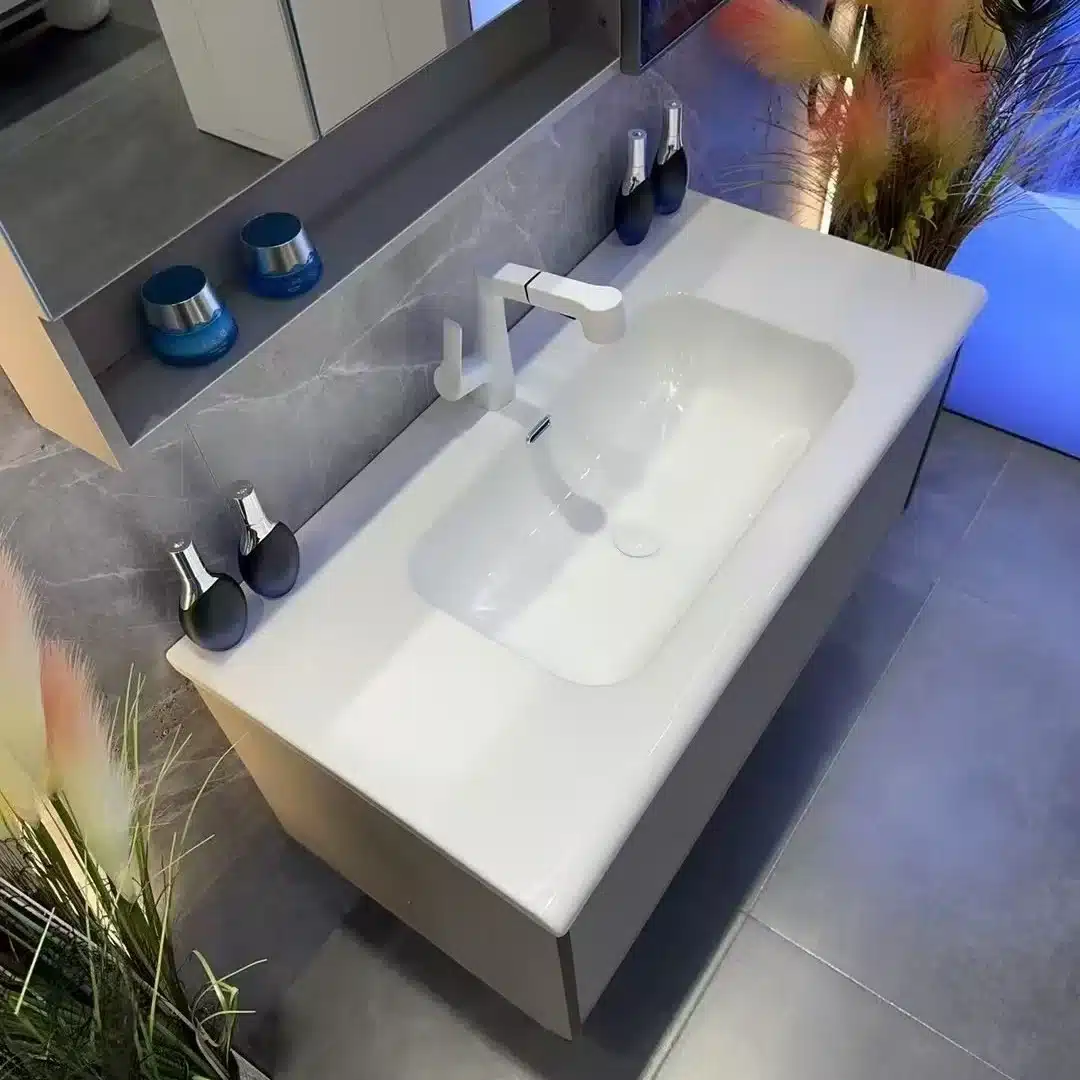
Every bathroom vanity contains a chemistry story that most buyers never read. The resin that bonds plywood layers, particleboard, and medium-density fiberboard (MDF) releases formaldehyde over time, and a warm, humid bathroom accelerates that release. Importers who skip the emission paperwork up front tend to meet it later, in a retailer’s compliance questionnaire, a customs query, or a customer complaint. The fix is cheap: learn the three standards that matter and ask for the reports before the purchase order, not after the container lands.
The bathroom vanity formaldehyde emission standard conversation usually settles on three names: E1, the European emission class for wood-based panels; CARB Phase 2; and TSCA Title VI. This article explains what each one regulates, which markets they cover, how the laboratory tests work, and which documents you should request from a factory. It uses Main Focus Cabinet (MFBATH), a bathroom vanity factory in Changge, Henan, China, as a working example: its plywood cabinets are produced to E1 at 0.1 ppm (parts per million) or below, with test evidence available to buyers.
Key Takeaways
- E1 is the European emission class for wood-based panels, verified by EN 717-1 chamber testing; MFBATH’s plywood vanities hold E1 at 0.1 ppm or below.
- CARB Phase 2 is California’s regulation for composite wood products, enforced through the Airborne Toxic Control Measure (ATCM) with third-party panel certification.
- TSCA Title VI is the federal United States rule that made CARB-style limits national; full compliance has applied since 2018.
- A valid formaldehyde test report names four things: the standard, the test method, the laboratory, and the batch tested. Missing any one, treat the claim as unverified.
- Request reports at quotation, verify the sample batch against the report, and keep certificates in a dated file for retailer and building-program audits.
- MFBATH combines E1 plywood with waterproof PVC edge sealing, FSC-certified material on request, a 15-set MOQ per model, color, and size, and a 2-year whole-cabinet warranty.
Table of Contents
- Formaldehyde in Vanity Cabinets: Where It Comes From
- E1: The European Baseline at 0.1 ppm
- CARB Phase 2 and TSCA Title VI: The North American Framework
- Test Methods and Reports You Should Request
- Choosing Low-Formaldehyde Materials for Your Line
- Frequently Asked Questions
- The Bottom Line
Formaldehyde in Vanity Cabinets: Where It Comes From
Formaldehyde does not arrive in a vanity cabinet by accident; it is built in during panel manufacturing. Urea-formaldehyde adhesives are the workhorse glue of particleboard and MDF because they cure fast and cost less than alternatives, and plywood manufacturers use formaldehyde-based resins between veneers as well. The resin locks the panel together, but a fraction of the formaldehyde stays free or re-forms through hydrolysis, and that fraction migrates to the surface and into the air. When a buyer opens a new cabinet and smells that familiar sharp odor, they are smelling residual formaldehyde coming off the glue lines.
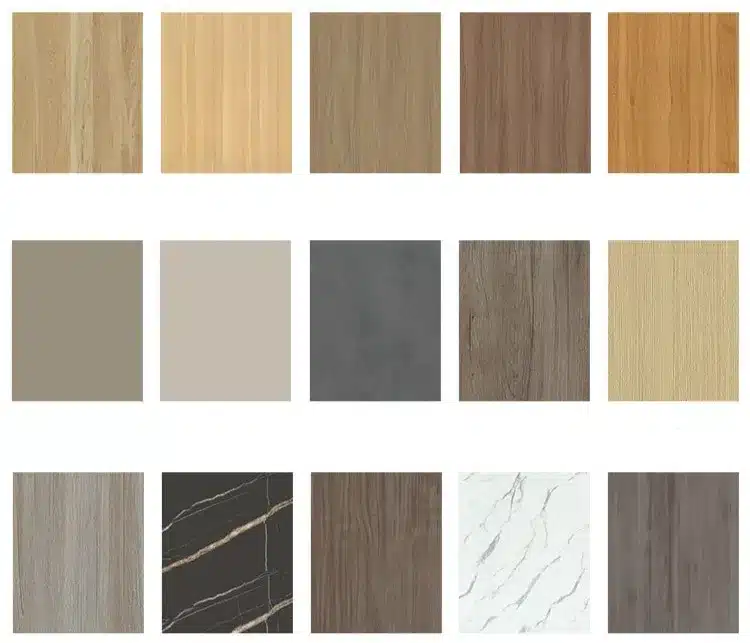
The rate of release is not constant. Warmth and humidity push the hydrolysis reaction faster, which is why the same panel emits more in a steamy bathroom than in a dry hallway. Emissions also leave a panel unevenly: cut edges expose the resin-rich core, so an unsealed cut edge releases far more formaldehyde than a laminated face. This is why edge banding is a compliance tool, not a cosmetic one. A panel that passes in the factory can fail on the job if it is cut on site and left bare, so the panel’s sealing and the cabinet’s finishing are both part of the emission equation.
For a bathroom, the arithmetic gets worse before it gets better. A small enclosed room, warm water, steam, and a cabinet surface area that wraps the entire vanity mean the airborne concentration around the product runs higher than a climate chamber test suggests. Health agencies have documented respiratory irritation and other effects from formaldehyde exposure, which is why retailers, building programs, and customs regimes now treat it as a specification item rather than a footnote. The formaldehyde background on Wikipedia summarizes the chemistry and health picture if you need a primer for your sourcing file.
Regulators responded at three levels. Europe standardized emission classes for wood panels decades ago, giving buyers the E1 label that most of the world still quotes. California went further in 2007 with a state rule that set enforceable limits for composite wood products sold there, and the federal government adopted a national version in 2016 under the Toxic Substances Control Act. The practical result for an importer is simple: the standard you need depends on the market you sell into, and the report you need depends on the standard. The sections that follow cover each standard, the tests behind it, and the paperwork that proves the product meets it.
E1: The European Baseline at 0.1 ppm
E1 is the emission class most of the world quotes first, and the one MFBATH verifies on its plywood cabinets at 0.1 ppm or below. In European practice, wood-based panels are classified by the amount of formaldehyde they release into conditioned air, measured in parts per million (ppm), the number of formaldehyde molecules per million molecules of air. The E1 class is the long-standing benchmark for panels intended for indoor use, and it appears across the EN standards for plywood, particleboard, and MDF under the CE marking framework for construction products. When a distributor in the Netherlands, the United Kingdom, or Australia asks for “E1 vanities,” this is the number they mean.
The test behind the number is a chamber test defined in EN 717-1. A conditioned panel of a specified size is sealed into a climate chamber with controlled temperature, humidity, and air exchange, and technicians draw air samples over a period of weeks until the formaldehyde concentration reaches a steady state. The result is reported in ppm and compared against the class limit. Because the chamber conditions are standardized, an E1 result from one accredited laboratory can be compared directly with a result from another, which is exactly what you want when comparing factories in two countries on the same product spec.
You will also see E0 and E0.5 labels on Asian products. These are commercial grades, not harmonized European classes, and their claimed numbers depend on the same chamber method but without the same enforcement chain. They are not wrong by definition, many panels genuinely test that low, but there is no E0 class in the EN system, so treat the label as a marketing claim and demand the chamber report behind it. E1 is the verifiable baseline; anything lower is a bonus you prove with paper.
MFBATH builds the E1 requirement into the panel rather than the label. The plywood core uses adhesive systems formulated to keep the finished board at 0.1 ppm or below, and the multi-layer structure is pressed under controlled heat and pressure so the resin cures fully before the panel reaches the cabinet line. Every cut edge is then sealed with waterproof PVC edge banding, which does double duty: it keeps moisture out of the core, and it closes the highest-emission surface of the panel. The E1 test report ships in the documentation pack alongside the ISO 9001 and ISO 14001 certificates, both issued in 2017 and confirmed valid in 2025, so the compliance file arrives with the quotation.
CARB Phase 2 and TSCA Title VI: The North American Framework
The California Air Resources Board (CARB) changed the industry in 2007 when it adopted the Airborne Toxic Control Measure (ATCM) for composite wood products. The rule sets emission limits for hardwood plywood, particleboard, and MDF sold in California, and it works in phases: Phase 1 raised the bar immediately, and Phase 2, fully in effect in the early 2010s, set the limits still referenced today. The CARB system also introduced two mechanisms the industry had never had: third-party certification of panels and a labeling chain that follows the product from mill to finished cabinet.
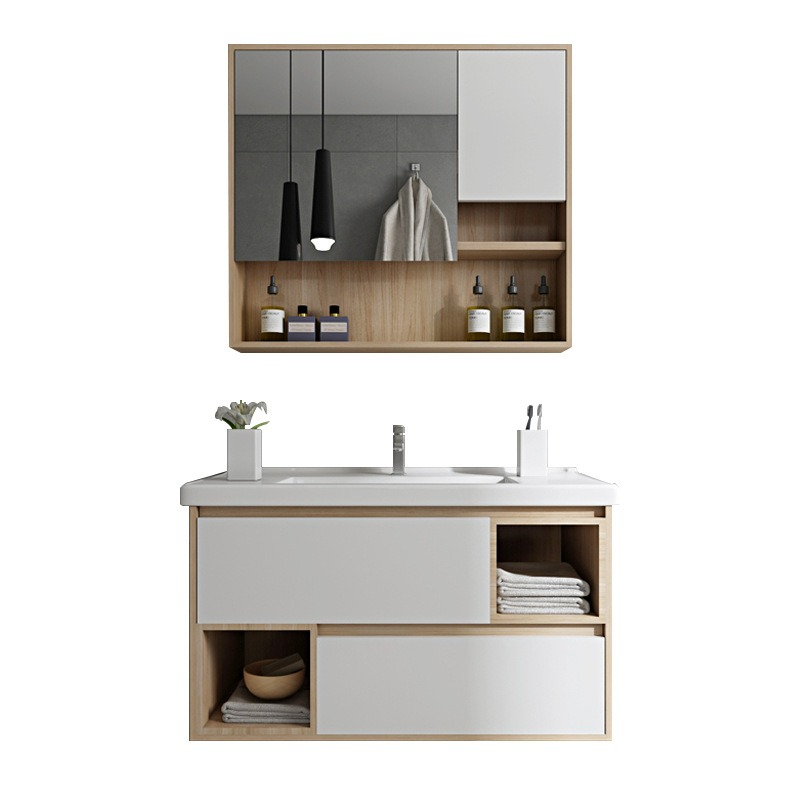
In 2016 the Environmental Protection Agency (EPA) finalized Title VI of the Toxic Substances Control Act (TSCA), and full compliance has applied since 2018. The federal rule takes CARB’s Phase 2 approach and extends it to all 50 states: the same product classes, certification structure, and record-keeping expectations. For an importer the practical effect is that a TSCA Title VI compliant line is also CARB Phase 2 compliant, because the federal limits were built from the California ones. The EPA’s TSCA Title VI page and the CARB ATCM program page document both programs if you need the primary sources for your compliance file.
Who certifies what matters on the import side. The rule places obligations on panel producers, fabricators, and importers of finished goods; an importer bringing vanities into the United States is expected to hold the records demonstrating that the panels inside the cabinets meet the limits. In practice that means asking the factory for panel-level certification documents, not a sales letter. A factory that buys certified panel stock and keeps the certificates on file can produce that chain in an afternoon. One that cannot is asking you to carry the risk of a product that could not legally be sold in the United States once the paperwork is challenged.
How CARB Phase 2 and TSCA Title VI Fit Together
Think of CARB Phase 2 as the technical source and TSCA Title VI as the legal copy. CARB owns the California program: the limits, the certification scheme, and the enforcement. TSCA Title VI takes those same limits national under EPA authority, with penalties across state lines. If your market is California, both apply; if your market is Texas or Ohio, TSCA Title VI applies, and most retailers will also accept a CARB Phase 2 chain as evidence because it is the stronger paper trail. MFBATH follows both frameworks: the plywood panels are produced to the CARB Phase 2 and TSCA Title VI formaldehyde limits, and the CARB P2 and TSCA Title VI compliance guide walks through the exact paperwork importers should collect.
Test Methods and Reports You Should Request
Emission testing splits into two families: chamber methods and desiccator methods. Europe’s EN 717-1 places a panel in a climate chamber and measures the airborne concentration, the United States uses ASTM E1333, a large chamber method, and ASTM D6007, a small chamber method, for the CARB and TSCA programs. Japan’s JIS A1460 desiccator method, in which panels sit in a sealed box with a water dish that absorbs released formaldehyde, is faster and cheaper, which is why many Asian factories screen with it between chamber tests. The trap is unit conversion: desiccator results are reported in milligrams per liter rather than ppm, and the two scales are not interchangeable, so a supplier who answers “we tested it” without naming the method has not answered anything.
Whatever the method, a report worth keeping has four elements:
- The standard and method applied: EN 717-1, ASTM E1333, ASTM D6007, or another named method, never a generic phrase like “environmental test.”
- The limit applied and the measured result in the same unit, so you can see the margin to the pass line.
- The laboratory: its name, accreditation body, and location, so you can confirm it exists and holds current scope.
- The sample: panel type, thickness, batch or production date, and who selected it, so you know the report describes your product rather than a showpiece.
Read the margin, not just the pass line. A panel that tested at 0.09 ppm against a 0.1 ppm limit passes, but a panel that tested at 0.05 ppm leaves room for the real world: heat, humidity, and cut edges handled on site. Then ask the factory about test cadence. Does it run a daily desiccator screen and send panels to an accredited chamber lab on a quarterly schedule, or does it test once a year? The cadence tells you whether the report describes the product you are buying or the product they made last season.
Four patterns should stop the conversation. A certificate with no laboratory name. A report for particleboard when the cabinet is plywood. A test date older than the material batch. And a claim of E0 or “zero formaldehyde” without a chamber report behind it. Wood-based panels can be made with no-added-formaldehyde adhesives, but “no added formaldehyde” describes the recipe, not the result, because a panel can still pick up formaldehyde from surrounding materials or release it from the wood itself. The honest phrase is the tested number, and the tested number always comes with the four elements above.
Build the paperwork into the buying sequence so it arrives with the product, not after it. Ask for the E1 report together with the quotation. At the sample stage, confirm the sample batch matches the report’s batch date. Before bulk shipment, book a third-party inspection and put panel emission sampling on the checklist, your inspector can witness the factory’s own test or take panels to an accredited lab. Keep every certificate in a dated file; retailers, LEED consultants, and building inspectors will ask for it, often a year after the container landed. The compliance and certification library collects the related guides, and MFBATH’s own documentation pack covers ISO 9001, ISO 14001, CE, and UL, with the CSA, NOM, and ADA product lines designed to meet those requirements rather than claimed as certified.
Compliant Vanities With Verified Test Reports
Browse this product, solution, or service page to explore relevant offerings.
Choosing Low-Formaldehyde Materials for Your Line
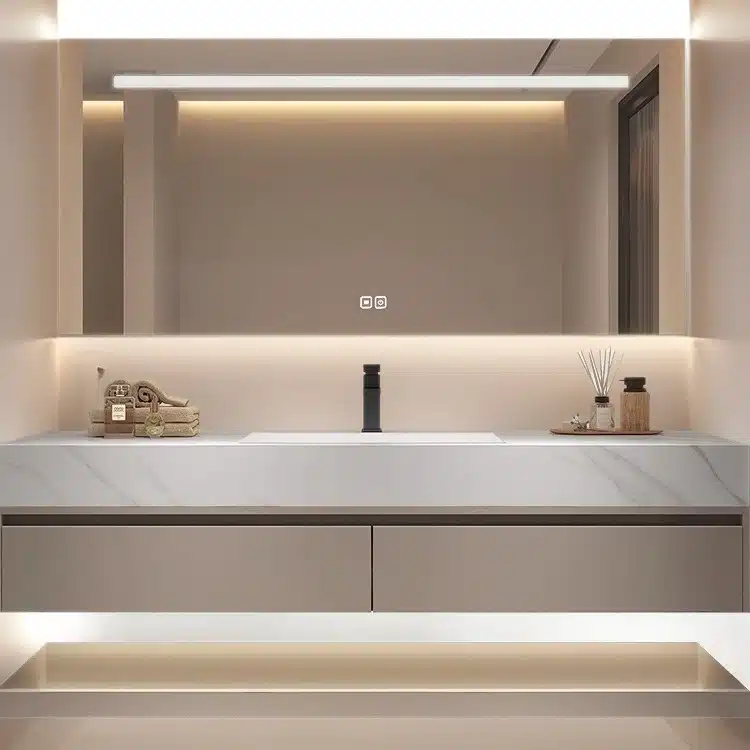
The fastest way to buy a compliant line is to choose the core material that needs the least help. Particleboard and MDF are dense with glue lines and are the primary targets of the CARB and TSCA rules; they can meet the limits, but they rely on resin chemistry and heavy edge sealing to stay there. Plywood, by contrast, carries far less adhesive per unit of volume because the glue sits in thin layers between solid veneers, and its multi-layer structure resists warping in humid air, which matters in a room that steams up twice a day. For a bathroom cabinet, plywood is the low-risk starting point for both emission compliance and dimensional stability.

MFBATH’s production reflects that choice. The standard cabinet is a multi-layer plywood core built to E1 at 0.1 ppm or below, pressed with adhesive systems cured under controlled temperature, then edge-banded with waterproof PVC on every exposed edge so moisture cannot enter the core and the highest-emission surface stays closed. That combination is why the cabinets carry a 2-year whole-cabinet warranty: moisture damage, the failure mode that follows poor edge sealing, is designed out rather than promised away. The factory has built more than 40,000 custom combinations from its modular program, so the low-formaldehyde spec applies across sizes and finishes, not just one flagship model.
For buyers whose customers track sustainability, Forest Stewardship Council (FSC) certification is available on request, covering the wood sourcing chain from certified forests through the factory. FSC pairs naturally with green building programs: projects pursuing LEED or WELL credits can count certified wood and low-emitting materials toward points, and the LEED and WELL certified vanity guide maps the documentation those consultants expect. The CARB and FSC certification overview covers both labels in one place, including what each certificate should look like on paper.
The material spec also has to survive the purchase order, and at MFBATH the numbers are fixed: a minimum order of 15 sets per model, color, and size; samples in 10 working days; bulk production in 20 to 30 days; FOB Qingdao Port. Certificates are part of the package rather than an extra: ISO 9001 and ISO 14001 were issued in 2017 and re-confirmed valid in 2025, and CE and UL certificates are held on file. For the CSA, NOM, and ADA product lines the language stays precise: the vanities are designed to meet those requirements, and the documentation stops at that claim.
| Standard | Where It Applies | Limit Basis | Regulatory Nature |
|---|---|---|---|
| E1 (European emission class) | Europe, and referenced worldwide as the baseline buyers quote first | Chamber concentration of 0.1 ppm or below; verified on MFBATH’s plywood cabinets | Product class under EN standards, verified by EN 717-1 chamber testing and documented in CE marking files |
| CARB Phase 2 | California, United States | Emission limits for hardwood plywood, particleboard, and MDF sold in California | State regulation under the CARB ATCM, enforced with third-party panel certification and labeling |
| TSCA Title VI | All 50 US states | National limits built from the CARB Phase 2 approach | Federal rule under the Toxic Substances Control Act, enforced by the EPA with full compliance since 2018 |
Frequently Asked Questions
What is the difference between E1 and CARB Phase 2?
E1 is a European emission class verified by EN 717-1 chamber testing, and MFBATH’s plywood holds it at 0.1 ppm or below. CARB Phase 2 is a California regulation with its own limits, third-party certification, and labeling system. Many factories hold both, but the reports differ because the test methods and limit structures differ, so request each document separately.
Do vanities need TSCA Title VI compliance if I sell outside the United States?
TSCA Title VI applies to composite wood products sold in the United States, so if any part of your volume ships there, treat it as mandatory and hold the panel-level records. For Canada, the EU, and other markets, E1 and CARB Phase 2 reports are the documents buyers most commonly request, so a factory that can produce all three covers every channel.
What paperwork should I request before ordering vanities?
Four items: a formaldehyde test report naming the standard, method, laboratory, and batch; ISO 9001 and ISO 14001 certificates with issue dates; material declarations for the core panels; and an FSC certificate if certified wood is claimed. Cross-check names and dates across the set, then keep dated copies in a compliance file your own auditors can open.
The Bottom Line
The formaldehyde standard you need is a function of your market: E1 at 0.1 ppm is the baseline, CARB Phase 2 covers California, and TSCA Title VI covers the entire United States. The report that proves compliance is a document with a named standard, method, laboratory, and batch, and anything less is a story. Choose plywood with sealed edges, ask for the reports before the purchase order, and hold any factory to the same paper standard you will face from your own retailers.



0 Comments