


A bathroom vanity that reaches a customer with a cracked stone top or a hinge torn out of a side panel is rarely a production failure. It is a packaging failure, born somewhere between the factory floor and the customer’s door — a forklift jab in a container yard, a settling stack, a fall off a tailgate. The cabinet was fine when it left the line; what mattered was everything the box met afterward. Packaging must be tested as a system, not assumed.
The bathroom vanity packaging drop test is the structured way to find out what a sealed carton will survive before the container door closes. This article explains the ISTA (International Safe Transit Association) procedures behind that test, what a 5-point QC (quality control) process adds, and how an importer verifies carton strength at the factory — with MOQ (minimum order quantity) planning, FOB (free on board) terms, and lead times in view.
Key Takeaways
- A drop test reproduces the handling a carton actually meets — forklift movement, warehouse stacking, truck vibration, tailgate impacts — exposing weaknesses while the fix is still cheap.
- ISTA 1A is a single-carton integrity test: drops on faces, edges, and corners plus compression, used as a fast screening pass on production packaging.
- ISTA 3A simulates a full distribution journey with repeated handling events, vibration, and drops, matching what parcel and LCL (less-than-container-load) shipments actually endure.
- A passing pack combines more than a thick carton: EPS or EPE foam blocking, corner protectors, stretch wrap, and a cabinet-to-box fit with no room to shift.
- At MFBATH, every piece goes through 5 QC checks; third-party inspection by SGS or TÜV is supported with advance notice, and internal checks end with a QC report plus photos and video.
- Buyers can verify before loading: check carton wall structure and grammage, watch foam insertion on the line, and ask for a sample drop test recorded on camera at the sample stage.
Table of Contents
- Why Drop Testing Matters for Vanity Shipments
- What a Drop Test Actually Does: ISTA 1A Explained
- Simulating the Real Journey: ISTA 3A and Distribution Testing
- Packaging Layers That Pass: Carton, Foam and Corner Protection
- Verifying Packaging Quality at the Factory
- Frequently Asked Questions
- The Bottom Line
Why Drop Testing Matters for Vanity Shipments
A bathroom vanity is a difficult object to protect. The mass sits at the top — a stone slab top or thick countertop — while the body below is a hollow box with doors, hinges, and plumbing cutouts. Drop a cabinet flat on its face and the doors take the impact. Drop it on a corner and the frame joints and the stone edge carry the load. That geometry is why vanities show a characteristic damage pattern in transit: corner crush on the carton, scuffed top edges, doors knocked out of alignment, and stone tops cracked at the faucet hole. Every one of those failures is visible at the packaging stage if someone looks.
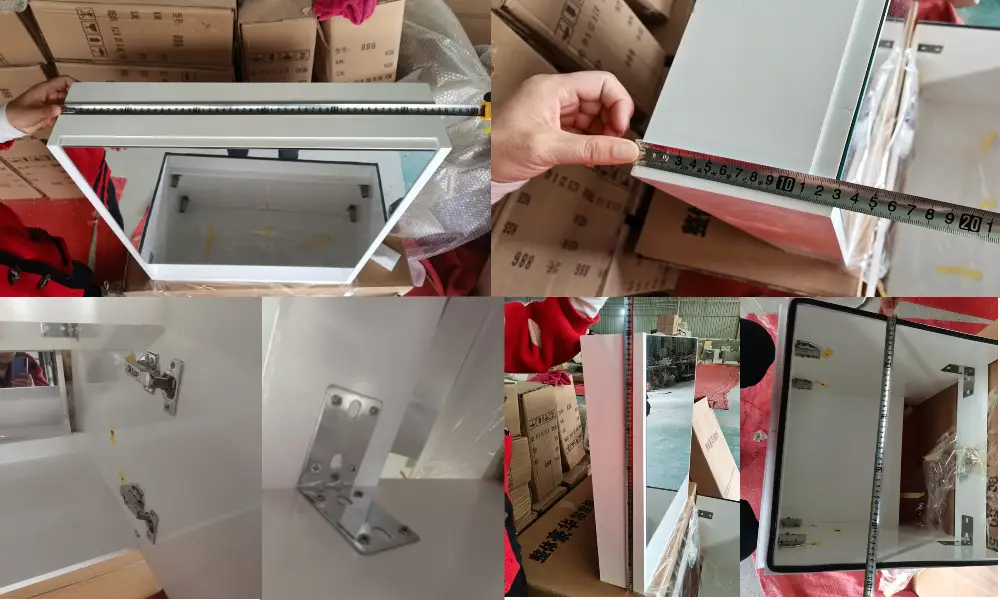
Without a test, damage becomes a claim: the importer pays for the product and the freight, then funds the replacement; the customer waits another cycle; the supplier relationship absorbs the blame even though the factory never touched the cabinet. MFBATH (Main Focus Cabinet), a bathroom vanity factory in Changge, Henan, holds a return rate below 1 percent and a monthly capacity of 5,000 sets across PVC, plywood, solid wood, and stone slab lines. A return rate that low is not luck — it is the output of packaging tested before it is loaded.
A drop test fits into the timeline at two gates. At the sample stage, the packaged unit gets dropped, opened, and inspected before you approve the sample and place the bulk order — inside the 10-working-day sample window at MFBATH, the lowest-cost moment in the project to find a packaging problem. At the bulk stage, with production running 20–30 days and loading at FOB Qingdao Port, a spot drop test on a finished carton pulled from the packing line shows whether the packaging approved at sample stage is the packaging used at scale. Between those gates the test costs minutes; after the container seals, it costs a claim.
A factory-level drop test looks like this: the QC (quality control) team takes a finished, sealed carton and drops it in sequence — corner first, then a flat face, then a long edge — from a height the pack is likely to see when lifted by hand or dropped off a pallet edge. After each drop they open the carton, photograph the impact point on the box and the cabinet inside, and check for foam displacement, cracked joints, hinge damage, and stone-top damage. The result is a short record: which orientation failed, what broke, and what changed to fix it — the record you should ask for, not a verbal “we test our packaging.”
What a Drop Test Actually Does: ISTA 1A Explained
The industry’s procedures come from the International Safe Transit Association, the organization that writes the test protocols most factories and third-party laboratories run. The first level most suppliers meet is ISTA 1A, a non-simulation integrity test: it checks whether a packaged product survives the basic shocks of transport without modeling any particular route. A 1A-style sequence drops the sealed carton on faces, edges, and corners, and applies compression to simulate stacking. It answers one question — can this package protect this cabinet under a defined set of impacts — and answers it fast.
At the factory, a 1A pass is usually run on a drop tester: a hoist lifts the carton to the release point, and the box falls onto a rigid steel base. The operator checks the carton first — creased walls, split tape, corner collapse — then the cabinet. As a buyer, you are not looking for “no damage” but for the packaging to do its job: the outer box may show dents, but the foam must stay in place, the cabinet must show no cracks, and the doors must still close and align. A carton that survives a drop by crushing onto the cabinet is a failed test even when the box looks fine.
Order the orientations the way a real fall happens. A corner drop is the most demanding, because the entire weight concentrates on a small point — for a vanity, usually where the stone top meets the frame. Then a flat face drop on the largest side, which stresses the doors and panel glue lines, and an edge drop along the top, where the countertop edge takes the impact. If the packaging survives all three with the cabinet undamaged and the foam unmoved, the pack has cleared the basic bar. If it fails, you have found the problem while it is still a packaging revision, not a container of damaged goods.
Know what 1A does not do: it does not simulate the full journey — the repeated handling, truck-bed vibration, warehouse stacking pressure, or the extra drops a parcel carrier adds. A single drop sequence is a screening test, right for the sample stage and for packing-line spot checks. For a distribution profile that matches what the carton actually endures, you move to ISTA 3A, covered in the next section.
Simulating the Real Journey: ISTA 3A and Distribution Testing
ISTA 3A is a general simulation test for packaged products shipped through small-parcel delivery systems, and it comes closest to the real abuse a vanity meets after leaving the factory. Instead of a single drop sequence, 3A builds a distribution profile: a series of handling events — drops from conveyor height, tosses, and slides — mixed with vibration and compression that mimic a delivery vehicle and a sorting facility. The package is re-oriented between events the way a parcel is tumbled, sorted, and re-stacked. A pack that survives 1A can fail 3A, because 3A tests cumulative damage: vibration loosens the foam, and later drops land on a cabinet no longer held tight.
Whether 3A is the right bar depends on how your shipment travels. A full-container-load (FCL) order mostly sees forklifts, stacking, and one loading cycle — compression and a few handling drops dominate, and a well-built pack with 1A-level integrity plus strong stacking strength carries it. Once the order moves as less-than-container-load (LCL), gets transshipped, or is broken into parcels for e-commerce resale, the handling count multiplies and a 3A-style profile becomes the honest test. Importers who resell vanities online should treat 3A as the default, because the customer’s doorstep is the final drop of the profile.
The mirror in the same box makes distribution testing personal. A vanity carton often carries a mirror panel, and mirrors are the first casualty of vibration: they rattle, edge-chip, and crack before the cabinet shows any damage. The engineering for that problem — foam channels around the mirror, edge protectors, and blocking that stops lateral movement — is covered in the ISTA 3A mirror packaging guide, worth reading if your orders include mirrors.
Use the two protocols as a pair: run a 1A sequence at the sample stage for speed, then ask whether the supplier has run a 3A-style distribution profile on the final pack. If the factory can show a 3A video with the foam still seated and the cabinet undamaged, you have evidence. If not, decide what your route demands: an FCL order can reasonably ship on 1A integrity plus a stacking check, while an LCL or parcel route should not. Put the choice in the purchase order so the approved bar is unambiguous.
| Protocol | Purpose | Environment Simulated | Duration and Scope | Typical Application |
|---|---|---|---|---|
| ISTA 1A | Verifies basic package integrity under defined impacts — whether the pack protects the cabinet at all | Single-carton handling on a rigid base: face, edge, and corner drops plus compression; no specific route modeled | A short sequence on one sealed carton; the result is a pass/fail on shock protection | Sample-stage screening, packing-line spot checks, and FCL orders with controlled loading |
| ISTA 3A | Simulates a complete distribution journey — whether the pack survives the route it will actually travel | Small-parcel distribution profile: repeated handling events, vehicle vibration, stacking pressure, and drops with re-orientation between events | A longer multi-stage profile covering the whole handling chain; reveals cumulative damage | LCL and transshipment orders, parcel and e-commerce routes, and any shipment where handling is unknown |
Packaging You Can Verify Before Loading
Browse this product, solution, or service page to explore relevant offerings.

Packaging Layers That Pass: Carton, Foam and Corner Protection
A drop test only passes if the packaging underneath is engineered, and vanity packaging is a layered system. Working outward from the cabinet: top and bottom caps of EPS (expanded polystyrene) or EPE (expanded polyethylene) foam hold the unit in place and absorb the first hit; foam corner blocks wrap the frame joints and stone top edges; the mirror rides in its own foam channel; stretch wrap seals the cabinet against dust and scuffs; and the assembly sits inside a corrugated fiberboard carton — the material class described in the corrugated fiberboard reference — sized so the cabinet cannot slide even a few millimeters.
The carton is where most cost is cut and most damage is born. Corrugated board is rated by its structure: single-wall for light packs, double-wall for heavy vanities, with flute profiles that add cushioning and stacking strength. The specification that matters is the combination of wall count, flute, and grammage — the weight of the paper per square meter — because stacking strength in a container follows from those three. A vanity with a stone top should not ship in a single-wall box sized for a lighter cabinet; a lower-cost carton quoted to win the order will be found out by the drop test.
Reading a Carton Like an Inspector
On a factory visit or a remote call, you can read a carton in under a minute. Open the flaps and look at the exposed corrugation: two visible layers of fluting means double-wall, one means single-wall. Pinch the wall between thumb and finger — a soft, easily compressed wall means low grammage and low stacking strength. Check the fit: a sealed carton should hold the cabinet with no movement when you push on a wall. Check storage: cartons should sit on pallets in a dry warehouse, not lean against a wet floor, because moisture destroys corrugated strength faster than any drop. Four observations, and you have a packaging spec check without a single tool.
Foam placement is the detail that decides drop results. EPS blocks are rigid — they hold position and take a heavy hit, which makes them right for the top cap under a stone countertop and for corner blocks. EPE is soft and flexible — it wraps and cushions, which makes it right for the mirror channel and for surfaces that can scuff. The failure mode to look for after any drop is foam displacement: if the foam shifts, the cabinet moves inside the box on the next impact, and every subsequent hit lands on a misaligned surface. Good blocking leaves the foam seated where it started, and a QC photo after a drop should prove it.
The outer layers close the system. Corner protectors — rigid cardboard or molded foam angles — sit over the carton corners and take the abrasion and impact of strapping and forklift forks. Stretch wrap over the carton holds the flaps and shields against moisture and dirt. On palletized loads, cartons stack in an interlocking pattern with the heaviest units at the bottom, and the pallet is banded so the stack moves as one block; a well-built carton still fails if stacked with seams misaligned. The full specification MFBATH builds to — foam density, carton structure, loading marks — is documented in the Zero Breakage Packaging Standards guide.
Verifying Packaging Quality at the Factory
Verification starts on the packing line, not at the container. On a factory visit, stand at the packaging station and watch the sequence: cabinet wrapped, foam caps fitted, corner blocks placed, carton raised over the unit, tape applied, stretch wrap added. The pace tells you whether the operator follows the spec or rushes to quota. On a remote call, ask the camera to hold on the packaging station for five minutes and film one complete pack. A factory that packs to a written standard is happy to show it; one that improvises will hurry the camera past.

Then check the QC system behind the line. At MFBATH, every piece passes five inspection checks — the 5-point QC (quality control) process — and packaging is one of them: before the carton is sealed, the operator verifies foam placement, hardware fit, and surface condition; after sealing, the carton gets a final check for tape, labels, and loading marks. Internal inspection closes with a QC report plus photos and video of the unit, delivered with the shipment documents. Ask for a filled-out QC report from your batch and read what the packaging line says: carton condition, foam coverage, and the drop-test record if one was run.
Third-party inspection is the independent layer, available if you ask in time. MFBATH arranges inspection by SGS, TÜV, or a similar agency when the buyer requests it with advance notice — built into the production schedule so the inspector arrives before final packing, not after. An inspector at the packaging stage checks the same things you would: carton structure against the spec, foam placement, tape and strapping, and the condition of units already packed. Their report is the document your bank, forwarder, and customer will accept as evidence of what was loaded.
Your verification checklist before loading: first, request the sample-stage drop test video and confirm the corner-face-edge sequence in the recording. Second, confirm the carton spec in writing — wall count, flute, grammage — and spot-check the line. Third, confirm the QC report covers packaging and arrives with photos. Fourth, confirm the inspection date with lead time to move it if production slips. Fifth, keep the first order inside the MOQ of 15 sets per model, color, and size so you can test several models without over-committing. Samples take 10 working days, bulk runs 20–30 days, loading is FOB Qingdao Port, and the 2-year whole-cabinet warranty starts at delivery — finish packaging verification before those clocks run out.
Packaging verification is also a cost lever. The same carton engineering that cuts damage claims can cut freight weight and cube, changing how many sets a 40-foot container carries and what the FOB price per set looks like. The Reduce FOB Costs via Packaging guide walks through those trade-offs, and the manufacturing excellence library collects the rest of the process documentation — production checks, inspection workflows, packaging standards — for benchmarking your supplier against a documented operation.
Frequently Asked Questions
What exactly is a bathroom vanity packaging drop test?
It is a controlled sequence of impacts applied to a sealed carton — typically a corner drop, a flat face drop, and an edge drop, plus compression — followed by an inspection of the cabinet inside for cracks, hinge damage, foam displacement, and stone-top damage. Its purpose is to prove the packaging protects the product before loading, and it is the same procedure third-party inspectors and testing laboratories use to validate a pack.
Can I request a drop test on my order, and does it slow down production?
Yes. Request the test at the sample stage, when the packaged sample is ready, so the packaging is approved before bulk production starts. At MFBATH, samples take 10 working days and bulk production runs 20–30 days, and the test sits inside the 5-point QC process, with the QC report plus photos and video delivered to you. Third-party inspection by SGS, TÜV, or a similar agency needs advance notice so it fits the production schedule.
What should I check when a carton arrives at my warehouse?
Start before you sign: photograph every carton with visible damage and note creased walls, split tape, crushed corners, and punctures. Inside, check foam displacement — moved foam means the cabinet shifted in transit — plus hinge alignment, door closure, and stone-top edge chips. Keep the evidence and file the claim with the carrier within the agreed window. With a 2-year whole-cabinet warranty and a return rate below 1 percent at MFBATH, the factory side of a claim is rarely the dispute; the carrier side is.
The Bottom Line
The bathroom vanity packaging drop test is the gate between a good cabinet and a good shipment: ISTA 1A screens the pack at the sample stage, ISTA 3A verifies it against the distribution route, and the packaging layers — foam, corner protectors, the right carton — decide whether either test passes. Verify on the line, with the QC report, and with third-party inspection before loading, and the most common source of transit claims becomes a documented, repeatable process. That is the difference between suppliers who ship cabinets and suppliers who ship confidence.





0 Comments