
Selling bathroom vanities into North American or European hotel, retail, and commercial programs increasingly means signing environmental declarations. Buyers ask whether your line is truly “eco-friendly,” and most importers want to say yes — but vague supplier statements are exactly what gets distributors into greenwashing trouble. This guide covers what you can actually verify when you source an iso 14001 eco friendly vanity: what ISO 14001 certification does and does not prove, which wood and emission claims can be documented (E1, CARB Phase 2, TSCA Title VI, FSC-certified wood, low-VOC finishes), what documents to request from the factory, and how to keep your own marketing defensible.
What ISO 14001 Actually Covers (and What It Does Not)
ISO 14001 is the international standard for environmental management systems, published by the International Organization for Standardization (ISO). When a factory holds ISO 14001 certification, an accredited registrar has audited its management system: how the plant tracks environmental compliance obligations, manages waste, monitors energy use, controls emissions, and sets improvement targets. The audits are repeated on a cycle, so a current certificate means the system survived re-certification, not just a one-time file review.
The most common buyer mistake is treating ISO 14001 as a product label. It is not. The certificate describes how an organization manages its environmental footprint, not what a specific cabinet is made of or how much formaldehyde it releases. If a supplier says “our vanity is ISO 14001 certified,” that sentence is technically meaningless for the product itself. What the certificate does for you as an importer is more indirect but still valuable: a factory with a certified environmental management system is more likely to control chemical inputs, segregate waste, keep documentation in order, and react quickly when you ask for test reports. It is a governance signal, not a performance claim.
ISO 9001 is the companion standard for quality management systems, and the two are frequently held together. A quality-certified plant documents its production procedures, inspection points, non-conformance handling, and corrective actions; an environmentally certified plant does the same for environmental aspects. When you evaluate an eco-friendly vanity manufacturer, ask to see both certificates, then check three things: the scope line (does it cover the actual production site, not just a head office?), the issuing registrar, and the validity dates. MFBATH, for example, has held ISO 9001 and ISO 14001 certification since 2017, and the certificates were confirmed current in 2025 — which tells you the system has been audited repeatedly since 2017. That history is checkable, and you should check it the same way with any supplier.
What ISO 14001 will never tell you: the formaldehyde emission of the plywood, the origin of the oak, or the VOC content of the finish. Those are product-level claims and they need product-level evidence, which is the subject of the next sections. Keep the two categories separate in your head, because your own marketing must too. If you put “ISO 14001” on a product sheet as if it were a product attribute, you are repeating the same category error you should be auditing your suppliers for.
Verifying Sustainable Wood and Sintered Stone Materials
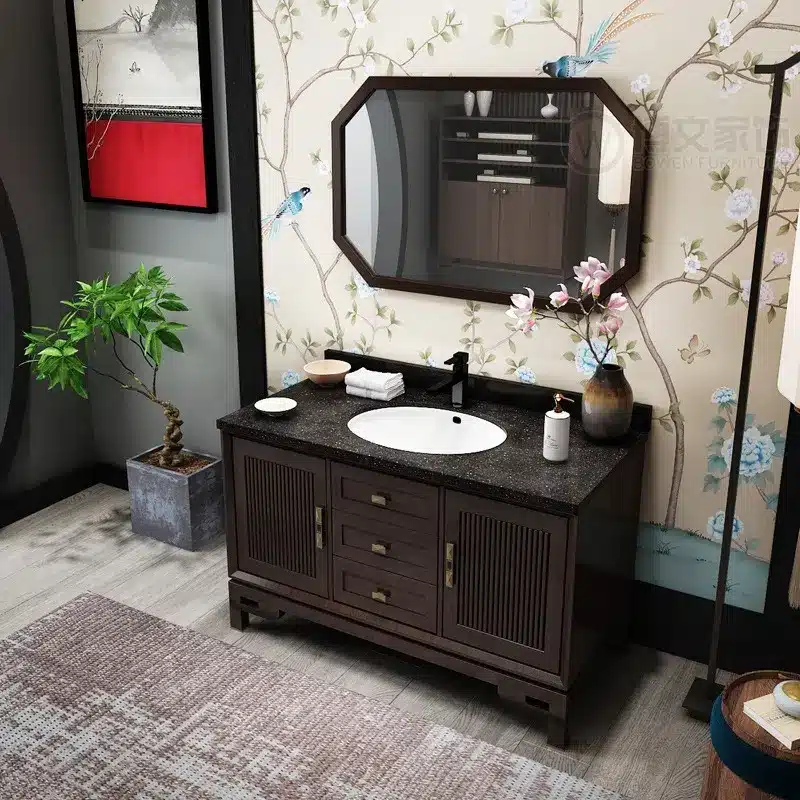
The materials inside a vanity determine which environmental claims you can honestly make, so start there. A typical MFBATH line offers solid wood in oak, walnut, maple, or ash, sourced from sustainable suppliers, with FSC-certified wood available as an option. The plywood used in cabinet construction is E1 low-formaldehyde grade, and FSC-certified plywood is also available on request. If “sustainable sourcing” matters to your buyers, the phrase needs a definition: either the supplier maintains a documented sourcing policy for legal, managed timber, or the specific wood carries FSC (Forest Stewardship Council) chain-of-custody certification, which traces material from a certified forest through each processing step to the finished panel.
Chain of custody is the key concept. A sawmill can hold an FSC certificate while a vanity factory does not, so the traceability must extend to the factory that cuts and assembles your cabinets. When a supplier offers “FSC wood,” request the chain-of-custody certificate and verify it through the FSC certificate database rather than accepting a screenshot. For a deeper look at how these certificates apply to cabinets, the vanity FSC certifications page walks through the document trail in detail.
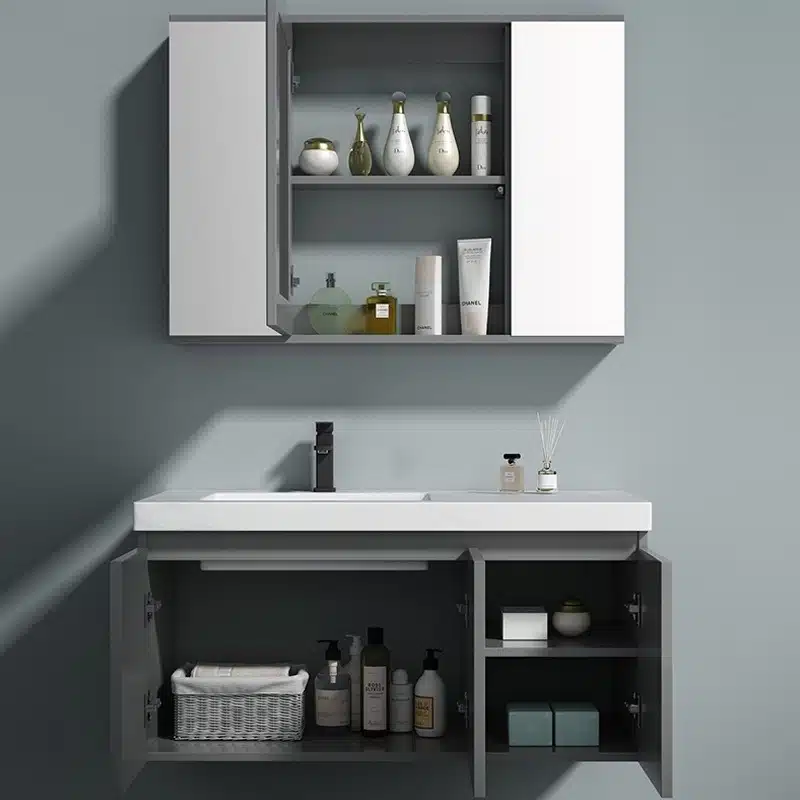
Solid wood and plywood are not the only materials that matter. Sintered stone basins are made from natural minerals — quartz, feldspar, and silica — sintered at high temperature and pressure. The process is resin-free, so the surface contains none of the binding adhesives that create formaldehyde concerns in composite materials; the result is non-porous and UV-stable. For sintered stone countertop lines, MFBATH can source materials produced under an ISO 14001 management system, meaning the raw material supplier’s environmental controls are themselves certified. That is a supply-chain-level claim, and you can request the supplier’s scope statement as documentation. The sintered stone basin certifications page covers which claims attach to sintered stone versus engineered materials.
When you compare material options, ask each factory the same three questions: What exactly is the wood or board, what is the emission level on the test report, and is FSC chain of custody available on the specific product you are ordering? The answers separate factories that manage claims from factories that repeat them. If you are still deciding between wood-based and board-based construction, compare how the two material families differ on moisture resistance, weight, and finish adhesion — then confirm that the test reports you collect cover whichever construction you select, because a report for one panel type will not defend a claim made about the other.
Emission Standards and Low-VOC Finishes You Can Verify on an Eco-Friendly Vanity
Formaldehyde is the emission that regulators care about in bathroom cabinetry, because it off-gases from the adhesives used to bind plywood and other composite panels. The relevant product-level claims are E1, CARB Phase 2, and TSCA Title VI, and they are not interchangeable. E1 is the European emission class with a formaldehyde limit of 0.1 ppm (parts per million); MFBATH plywood is E1 low-formaldehyde grade. CARB (California Air Resources Board) Phase 2 comes from California’s composite wood products airborne toxic control measure, the rule that first pushed formaldehyde limits down for hardwood plywood, particleboard, and medium-density fiberboard sold in California. TSCA (Toxic Substances Control Act) Title VI then created a national formaldehyde emission standard for the same composite wood categories, enforced by the EPA (U.S. Environmental Protection Agency).
For an importer selling into the U.S. market, the practical question is not which of these standards a factory “has,” but which documents prove compliance for the actual panels in your shipment. A third-party formaldehyde emission test report from an independent laboratory is the strongest evidence; a manufacturer’s certificate of compliance is the routine documentation that accompanies compliant production. Ask for both and make sure the tested panel construction matches what you are buying — a report for 12 mm plywood does not automatically cover the 18 mm board in your vanity. The U.S. import side of this is worth reviewing separately, since documentation requirements apply at the border, not just in your marketing; the US import requirements guide covers what customs and downstream customers expect.
The finish is the second place emissions hide. Low-VOC finishes keep VOC (volatile organic compound) content down, which matters for indoor air quality in hotels and apartments where units are installed shortly before occupancy. Ask for the finish’s VOC content data sheet or a finish test report, and confirm which coating system the factory applies by default versus on request. MFBATH finishes are low-VOC, and the factory also holds CE and UL markings on the relevant product configurations — CE for the European market and UL for North American electrical and safety expectations. Those are market-access markings rather than environmental certifications, but they belong in the same compliance file because inspectors and specifiers will ask about all of them. For a broader map of which certificates attach to which component of a bathroom setup, the bathroom sink certifications page breaks down sink-level versus cabinet-level claims.
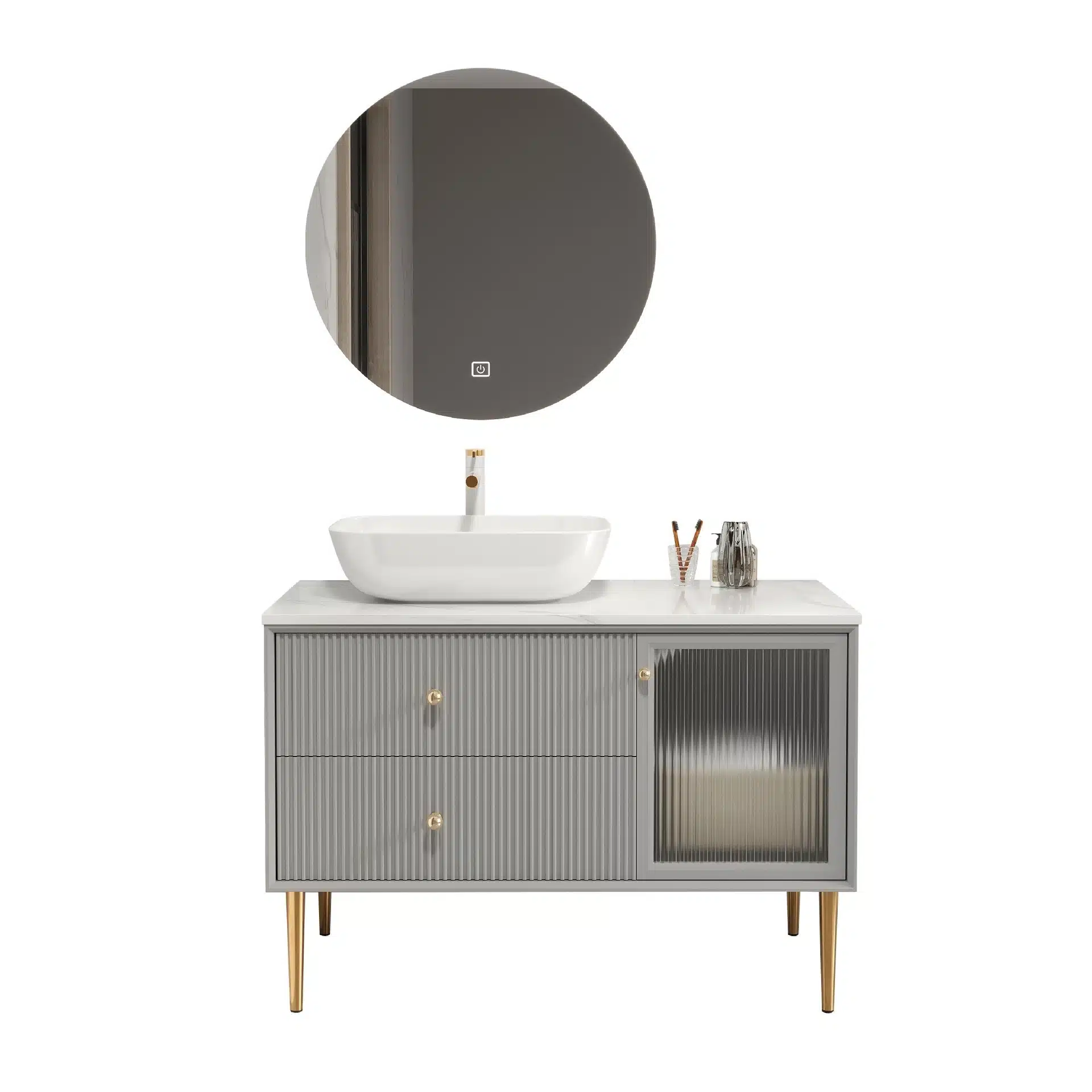
One caution about scope: CE and UL markings, CARB Phase 2, and TSCA Title VI all have specific product scopes. A vanity is an assembly of cabinet, countertop, basin, mirror, and hardware, and no single marking covers all of them. Your documentation file should therefore be itemized: the emission standard applies to the composite wood panels, the finish data to the coating, the electrical marking to the integrated lighting and outlets, and so on. The factory that can produce this itemized file is the one whose environmental claims survive a buyer’s audit.
Treat test reports as perishable documents. Panel suppliers, adhesive formulations, and finish chemistry can change between production runs, and a report issued three years ago says little about the batch that is on the water now. Ask the factory how recently the report was issued and whether the panels in your current order came from the same supplier and specification as the tested batch. A factory that re-tests on a schedule treats compliance as an operating cost; a factory that re-tests only when asked treats it as a negotiation point.
Eco-Friendly Vanity Lines With Verifiable Claims
Browse this product, solution, or service page to explore relevant offerings.
The Eco-Friendly Vanity Verification Checklist: Claim, Standard, Document
Every environmental claim you make in your catalog should map to a standard and a document. If the factory cannot produce the document, drop the claim — from their presentation and from yours. The checklist below is the file you should assemble before you put any environmental language on a product sheet for your iso 14001 eco friendly vanity line.
| Environmental claim | Standard or limit to match | Document to request from the factory |
|---|---|---|
| Environmental management system | ISO 14001, certified since 2017 and confirmed current in 2025 | ISO 14001 certificate with site scope, registrar, and validity dates |
| Quality management system | ISO 9001, certified since 2017 and confirmed current in 2025 | ISO 9001 certificate with site scope, registrar, and validity dates |
| Low-formaldehyde plywood | E1 class, formaldehyde ≤ 0.1 ppm | Third-party formaldehyde emission test report |
| California market compliance | CARB Phase 2 for composite wood products | CARB certificate of compliance or matching test report |
| U.S. federal compliance | TSCA Title VI formaldehyde standard | TSCA Title VI certificate or EPA-recognized test report |
| Sustainable wood sourcing | FSC-certified wood (optional) | FSC chain-of-custody certificate, checkable in the FSC database |
| Low-VOC finishes | Low-VOC coating system | VOC content data sheet or finish test report |
| Sintered stone countertop materials | ISO 14001 materials available | Supplier scope statement for the material source |
| Product inspection | 5-stage QC; third-party inspection welcome | QC reports plus an SGS or TÜV inspection report on request |
Three rules keep this checklist honest. First, match the document to the exact product: a certificate of compliance for a different cabinet model does not cover yours. Second, prefer third-party evidence over self-declarations wherever the standard allows it; independent laboratories such as SGS (Société Générale de Surveillance) and TÜV (Technischer Überwachungsverein) issue the reports that hold up when a hotel chain or retail buyer asks for proof. Third, store everything with an eye to the warranty period — the 2-year warranty on MFBATH vanities means your documentation should outlive the transaction, because that is the window in which claims get examined. Factories that are used to this drill respond to a document request list without hesitation; factories that are not will suddenly discover their “certifications” were verbal.
How the Factory Backs Its Claims: QC, Inspection, and Commercial Terms
Environmental documentation is only useful if the product it describes is the product you receive, which is why verification has a physical side. MFBATH runs a 5-stage QC (quality control) process covering materials intake through finished-unit inspection, and third-party inspection is welcome at any stage — you can commission an inspector from SGS, TÜV, or another recognized body to check units against the specification before they leave the factory. If you are going to claim E1 plywood and low-VOC finishes in your market, the inspection should explicitly confirm those attributes on the units being shipped, not just on the sample you approved.
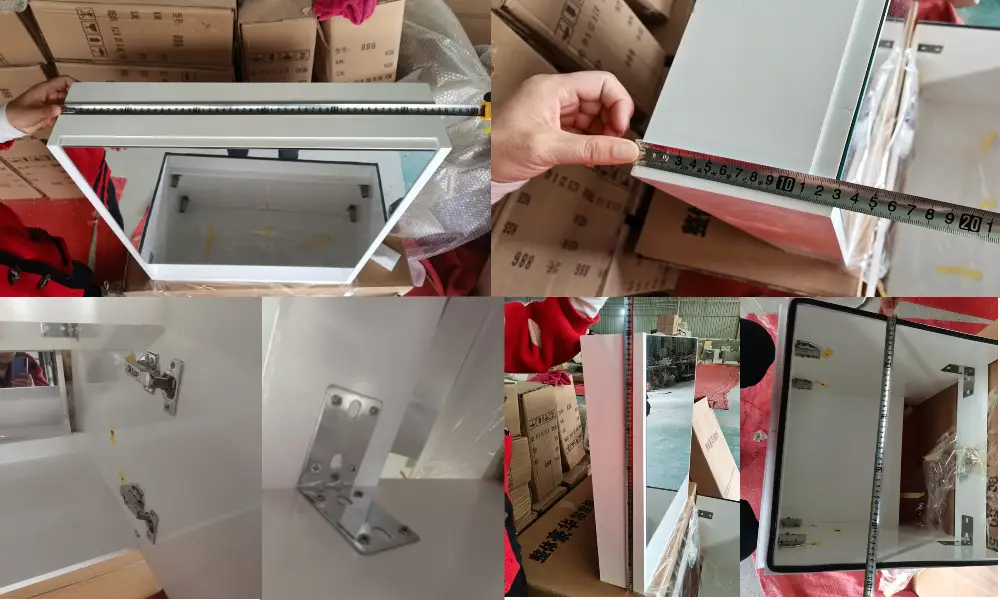
The commercial terms around a factory’s claims are just as revealing as the certificates. MFBATH works with an MOQ (minimum order quantity) of 15 units per model, color, and size, which keeps first orders small enough to validate the product and the paperwork before you commit to volume. Mixed container loading lets you combine models in one container rather than ordering full container loads of a single SKU. The ordering rhythm is straightforward: free samples ship within 10 working days so you can inspect materials and finishes in hand, bulk production takes 20–30 days, and shipment goes out of Qingdao port. Payment is FOB (free on board) with a 30% deposit and the balance due within one week of the draft BL (bill of lading), terms that are standard enough to let you focus your negotiation on documentation rather than exotic payment structures.
Warranty and quality history belong in the verification file too. MFBATH provides a 2-year warranty on its vanities and reports a return rate below 1%, a figure you can validate by asking for the last year’s claims and returns summary before you commit. No number is worth more than the audit trail behind it, and the same discipline applies to environmental claims: a factory that can show you its quality returns data is a factory that treats its ISO 14001 scope, its test reports, and its FSC documentation as operating documents rather than marketing props.
Use the sample stage to pressure-test the paperwork. Ask that the sample shipment arrive with the test reports and certificates covering the exact materials used in that sample, then check the documents against the product in hand: panel thickness, finish type, and any FSC marking on the wood. A factory that ships documentation with samples saves you a full verification round later; a factory that sends documents only after three reminders is telling you where compliance ranks in its priorities.
Once you have samples, test reports, chain-of-custody certificates, and inspection results, you can assemble a defensible claim file: which claims apply to which components, which documents prove each one, and when each document needs refreshing. That file becomes your own due-diligence record, your marketing source, and your answer when a hotel procurement team or retail buyer asks the inevitable follow-up question. For the full range of products you can build claims around, start from the compliance and certification library, which collects the per-component explainers in one place.
Frequently Asked Questions
Is ISO 14001 a product certification for vanities?
No. ISO 14001 certifies a factory’s environmental management system — its processes, controls, and audit cycle — not the environmental performance of an individual product. For product-level claims, request the specific evidence: an E1 formaldehyde test report, CARB Phase 2 and TSCA Title VI certificates of compliance, FSC chain-of-custody documentation for wood, and VOC content data for finishes.
What documents prove CARB Phase 2 and TSCA Title VI compliance?
Request the manufacturer’s certificate of compliance for the specific panels used in your order, plus a third-party formaldehyde emission test report from an independent laboratory. The report should match the board thickness and construction of the panels actually shipped. For U.S. sales, treat these as import documentation, not just marketing support, and keep them on file for your warranty period.
Can I claim my vanities use FSC-certified wood?
Only if the chain of custody reaches the factory that produces your units, not just the forest or the sawmill. Ask the factory for its FSC chain-of-custody certificate and verify it in the FSC certificate database. MFBATH offers FSC-certified solid wood and plywood as an option, so the claim is available to you — if you request it and document it.
The Bottom Line
Environmental claims only work when they are verifiable, so treat every eco claim as a document request before you treat it as a marketing phrase. Verify ISO 14001 and ISO 9001 validity dates and scope, collect E1, CARB Phase 2, and TSCA Title VI evidence for your exact panels, and confirm FSC chain of custody if you intend to use the word “FSC.” When you request pricing for an iso 14001 eco friendly vanity, send this checklist alongside your inquiry, inspect the physical units with a third party, and publish only the claims your file supports.



0 Comments