

The supplier’s email says “Attached: Test Report,” and the easy move is to forward it to compliance. Hold on. The question is not whether a PDF exists. It is who ran the test, which standard it cites, and whether the sample relates to the container you are about to pay for. A vanity third party lab test report can stop a shipment at the border or trigger a retailer chargeback. Most buyers never read one closely enough.
This guide covers the five test groups that matter for bathroom vanities: formaldehyde E1 ≤0.1ppm, CARB Phase 2, TSCA Title VI, hardware cycle life, finish adhesion, moisture, and structural strength. It also covers ISO 2859-1 sampling and what to ask before you sign. Timing is the point: MOQ (Minimum Order Quantity) is 15 sets, production runs 20-30 days, and US/Canada/Mexico delivery takes 4-6 weeks.
Key Takeaways
- Composite wood vanities for the US market face formaldehyde gates at E1 ≤0.1ppm, CARB Phase 2 and TSCA Title VI; the report must cite the regulation, not just a limit.
- A published 100K-cycle hardware test on this site showed door hardware failing at 45,000 cycles in a humid environment — test conditions decide whether a pass means anything.
- ISO 2859-1 sampling with a defined AQL (Acceptable Quality Limit) determines how many units get tested; a report without a batch reference covers only the sample.
- MFBATH runs 5 inspection checks on every unit and supports third-party factory audits and inspections by SGS, TÜV and similar firms — arranged in advance.
- Plan testing into the timeline: samples take 10 working days, production 20-30 days, and US/Canada/Mexico delivery 4-6 weeks.
- MOQ is 15 sets per model, color and size with mixed-container loading; the 2-year cabinet warranty needs documented failure-handling terms.
- A factory self-test report is process evidence, not independent proof — keep it, but ask for the third-party original.
In This Guide
- What Third-Party Testing Actually Covers
- The Tests That Matter for Bathroom Vanities
- Reading a Lab Report Before You Accept It
- Sampling, AQL and Your Delivery Batch
- Questions to Ask Your Factory About Testing
- Frequently Asked Questions
What Third-Party Testing Actually Covers
A third-party lab test differs from factory QC (quality control) in one structural way: the lab is not the factory. An independent laboratory takes a sample, runs it against a published standard, and issues a report carrying the lab’s name and accreditation. That separation is what makes the document usable as evidence for your customers, customs brokers, and retailer compliance teams. Factory internal checks remain necessary — MFBATH runs 5 inspection checks on every unit — but internal checks prove process control, not material compliance. To see how an audit verifies that control, read our guide to ISO 9001 factory audit verification.
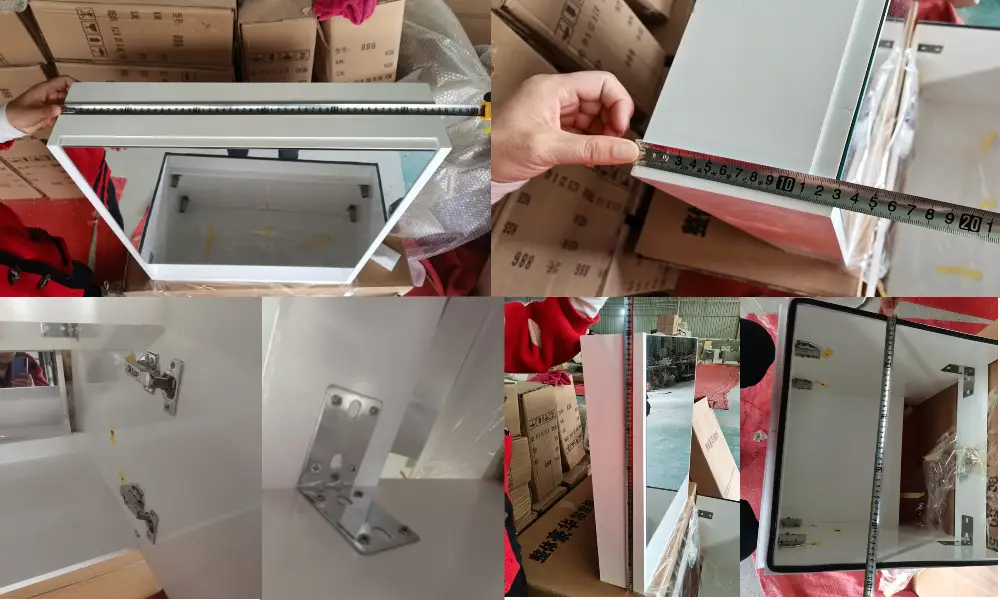
What a lab actually measures is narrower than most buyers assume. A lab measures one property, under defined conditions, against one standard; it does not certify a whole product. The formaldehyde test seals panels in a chamber and measures airborne emissions in ppm. A hardware test cycles a hinge until failure. A finish test cuts or scrapes the coating. That is why a useful report is a stack of specific tests rather than one vague compliance letter. Ask for the tests individually, and you will quickly see which supplier holds real data.
The layer people confuse with testing is inspection. Inspection checks that units on the line match the order — quantity, dimensions, finish, hardware function. Testing measures properties of samples in a lab. You need both: inspection catches batch-level problems, testing catches material-level problems. When a factory offers only one, it is usually inspection, because inspection is cheaper and faster. Our bathroom vanity QC guide explains how the two layers work together across a typical order.
Follow the document chain and the reason for third-party reports becomes concrete. Your importer’s compliance team asks for them, a US retailer’s vendor portal asks for them, and a customs broker may ask for them when the product category flags. Each handoff carries a cost when the report is missing — a re-inspection, a hold at the port, a credit note. That is why the request belongs in the order confirmation, not in a follow-up email after production starts.
The Tests That Matter for Bathroom Vanities
Five test groups decide whether a vanity survives a bathroom: formaldehyde emission, hardware cycle life, finish adhesion and scratch resistance, moisture and waterproofing, and structural strength. Formaldehyde is the regulatory gate; hardware is the most common field failure; the other three determine how the cabinet looks and holds up after years of humidity. The 100K-cycle hardware case published on this site shows exactly why test conditions matter: door hardware that passed on a dry bench failed at 45,000 cycles in a humid environment.
Formaldehyde Emissions (E1, CARB Phase 2, TSCA Title VI)
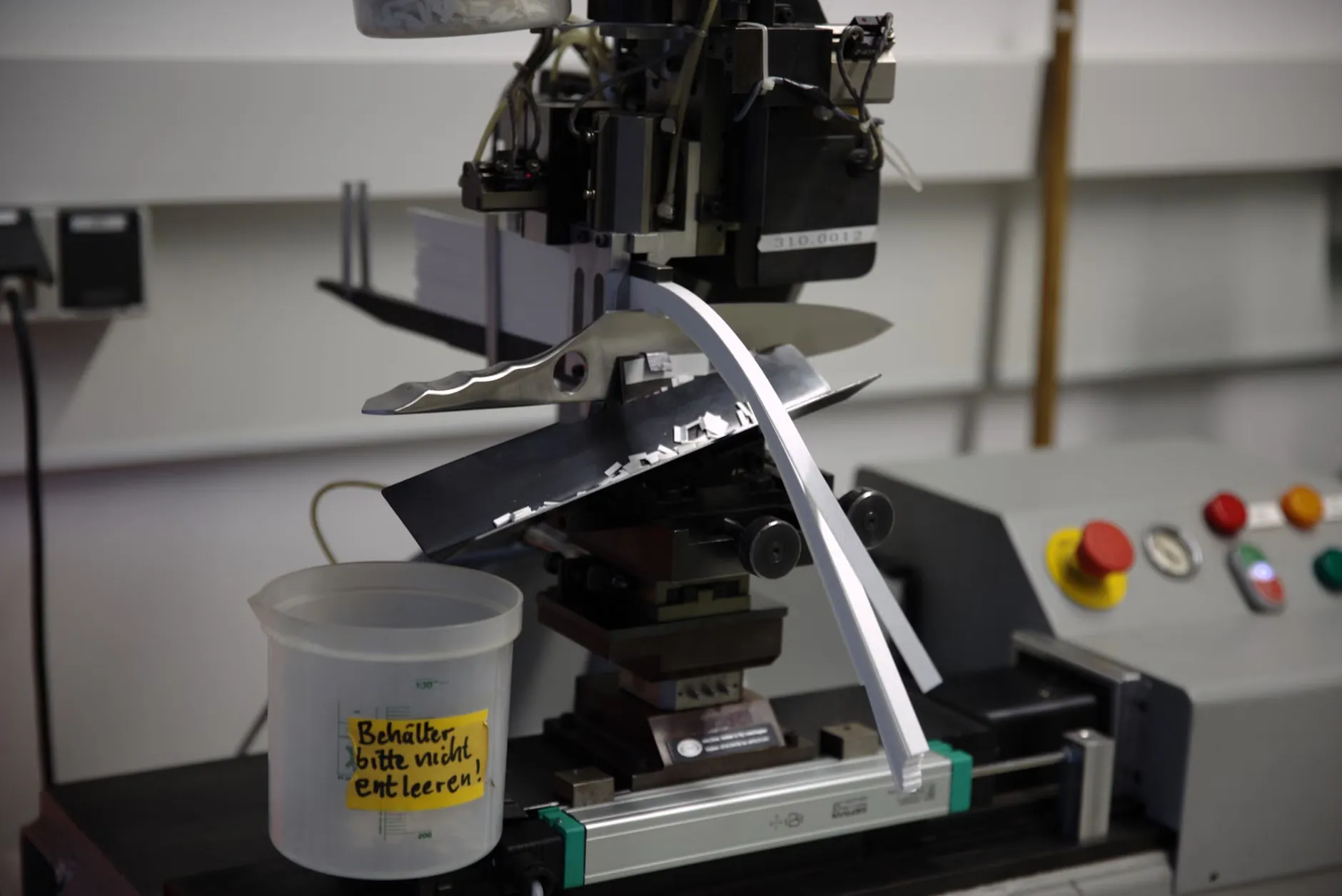
Composite wood panels — the plywood cores behind most vanities — put formaldehyde emission at the center of compliance. The benchmarks to know: E1 at ≤0.1ppm, California CARB Phase 2, and the federal TSCA Title VI rule. A report that says only “low formaldehyde” is not a report; it should name the regulation, the test method, and the measured value in ppm. MFBATH designs its vanities to meet E1 ≤0.1ppm, CARB Phase 2 and TSCA Title VI requirements, with low-VOC finishes. Still, verify the path for your target state, because state and federal rules do not always line up.
Hardware Cycle Life
Hinges and soft-close mechanisms fail more often than any other vanity component in the field. The common target is 100,000 open-close cycles, and the failure case above shows why conditions matter: at 45,000 cycles in humidity, hardware that passed a dry test gave out. Ask for the cycle count, the failure mode, and the temperature and humidity used during the run. If a factory cannot show humidity-conditioned cycle data, assume the number is a dry-bench number. MFBATH conducts soft-close hardware cycle life testing at the factory — factory data, useful for screening. For shipment-level evidence, have an independent lab repeat the test.
Finish Adhesion and Scratch Resistance
Bathroom finishes face cleaning chemicals, hard water, and bottle rings every day. The two report items to look for are adhesion — a cross-cut test scores how well the coating bonds — and scratch resistance. Low-VOC finishes meet emission goals, but a soft coating still scratches. Ask for the adhesion class and the test method, and compare suppliers on the same basis; “scratch-resistant” alone hides very different data.
Moisture Content and Water Resistance
Water is the reason most vanities fail in service. Two report angles matter: panel moisture content and water resistance. PVC cabinets are 100% waterproof and do not absorb water — a material property the report should state plainly. Plywood comes in grades — standard, BWR (boiling water resistant), and marine — and the report should name the grade used in your batch. A moisture percentage plus a soak or swell result tells you whether panels will warp in a damp room.
Structural Strength
Load tests matter most for countertops, shelves, and wall-mounted units. A structural report records the load applied, the deflection measured, and a pass/fail against the standard. If you buy floating vanities — the wall-mounted range at MFBATH runs 600-1800mm, or 24-71 inches — ask how the mounting system was loaded, not just the cabinet body.
Prioritize the tests by what actually fails in the field, not by what looks impressive on paper. For a PVC cabinet, hardware and finish outrank everything except formaldehyde; for a plywood cabinet, moisture and formaldehyde carry equal weight. If a supplier can only afford one test, that tells you something about its material confidence. A supplier that offers test documents proactively usually has nothing to hide — and the reverse is often true as well.
Vanity test types: what each covers and what to check on the report
| Test type | Standard family | What it covers | What to check on the report |
|---|---|---|---|
| Formaldehyde emission | E1 ≤0.1ppm; CARB Phase 2; TSCA Title VI | Emissions from composite panels in a sealed chamber | Named regulation, test method, measured ppm |
| Hardware cycle life | 100,000-cycle target | Hinge and soft-close durability | Cycles completed, failure mode, humidity and temperature |
| Finish adhesion and scratch | Cross-cut adhesion; scratch method | Coating bond and surface durability | Adhesion class, scratch result, test method |
| Moisture and waterproofing | PVC: 100% waterproof; panel moisture | Absorption, swelling, warping | Moisture percentage, soak or swell result |
| Structural strength | Load and deflection | Frame, shelf and mount capacity | Load value, deflection, pass/fail |
Reading a Lab Report Before You Accept It
Six elements should appear in every vanity third party lab test report you accept. The lab’s name and accreditation, the standard cited with its version, and a sample description matching your product come first. The test conditions, the numeric results, and an issue date with validity complete the set. Any one missing is a reason to ask for a corrected document, not a reason to shrug. The sample description is the most commonly faked part — a report that says “cabinet, plywood” does not tell you whether it tested your 24-inch model with your hinge.
Factory self-test report vs. third-party lab report
| Report type | Who runs it | What it proves | Red flags |
|---|---|---|---|
| Factory self-test report | Factory’s own QC (quality control) bench | Process control and internal pass/fail | No lab accreditation, no standard version, no batch reference |
| Third-party lab report | Independent laboratory (SGS, TÜV or another accredited lab) | Independent measurement against a published standard | Missing sample description, expired validity, no raw data |
In practice, the two are easy to tell apart. A self-test report usually carries the factory’s name or logo, no accreditation number, and simple pass/fail language. A third-party report names an independent body, cites the standard, and shows raw data with units. Watch for hybrids: factories sometimes pay a lab to test but write the summary themselves, and the original lab data is the document you actually want. If the supplier’s “third-party report” is a photocopy without a stamp, treat it as unverified.
Validity is the part buyers skip. Some reports get dated once and reused for years, and a formaldehyde report from last year’s plywood order says nothing about this order’s panels. Match the report date and batch reference to your production window — 20-30 days before shipment — and ask for the report that matches your batch. MFBATH supports third-party factory audits and inspections by SGS, TÜV and similar firms, arranged in advance, so you can name both the lab and the timing in the order confirmation.
You can verify a lab without leaving your desk. Most accredited labs publish their scope online, and the standard number on the report tells you which edition was current when the test ran. If the cited standard has been revised since, ask whether the report reflects the new edition. Accreditation scope matters more than the logo: a lab accredited for textile testing is not automatically accredited for formaldehyde chamber testing. Check the scope line, not the letterhead.
Source Vanities With Testing You Can Verify
Browse this product, solution, or service page to explore relevant offerings.

Sampling, AQL and Your Delivery Batch
Lab tests run on samples, never on every unit, and the sampling plan decides how much a report can tell you. ISO 2859-1 sampling is the framework: it defines inspection levels, sample sizes by lot size, and AQL (Acceptable Quality Limit) — the worst defect rate a lot can carry and still pass. AQL 1.5 is stricter than AQL 2.5; the number is the maximum tolerable defect percentage. When a supplier says “tested per AQL 2.5,” the plan accepted the defect rate — it did not verify every unit.

The gap buyers miss: a report covers the batch that was sampled, not your shipment. Three fields tie a report to your order — batch number, production date, and quantity covered. If your order is 15 sets per model, color and size — the MOQ at MFBATH — with production running 20-30 days, the report date should sit inside that window. A report from another customer’s order, another factory, or last year’s material purchase is decorative, not evidence.
Inspection and lab testing are complements, and both should be scheduled before you release money. The payment sequence at MFBATH is 30% deposit to start production, balance within one week after draft BL (draft bill of lading). The practical window for third-party pre-shipment inspection is during production, after your units exist and before they leave Qingdao under FOB (Free On Board) terms. That is why advance arrangement matters: SGS or TÜV inspectors book slots, and last-minute requests slip the 4-6 week delivery promise.
Put the sampling plan in writing and the ambiguity disappears. Specify general inspection level II under ISO 2859-1, state the AQL for critical, major, and minor defects, and require the inspector to record the lot size on the report. Mixed-container orders complicate this: the 15-set MOQ per model, color and size can produce several lots inside one container, and each lot deserves its own sample. A single report covering a whole container is usually too thin to be useful.
Questions to Ask Your Factory About Testing
Use this list as the testing section of your RFQ or order confirmation:
- Which accredited lab ran the tests, and can you send the original report with the lab’s stamp?
- Which standard versions are cited — E1 ≤0.1ppm, CARB Phase 2, TSCA Title VI, or others?
- Does the report cover my batch? Give me the batch number, production date and quantity tested.
- What were the test conditions — temperature, humidity, cycle count, load?
- Can you arrange an SGS or TÜV factory audit or pre-shipment inspection, and how many days of notice do you need?
- If a test fails or inspection finds defects, what happens — rework, retest, or replacement under the 2-year warranty?
- Will the tested sample use the same material grade, hardware and finish as my production units?
Watch what happens when you ask. A factory that hesitates on a simple question — which lab, which standard, which batch — is telling you the documentation does not exist yet. Testing can always be arranged after the contract, but the price, the timeline, and the leverage all change once the deposit is paid. With 30% down and the balance due within one week after draft BL, your negotiating position is at its strongest before the first payment, not after.
Timing the questions into the schedule is half the value. Samples take 10 working days, production 20-30 days, and US/Canada/Mexico delivery 4-6 weeks. If testing and inspection add two weeks of lead time, the numbers only work when planned before the deposit. The documents you should see before signing: our bathroom vanity compliance checklist lists them. For the EU side of the documentation chain, our article on CE marking for bathroom cabinets covers it.
A factory should also show a verifiable certification history and a willingness to let a third party in. MFBATH has held ISO 9001 and ISO 14001 since 2017, with validity re-confirmed in 2025, and holds CE and UL certification. Its products are designed to meet E1 ≤0.1ppm, CARB Phase 2 and TSCA Title VI requirements. What the factory does not do is claim third-party lab certification of its products — that claim belongs to the lab report, and you should hold the report in your hand. BIFMA furniture standards are worth citing in your own documentation, and the ISO 9001 overview explains the management framework behind factory audits. For a deeper read on vetting quality systems, see our profile of the ISO 9001 bathroom vanity manufacturer.
Frequently Asked Questions
Can I rely on a factory’s own test report instead of a third-party lab report?
A factory self-test report is useful process evidence, but it is not independent proof. A third-party report names an accredited lab, cites the standard, and shows raw data. Use the self-test for screening; require the third-party original for your compliance file.
Does a third-party lab report cover my entire order or just the tested batch?
It covers the sampled batch, not your whole order. Check the batch number, production date and quantity on the report and match them to your order. With MOQ of 15 sets and 20-30 day production, the report should fall inside your production window.
How much lead time do I need to arrange SGS or TÜV inspection?
Arrange it in advance — the factory’s stated requirement. Budget sample delivery at 10 working days and production at 20-30 days, then place the inspection request inside the production window so results are ready before the 4-6 week delivery clock starts.
The Bottom Line
Treat a third-party lab report as batch evidence, not brand decoration: verify the lab, the standard version, the sample description, the conditions, the numbers, and the date. Match the report to your batch, schedule SGS or TÜV inspection inside the 20-30 day production window, and confirm the documentation before paying the 30% deposit. Ask the questions, keep the originals, and your 2-year warranty will have paperwork behind it when a claim comes.




0 Comments