

How do you verify soft-close hardware quality before a $50K order goes sideways? That’s the question buyers ask after the pre-production sample closes like silk and the mass production run sounds like gravel in a coffee can. The standard answer — ‘we tuned the damper for the sample’ — usually means the opposite: the spec changed after approval.
The visible parts look identical. Same hinge cups, same slide rails, same screws. What changes is the steel gauge and the damping alignment, and neither one shows up in a product photo. When sample approval covers appearance and a few hand-cycles, you’ve approved the cabinet, not the hardware. The squeak shows up in month nine, after the vanity is installed in a 40-room hotel and the warranty cost lands on your side of the contract.
This is a tolerance problem, and it tends to surface when FOB pricing gets squeezed. A supplier trims 0.2mm off the hinge cup steel or swaps the damper oil for a thinner grade, and the savings go straight to their margin. You won’t catch it in the quote or the sample photo — you catch it in the cycle test report and a simple bend test. The good news: you don’t need a factory visit to run those checks.
You can verify soft-close hardware quality with the same evidence a competent QC department uses. Cycle test certificates, salt spray results, and five-minute physical checks that reveal metal thickness and damping consistency. For bathroom hardware, the minimums are clear: 80,000 cycles or more, 48 hours of salt spray resistance minimum for indoor use, and a damping test performed under real door weight. Focuscabinet pre-tests its soft-close hinges and slides to 100,000 cycles and includes the test video with its sample packs — a useful baseline for what transparent suppliers should hand over without pushback.
The six steps below function as a bathroom vanity hardware procurement checklist: request the documents first, then run the physical tests on the samples. Skip them, and you’re not saving time — you’re moving the failure from the factory floor to an installed project, where replacement costs multiply and the delay hits your schedule. Run them once, and the next order rests on evidence rather than trust.
Step 1: Request Cycle Test Certificates
A certificate only proves the sample passed — verify the model number matches what ships.
Most procurement teams treat a cycle test certificate as a checkbox. Here is the flaw: a certificate proves one sample survived lab conditions, not that the 5,000 hinges in your container share the same steel thickness, spring tension, and damper. First, check traceability. The model code on the certificate must match the model code in your quotation and on the packing list. If it does not, the report is decorative.
Next, read the test parameters rather than the verdict line. Bathroom hardware tests follow EN 15570 for hinges and EN 15338 for drawer slides. Confirm the report states the test load, cycle rate, and pass criteria — how much sag is allowed before failure. A slide tested at 10 kg tells you nothing about real bathroom drawers carrying 30 kg. Verify the report number against the issuing lab’s portal; an ISO 17025-accredited lab gives you something to stand on. And check the date — a five-year-old certificate for a discontinued model is common supply-chain theater.
-
- Cycle floor: 80,000 cycles is the accepted endurance benchmark for bathroom cabinet hardware. Since dampers degrade faster in humid environments, treat 80,000 as the minimum and require the soft-close function to remain fully intact at the end of the test — not just the mechanical joint.
- Failure mode: A hinge that completes 80,000 cycles without its damping cylinder engaged ran half the test. The report must state whether the soft-close mechanism was active for the full run.
- Traceability risk: A certificate with no batch number, production date, or accredited lab is not evidence — and it removes your legal recourse if the shipped batch fails on site.
Practical shortcut: ask the supplier to send a video of the cycle test running, not a PDF summary. Focuscabinet’s pre-tested DTC hardware includes a recorded cycle test of 100,000 closes for the exact hinge model you are quoted. If a supplier hesitates to show the test live, that hesitation is your answer.

Step 2: Ask for Salt Spray Test Results
A salt spray report without hours, a rating, and sample photos is not a test — it’s a marketing PDF.
Salt spray testing is the fastest way to predict how a soft-close hinge or drawer slide will hold up inside a bathroom, where humidity, cleaning chemicals, and temperature swings attack the finish daily. The standard most suppliers cite is ASTM B117 or ISO 9227: a 5% NaCl mist at 35°C for a defined period. For indoor bathroom hardware, 48 hours is the commercial baseline. If you’re sourcing for a coastal market, a hotel property, or a facility with heavy cleaning regimens, specify 72 hours instead. The extra 24 hours exposes weak pretreatment and plating thickness issues that look fine at 48 hours.
Read the report the way a metallurgist would. Look for the duration, the standard used, the sample description, and the corrosion rating. Rating scales follow ASTM D1654 or ISO 10289, from 0 (total surface failure) to 10 (no visible attack). For 48 hours, a rating of 9 is the minimum threshold. That means a few tiny corrosion spots at the scribe mark, no red rust on edges or fastener holes, and no blistering of the coating. If the report shows red rust on a cut edge or hinge cup rim, the surface treatment failed — not cosmetic staining, but substrate corrosion.
-
- Rating 9-10:: Micro-corrosion at the scribe only. Acceptable for residential bathroom or commercial projects.
- Rating 7-8:: Localized corrosion at the scribe, no edge rust. Acceptable only for dry, well-ventilated bathrooms with low daily use.
- Rating 6 or below:: Visible red rust on edges or drilled holes. Reject — this hardware will fail within a year in a real bathroom environment.
One hard rule: never accept a summary line like “Passed 48h salt spray.” Demand the full report PDF, the rating, and photos of the actual test samples. Most soft-close hinges and slides are cold-rolled steel with an electroplated or powder-coated finish — there, salt spray performance is the difference between a 5-year project and a 12-month callback. If the supplier claims 304 stainless steel, salt spray matters less because the steel itself resists oxidation, but confirm the grade on the certificate — cheaper grades with a “stainless-looking” coating show up quickly in this test.

Step 3: Perform a Bend Test on Hinge Cups
One mallet swing and a caliper will tell you more than any hinge spec sheet.
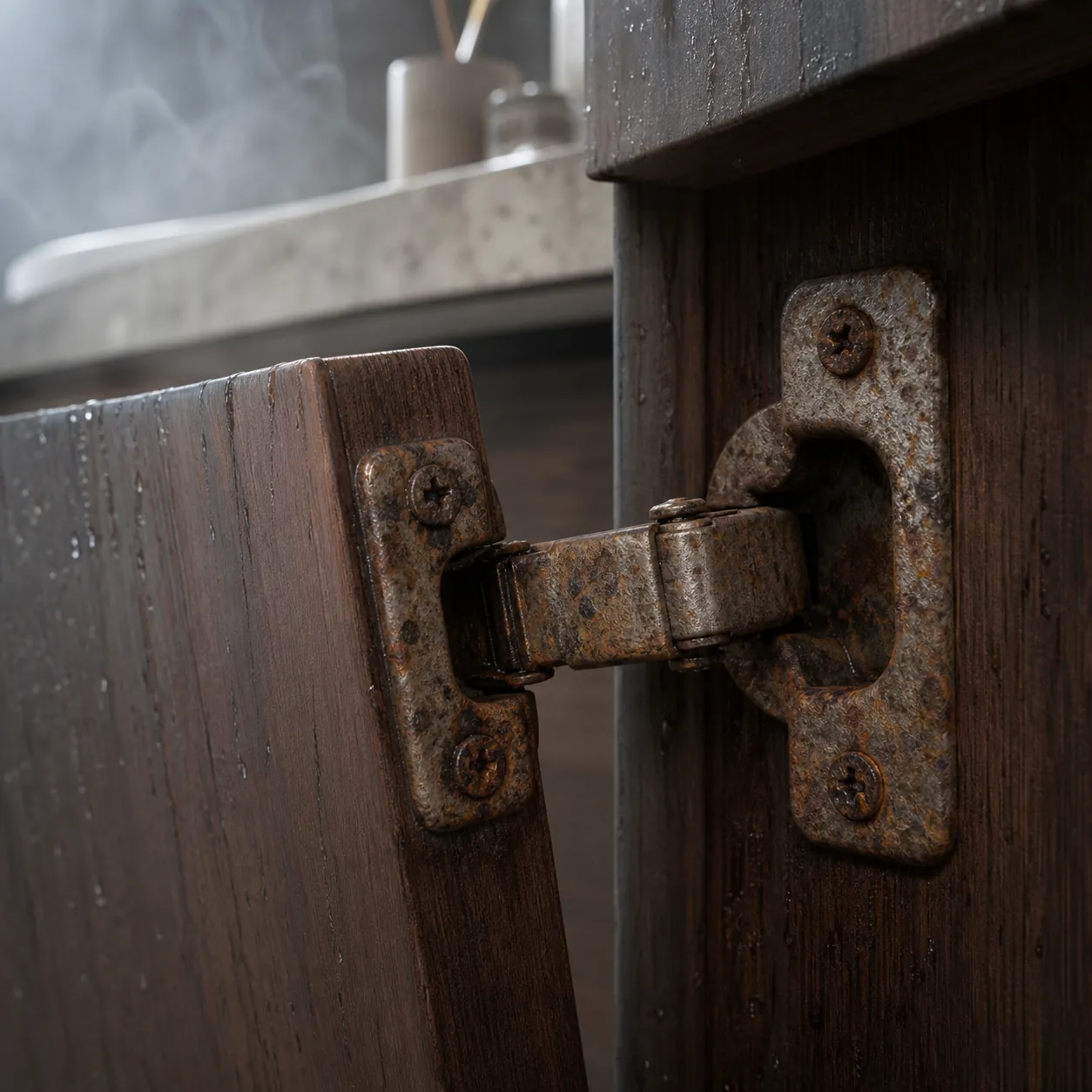
The hinge cup is the cylindrical metal piece that recesses into the cabinet door. Every supplier lists a steel thickness on the quotation, but the number on paper only matters if it matches what is actually being stamped. A bend test is the fastest way to confirm real hinge cup metal thickness before your container leaves the factory.
-
- Thickness: 1.2mm steel keeps screw threads seated and resists flexing when doors are slammed. 1.0mm steel is acceptable for light MDF doors, but in continuous-use bathrooms it starts to squeak when the cup flexes on its own mounting screws.
- Batch comparison: Bend one hinge from the pre-production sample and one pulled at random from a sealed production carton. If the production cup measures 1.0mm while the approved sample measures 1.2mm, your batch quality is not stable — and the variation will appear across the whole order.
- Plating check: After the deformation, inspect the zinc coating at the bend point. Cracks or flaking expose raw steel and turn into corrosion around the screw holes within months in a damp bathroom environment.
This test is not about damaging a hinge for fun. It is about catching the difference between the approved sample and the mass production run before you commit to a purchase order. A supplier who will not sacrifice one hinge from the batch for a 15-second verification is telling you exactly how much confidence they have in their steel.
Step 4: Test Soft-Close Damping Consistency
Finger-push tests prove nothing — mount the door, add 10 kg, and watch the last 40 mm of travel.
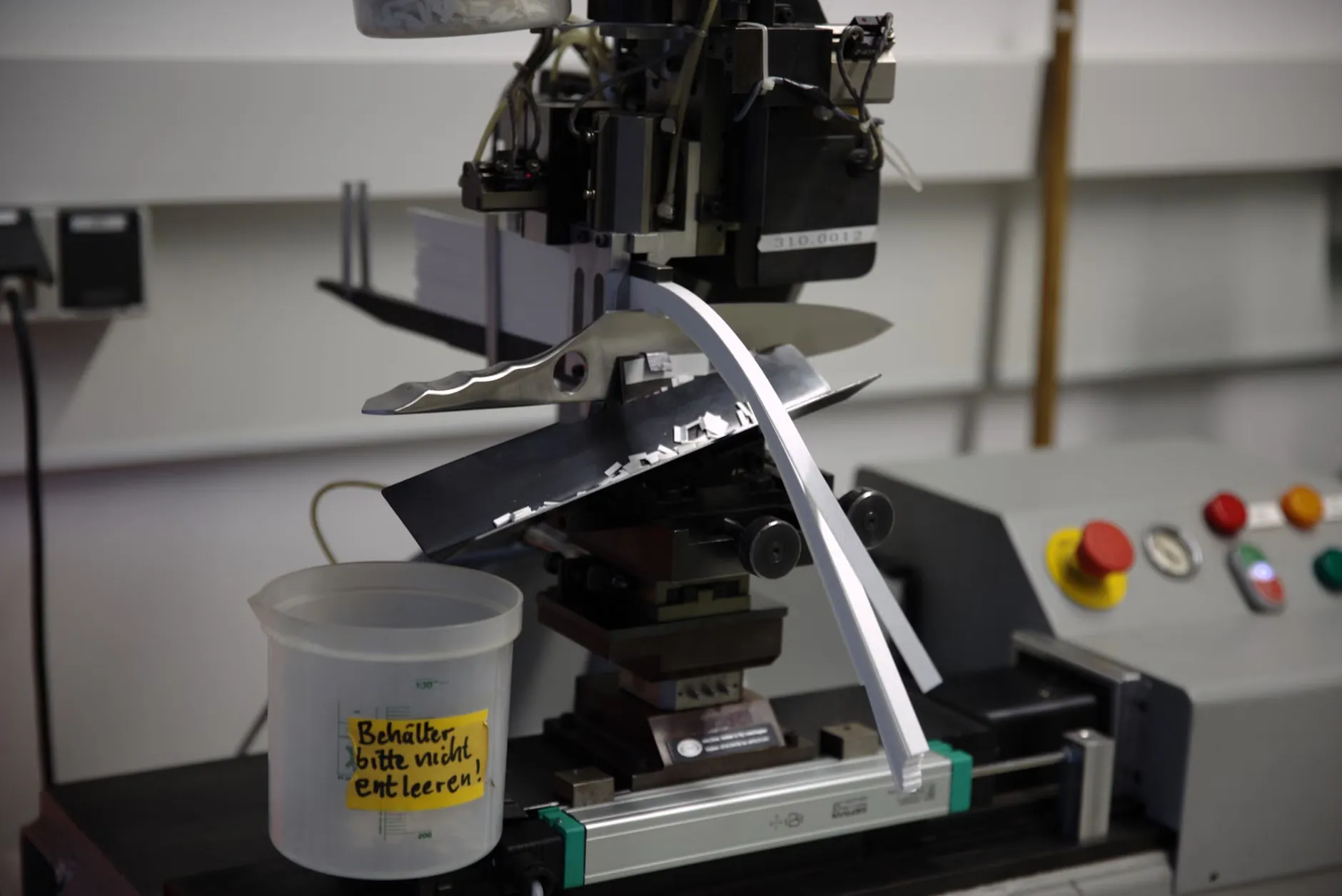
The showroom finger test is not a procurement test. Your hand applies variable force, so a damper that feels fine on an empty cabinet door can fail completely once mounted on a 12 kg mirrored vanity door — the exact scenario that generates callback complaints six weeks after installation. A proper soft close damping mechanism test procedure uses a fixed deadweight: mount the hinge or slide exactly as it will sit in production, attach a 10 kg load to the drawer or door panel, open fully, and release.
Watch the final 30–40 mm of travel. The damper should decelerate the load in one smooth motion and settle into the closed position without bouncing. If the door rebounds, the valve spring is too weak for that weight. If it hisses and then slams, the piston seal is leaking air. Run 20 consecutive cycles and compare the closing time across all of them — consistency under repetition is the metric that predicts whether that hardware survives its 80,000-cycle minimum.
-
- Closing-time drift: If the door takes 4 seconds on cycle 1 and 2.5 seconds on cycle 20, the damping oil is degrading or the valve is losing seal. Reject that batch before it reaches production.
- Weight-range match: Hinges and slides are rated for specific loads. A damper tuned for a 6 kg door will stall or close incompletely on a 12 kg door. Demand the rated weight range in the spec sheet and verify it against your actual door mass.
- Temperature sensitivity: Low-grade damping fluid thickens at 5°C and thins at 40°C. If your project ships to both cold-climate and tropical regions, test the sample at both temperatures — the closing time will tell you which supplier did the engineering.
- Bounce-back check: The door must settle without rebounding. A visible bounce means the damping force is insufficient for the load, and every unit in that batch will behave identically.
For B2B soft-close slide pre-order verification, a recorded cycle-test video carries more weight than a scanned PDF. Focuscabinet ships sample packs with pre-tested DTC hardware and a video of 100,000 closes, so you can watch the mechanism under load before committing to a container. A sample pack costs a fraction of the first rejected shipment.
Step 5: Inspect Drawer Slide Rail Smoothness
A slide that glides smoothly empty can bind at 20kg.
Run the drawer slide load capacity test at 20kg, not at empty weight. In a project scenario, a stocked vanity drawer carries 15–20kg once towels, a hairdryer, and cleaning supplies are inside. A slide that feels smooth with zero load will often bind, grind, or deflect when that weight sits on the rails. This is the most revealing 60-second check in the entire B2B soft-close slide pre-order verification process.
-
- Rail deflection: Thin steel (below 1.2mm) bows at the midpoint of travel. You will feel a scrape or a notch when the drawer passes the bend, and that bend worsens with humidity.
- Bearing cage alignment: A misaligned or low-ball-count cage turns gritty under load. A healthy slide at 20kg should have zero gravel feel at any point in the stroke.
- Damping handoff: The soft-close piston must catch the drawer in the final 30mm and pull it in without bounce. If it cannot handle the momentum at 20kg, the damping cylinder is undersized for the rail.
Most supplier showrooms demo slides with a 10kg deadweight — it is a practical field test, and Focuscabinet’s sample packs are built so distributors can simulate the feel that way. But 10kg will not expose a rail made from 1.0mm steel. A 20kg load will. For any project spec, insist on the 20kg dynamic test and note the result in your bathroom vanity hardware procurement checklist.
After the load runs, grip the open drawer at the front corners and twist left-right. Lateral play above 3mm means the bearing cage is loose or the left and right rails are mismatched — a common issue when a factory batches slides from different suppliers. That 3mm of play will generate a scraping noise within a year of daily use, and it is the kind of defect that triggers architect rejection on a completed project.

Step 6: Verify Finish Under Magnification
A 10x loupe costs less than the sample’s shipping — it will save you from accepting a finish that fails in year.
Sample approval tells you what a part looks like when everything goes right. Mass production reveals what a factory tolerates. For soft-close hinges and drawer slides, the fastest way to expose that tolerance is a 10x jeweler’s loupe. You are not looking for beauty; you are looking for the exact points where corrosion starts and coating separates.
Move the loupe across flat surfaces, stamped edges, mounting holes, and the hinge cup interior. Work through three failure modes, and reject the batch if any of them show up on more than 1% of the pull.
-
- Pitting: Look for red, brown, or black dots 0.1–0.5mm wide. These are craters left by impurities in the plating bath. A pit on the hinge cup wicks humidity straight to the steel. Even if the pre-shipment sample passed an ASTM B117 salt spray check, pitting on the production run will cut service life by roughly a third in coastal climates.
- Adhesion: Scrape a hardened pick across an inconspicuous area of the hinge arm and slide rail. If the plating flakes or rolls up, the base metal was not activated before the topcoat was applied. Poor adhesion means the finish will detach at flex points — exactly where the damping mechanism absorbs force. Reject the lot if any flaking appears within 2mm of the mounting screw holes.
- Edge coverage: Stamped parts have shear edges where plating deposits thinner. Check cut-outs and radius corners at a 45-degree angle. Bare steel showing at the edges will rust in humid rooms before the first maintenance cycle. A field test: wipe the edge with a copper sulfate solution — a red deposit confirms exposed steel.
Do not overlook the steel gauge during the same inspection. A hinge cup stamped from 1.2mm steel holds the plating layer far better than a 1.0mm cup because thicker steel flexes less and does not microcrack the finish after six months of use. Suppliers who pre-test hardware at 100,000 cycles and send sample packs with the same installed hardware make your audit easier. You still inspect every incoming lot, but you are checking for manufacturing drift rather than gambling on a supplier’s promises.
Conclusion
Before you commit to a bulk order, run these three yes/no checks against your supplier. First: can they produce a soft close hinge cycle test report showing at least 80,000 cycles, ideally with a video of the actual test run? Second: will they share salt spray test bathroom hardware results covering a 48-hour minimum exposure, with the corrosion rating written in plain language? Third: can you physically verify the hardware in-hand — bend test hinge cup metal thickness with a mallet, run a drawer slide load capacity test with a 20kg deadweight, and inspect the finish under a magnifying glass?
If any answer comes back vague, treat that as a red flag. The 1.2mm steel cup and consistent damping mechanism test procedure are what separate a 10-year hinge from a 2-year headache. Review current product offerings on the Focuscabinet catalog page to compare documented hardware performance before you finalize your bathroom vanity hardware procurement checklist.
Frequently Asked Questions
What should I check in hinge test certificates?
Confirm the certificate lists the exact hinge model you are ordering, not a similar sample. Look for an independent lab report showing at least 80,000 open-close cycles for bathroom cabinets. Match the model number before trusting any test report.
Why require salt spray test results?
Salt spray testing verifies corrosion resistance in humid bathroom environments, where cheap hinges rust fast. Demand a report with exposure hours, a corrosion rating, and photos—a sheet without those details is not a test. Treat 48 hours as your minimum indoor benchmark.
How can I field-test soft-close hardware quality?
Do a bend test on hinge cups with a mallet and caliper to check metal thickness and deformation. Then open and close the door repeatedly to see whether damping stays smooth from start to. If damping catches or slams, reject the batch.
How do I test soft-close damping consistency?
Open and close the door with added weight and feel whether the damper engages smoothly without sticking or noise. Good dampers stay consistent over multiple cycles; weak ones catch or slam in the. Run at least 20 cycles before approving the sample.
What cycle count proves soft-close hinges are durable?
Look for an independent test certificate showing at least 80,000 open-close cycles. For high-use bathroom cabinets, that is the accepted benchmark—anything lower is a red flag. Ask for the lab report, not the brochure.




0 Comments