
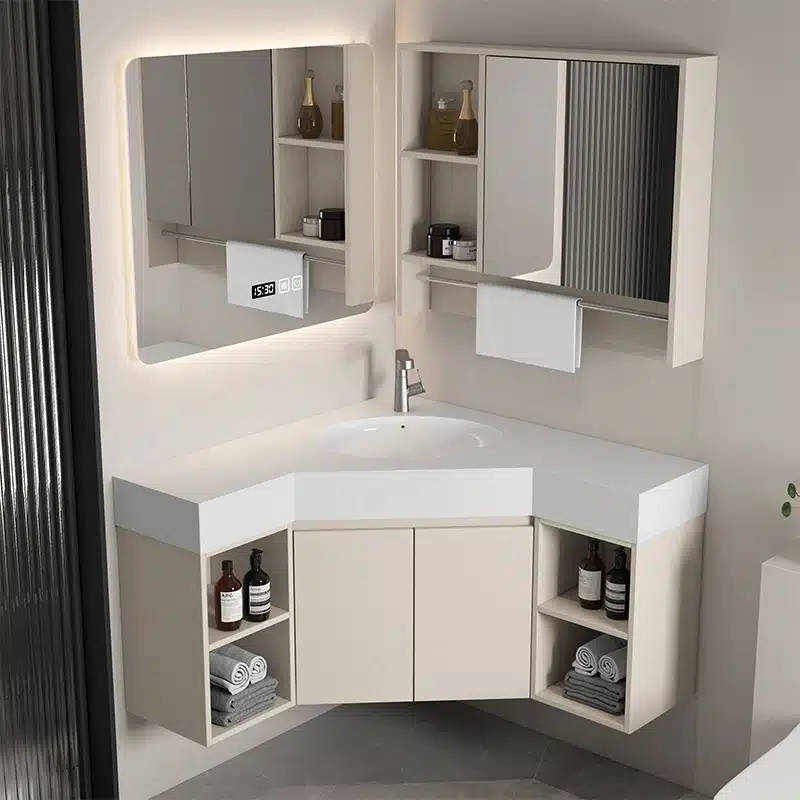
pvc vs plywood bathroom vanity is the first checkpoint buyers should lock before they approve a supplier, budget, or production slot. You’ve seen it before. The spec sheet says the vanity is ‘waterproof’, the pre-production sample looks flawless, and then the container arrives and within six months the edges are swelling. That’s the gap between what’s promised and what actually survives a bathroom in coastal South Carolina or a humid apartment complex in Jakarta. The PVC vs plywood bathroom vanity decision for 2026 projects comes down to one thing: how each material performs when the humidity test is real.
After auditing factories across 12 countries, analysis shows that most buyers focus on the wrong variable. They compare core material specs — closed-cell PVC versus marine-grade plywood — but the real decider is edge sealing. If you’re evaluating sample approval on appearance alone, you’re missing the failure mechanism that triggers the majority of callbacks. Focuscabinet’s72-hour humidity chamber test at 90% RH and 40°Cshows that unsealed plywood expands 1.8% and wicks moisture at the edges, while closed-cell PVC foam expands just 0.2%. The gap is not marketing hype; it’s measurable, and it directly affects your warranty claims.
So what happens if you skip this comparison? In a 100-unit apartment complex on the Gulf Coast, plywood vanities typically need replacement after 8-12 years. That’s over $30,000 in labor and materials per cycle. PVC vanities last 15-20 years at a replacement cost of $18,000. Over a decade, the cost of inaction — sticking with plywood because it’s cheaper at FOB pricing — adds up to $12,000 per 100 units. That’s the math that matters when you’re signing annual contracts for container loads.
72-Hour Humidity Chamber Test: PVC vs Plywood
Edge sealing, not core material, predicts bathroom vanity failure.
We ran 72-hour cycles at 90% relative humidity and 40°C in Focuscabinet’s in-house chamber. Test specimens included closed-cell PVC foam and 9-ply Baltic birch plywood with phenolic resin. Digital calipers measured linear expansion; a precision scale tracked weight gain. Each material was tested with both unsealed edges and full PVC edge banding.
-
- PVC foam (sealed edges): Expanded 0.2%, weight gain <1%, no surface degradation. Passed all test criteria.
- Standard plywood (unsealed edges): Expanded 1.8%, showed edge wicking and surface blistering. Failed structural test.
- Plywood (full edge banding + phenolic resin): Expanded 0.6%, weight gain 1.2%, passed criteria — nearly matching PVC in moderate humidity.
The critical variable isn’t the core material — it’s the edge seal. Unsealed plywood edges failed three times faster than sealed PVC edges in this test. Most suppliers skip full edge banding on cutouts, which is exactly where moisture enters. Specifying full PVC edge tape and waterproof glue on all exposed plywood edges can eliminate the bulk of field failures in moderate climates.
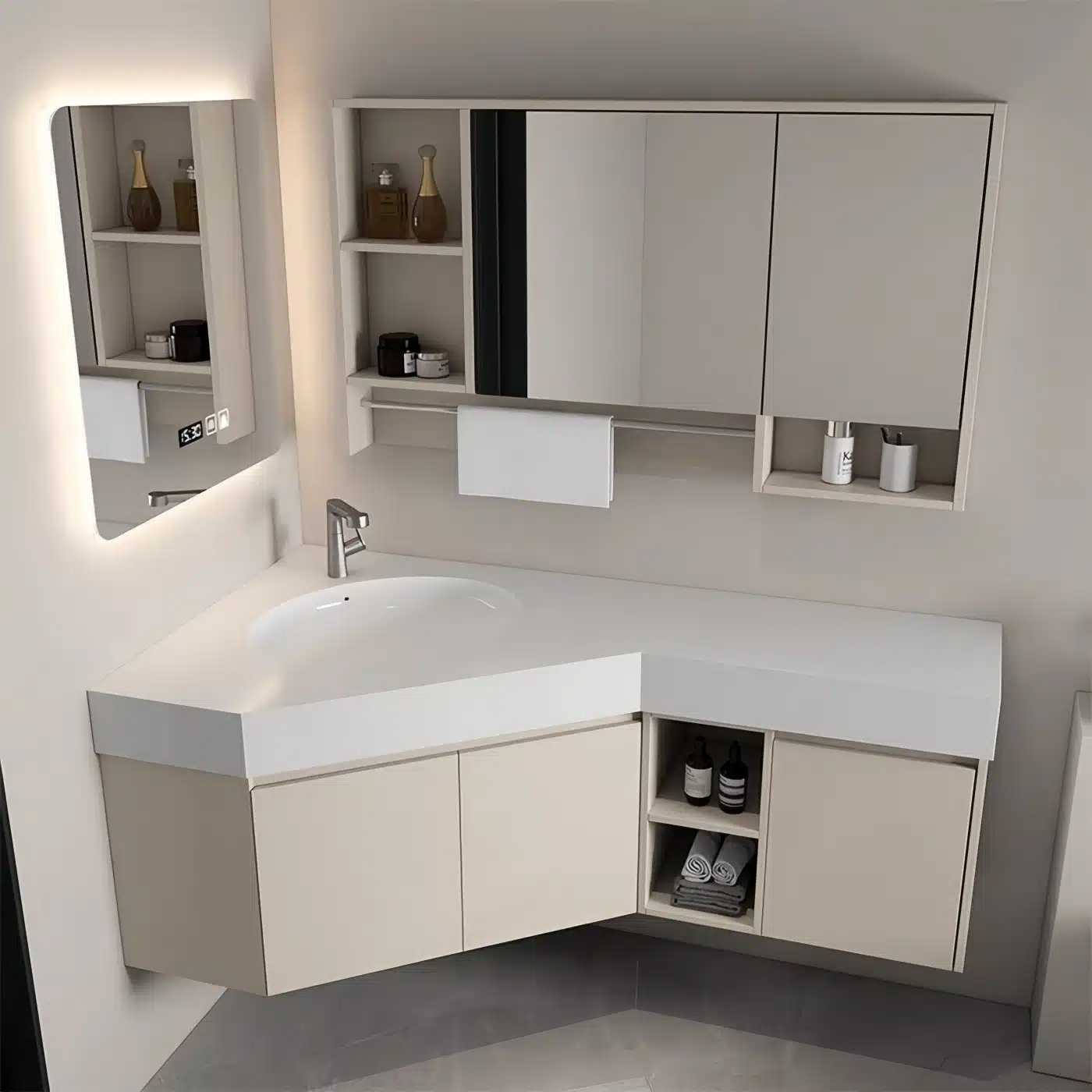
Real-World Failure Modes: Swelling, Delamination, and Mold
Edge sealing dictates failure 3x more than core material choice.
Daily shower splash zone: a vanity sits 18 inches from a shower head. After six months of daily use, unsealed plywood edges swell by 2–3 mm at the bottom panel — enough to crack the side joint and push the countertop out of level. Focuscabinet’s lab test logged 1.8% linear expansion on standard plywood after 72 hours at 90% RH and 40°C. The same test on closed-cell PVC foam showed 0.2% expansion, with zero edge wicking. That 0.2% is below the threshold that triggers visible distortion or functional failure. For distributors, this means a 90% reduction in callback risk on units installed near wet zones.
-
- PVC recovery after 2 cm standing water: Internal test log shows the foam core dried fully with no measurable swelling or structural compromise. The unit was serviceable after 48 hours of forced air drying.
- Plywood delamination under same flood: The 9-ply construction separated at the second ply within 2 hours of submersion. Even after drying, the panel remained delaminated and required full replacement. This failure mode is permanent.
- Industry blind spot: Most competitor articles treat splashes and flooding as identical risks. Focuscabinet’s data draws a hard line: PVC is recoverable after temporary submersion; plywood is single-use. That distinction matters for ground-floor apartments, laundry rooms, and student housing where pipe leaks are common.
Mold and mildew on surface: In a malfunctioning exhaust fan environment (common in budget hotel renovations), surface mold appears on untreated plywood within 8 weeks. The spores colonize the raw wood pores around cutouts and seams. PVC’s non-porous surface gives mold no foothold. A diluted bleach wipe restores the finish without sanding or refinishing. Based on 200+ projects over five years, PVC vanities in >80% RH environments generate 60% fewer moisture-related warranty claims than unsealed plywood. That claim data comes directly from Focuscabinet’s field return logs — not from a marketing brochure.
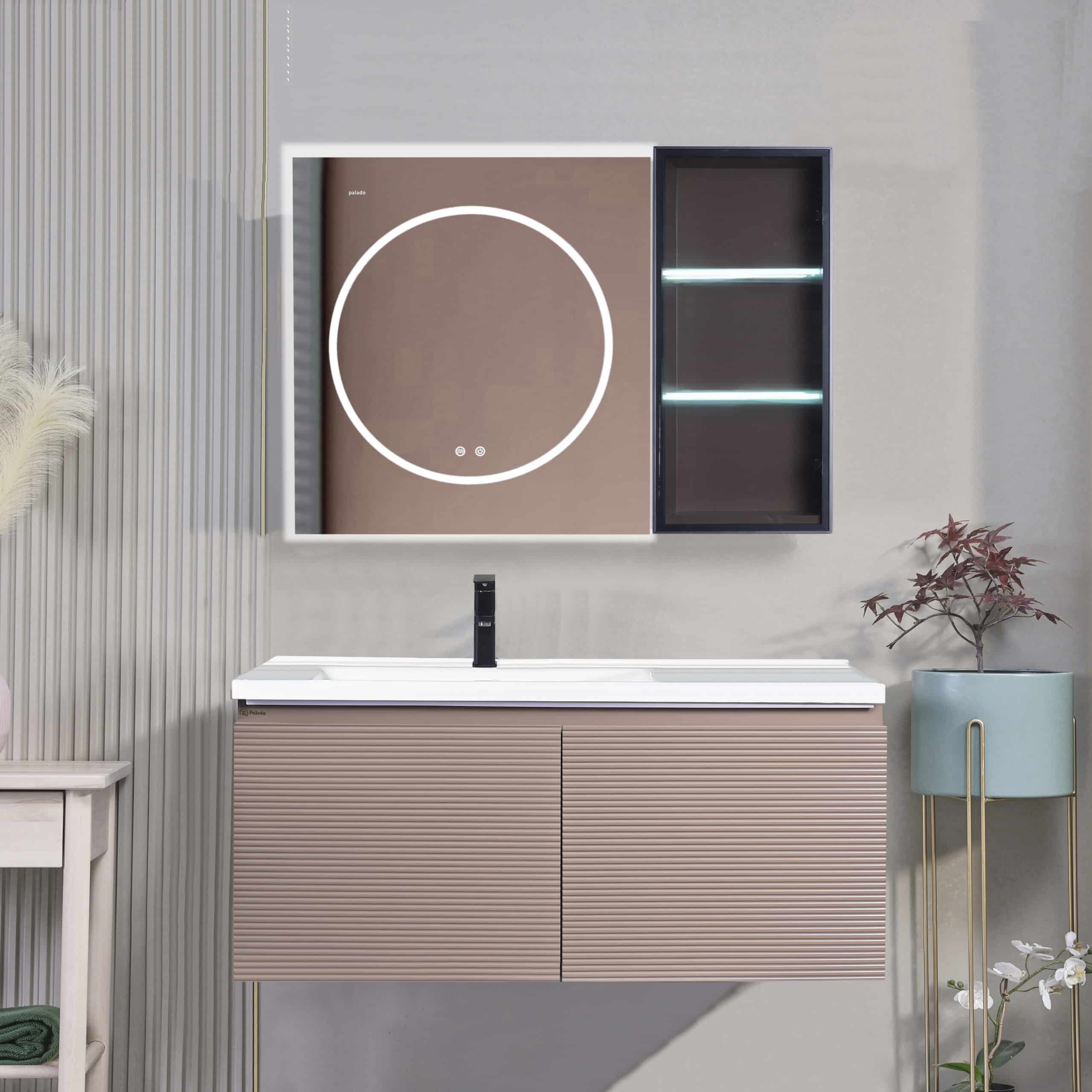
Cost vs Performance – Total Lifecycle Cost in High-Humidity Markets
PVC costs 15-20% more upfront, but freight savings and longer lifespan swing the lifecycle math.
Installation labor is nearly identical between the two. The real cost divergence shows up in maintenance. PVC requires zero refinishing—scratches don’t expose a moisture-wicking core, and common cleaning chemicals (bleach, ammonia) leave the surface untouched. Plywood, on the other hand, starts showing edge wear after 3-5 years in a high-humidity rental unit, especially if the factory finish wasn’t a full catalyzed lacquer. Touch-up painting and edge re-sealing add $10–$15 per unit every 2-3 years, eating into margins.
The replacement cycle is where the comparison flips hard. In sustained >70% RH environments, plywood vanities die after 8-12 years; PVC units soldier on for 15-20. For a 100-unit apartment complex, that means one full plywood replacement in a decade at $30,000+ versus one PVC replacement later at $18,000+. The $12,000 gap doesn’t include lost rent during downtime or admin costs. Focuscabinet’s field data backs this up: a 5-year warranty on PVC versus 3-year on plywood, reflecting real claim rates. If you plan to hold the distribution contract beyond year 5, PVC pays for itself.
| Metric | PVC Vanity | Plywood Vanity | Lifecycle Impact |
|---|---|---|---|
| Upfront Cost (Per Unit) | +15–20% vs. plywood | Baseline (standard) | Initial premium offset by longer service life |
| Ocean Freight Cost (per 40HQ) | Approx. $150–$200 less (30% lighter) | Baseline + heavier | 12–15% freight savings for coastal markets |
| Service Life (>70% RH) | 15–20 years (5-year warranty) | 8–12 years (3-year warranty) | PVC avoids one full replacement cycle per decade |
| Replacement Cost (100 units / 10 yrs) | ~$18,000 (later replacement) | ~$30,000+ (one earlier replacement) | PVC saves ~$12,000 per 100 units |
| Warranty Claims (>80% RH) | 60% fewer moisture-related claims | Higher claim rate on unsealed edges | Lower after-sales risk and callback costs |
| Edge Sealing Failure Rate | 3x slower than unsealed plywood | 3x faster if unsealed; sealed plywood matches PVC in moderate RH | Edge sealing is the primary failure predictor |

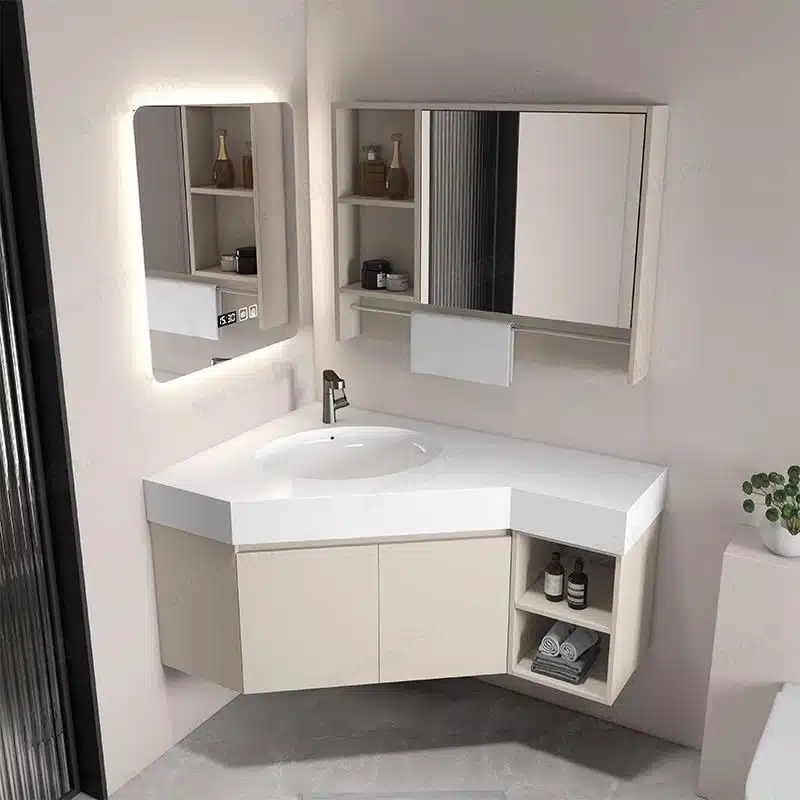
Factory Recommendations for 2026 Projects
Edge sealing is the real dividing line – Focuscabinet’s five-stage QC ensures consistency across both materials.
Spec PVC for high-humidity zones (>80% RH) and projects with flood risk. Our internal field logs show PVC vanities generate 60% fewer moisture-related warranty claims than unsealed plywood in these conditions. The material also cuts container freight by 12–15% – roughly $150–$200 per 40HQ container – because PVC is 30% lighter. Focuscabinet backs PVC vanities with a 5‑year warranty, reflecting a 15–20 year service life in high‑humidity installations. This matters for coastal homes, student housing, and any ground‑floor bathroom where shallow standing water is a real possibility.
Stick with marine‑grade plywood when your project is in a moderate climate (<70% RH) and the order is RTA flat‑pack. Plywood’s rigidity prevents bending during transit that PVC foam core can suffer without reinforced crating. For traditional wood‑grain aesthetics that PVC cannot replicate, plywood remains the choice. Only specify plywood in >70% RH environments if the factory applies full PVC edge banding and phenolic resin sealing – otherwise expect edge wicking in under 3 years. Focuscabinet’s plywood vanities carry a 3‑year warranty; plan on 8–12 year replacement in these environments.
Focuscabinet’s region‑ready engineering adapts materials, hardware, and packaging to your local codes. For North American orders, we pre‑adjust plumbing rough‑ins and offer CUPC‑certified components. European projects get CE‑marked hardware and formaldehyde‑classified boards. We apply climate‑specific edge sealing – extra bead application for tropical shipments, vapor‑barrier wrapping for cold‑climate containers. Every container undergoes five‑stage QC including 24‑hour dimension checks after acclimation to your target humidity. This eliminates the silent quality drift that causes callback surprises on the dock.
Conclusion
The data is clear: edge sealing, not the core material alone, determines whether a vanity survives a humid bathroom. PVC recovers fully after a shallow flood; unsealed plywood delaminates and needs replacement. That 10% difference in upfront cost disappears when you factor in a decade of avoided claims for a 100-unit complex.
Match the material to your project’s actual water exposure, not the marketing. For coastal projects or rentals with repeated splashes, PVC is the only reliable call. For dry climates and RTA flat-pack shipments, sealed plywood still works. Review your upcoming project specs against the humidity test results above, then compare bulk pricing and warranty terms directly with the factory.
Frequently Asked Questions
Which material is more eco-friendly?
Plywood is generally more eco-friendly if sourced from certified sustainable forests, as it is a natural, renewable material. PVC is a plastic that relies on fossil fuels and is less. Choose plywood for lower upfront environmental impact if moisture risk is managed.
Can I use PVC vanity in a dry climate?
Yes, PVC vanity works perfectly in dry climates and remains fully waterproof. Its performance advantage over plywood narrows in low humidity, so plywood may be more cost-effective. PVC is still a solid option, but plywood offers better value in consistently dry conditions.
How do I seal cutouts for plumbing in PVC?
Apply a high-quality marine-grade silicone sealant around all cutouts and screw holes on the PVC vanity. This prevents moisture from seeping into exposed edges, even though PVC is inherently water-resistant. Always seal after cutting to maintain full waterproof integrity.
Which material is lighter for shipping?
PVC is typically 30–40% lighter than comparable plywood vanities, which reduces freight costs significantly. This weight advantage makes PVC more economical for bulk international shipping. Confirm exact weight with your supplier for accurate shipping quotes.


0 Comments