

bathroom vanity material mistakes is the first checkpoint buyers should lock before they approve a supplier, budget, or production slot. A distributor I know has been importing for fifteen years. He still paid $5,000 extra on FOB pricing last quarter because the quality tolerance between his pre-production sample and the final bathroom vanity container didn’t match. The spec sheet said “solid wood.” The container arrived with drawer boxes that warped within three weeks of hitting a coastal warehouse. This is the gap that most bathroom vanity material mistakes live in—the space between what the factory promises on paper and what actually survives a humid shipping lane and a customer’s bathroom.
The spec sheet is not your friend. It tells you what the factory intends to build. It doesn’t tell you whether the edge banding will peel after six months in a rental property bathroom, or whether that “E1” board will still meet emission limits after sitting in a sealed container for four weeks. The sample approval stage is where you either catch these problems or sign off on them. Miss it, and you’re not just buying vanities. You’re buying warranty claims, return shipping costs, and a conversation with your biggest client about why the hotel bathroom cabinets are swelling at the base.

Skip the material due diligence on your next order, and the cost of inaction shows up fast. You’ll see it in the 60% return rate that comes from moisture-damaged, unsealed edges. You’ll see it when a batch labeled “E1” drifts past safe limits after six months in humid storage. You’ll see it in the replacement order you have to place at full cost because your original supplier’s warranty doesn’t cover “improper climate storage.” The five mistakes below are the ones that turn a profitable container into a loss. Fix them before the production line starts, and you keep your margin. Let them slide, and the next container’s chargeback eats your profit for two months.
Mistake 1: Assuming All ‘Solid Wood’ is Moisture-Proof
Most ‘solid wood’ bathroom vanities on the market are rubberwood — and rubberwood rots faster than plywood in humidity above 65% RH.
Every sourcing guide on the first page of Google tells you the same thing: ‘Buy solid wood vanities. They last longer.’ That advice is dangerously incomplete. I’ve walked through warehouses in Rotterdam and Jeddah where entire pallets of rubberwood vanities swelled past the point of drawer function — all within 18 months of arrival. The wood was real. The marketing said ‘solid hardwood.’ The containers still became insurance claims.

A distributor I work with in Texas took delivery of a $50,000 order last year. Pre-production samples looked flawless. The mass production run used a different rubberwood source — lower density, higher moisture content at origin. Within six months, door panels warped, joints separated, and the end-client hotel chain rejected the entire batch. The supplier’s defense? ‘It’s still solid wood, technically.’ That’s the gap between a spec sheet and a lawsuit.
The distinction that matters is rubberwood versus teak. Rubberwood (Hevea brasiliensis) is a byproduct of latex plantations. It’s abundant, affordable, and machines well — all reasons it dominates the budget vanity segment. But its cellular structure is porous. Left unsealed, it absorbs moisture at roughly 8-12% of its weight in high-humidity environments. Exposed to the daily steam cycle of a bathroom, the fibers swell and contract repeatedly. The result is not a slow patina. It’s delamination at the joints within 12-24 months.
-
- Rubberwood Density: 560–600 kg/m³. Open grain, no natural oil content. Requires chemical treatment to resist fungus. Even when treated, repeated humidity cycling causes micro-cracking at dovetail joints.
- Teak Density: 650–700 kg/m³. Contains natural silica and rubber-like oils. Used in marine decking for decades. Absorbs less than 2% of its weight in moisture even at 90% RH. The trade-off: teak costs 3–5x more per cubic meter than rubberwood.
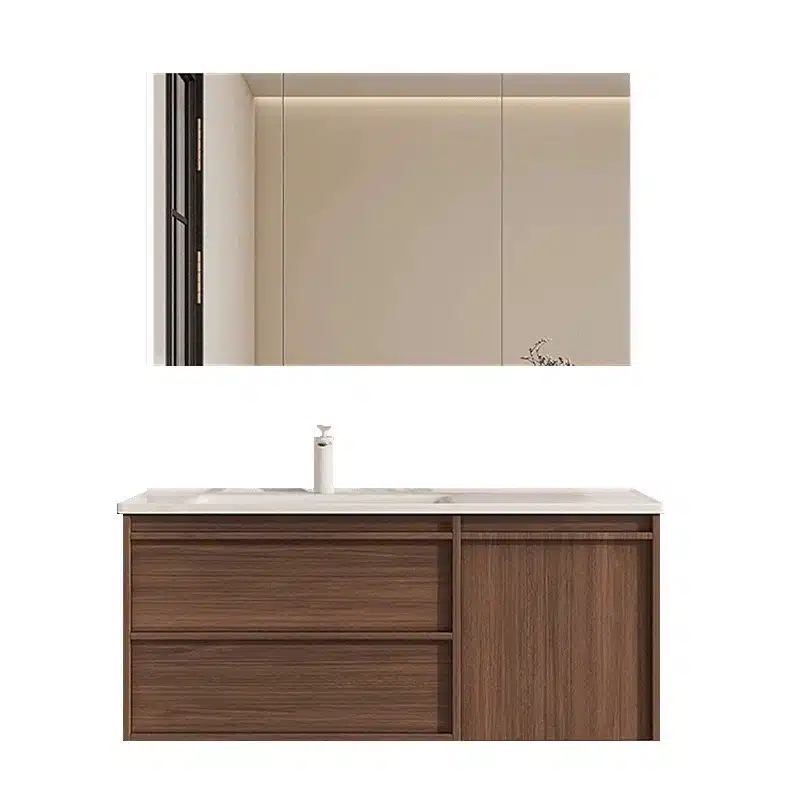
If the FOB price on a ‘solid wood’ vanity seems too good to be true, ask the supplier to specify the wood species on the commercial invoice. Not just ‘hardwood’ — the Latin name. Rubberwood has its place in dry-climate bathrooms with proper edge sealing. But for projects in Southeast Asia, coastal Africa, or the Gulf States, specifying teak or marine-grade plywood is the difference between a 10-year product and a 10-month warranty nightmare.
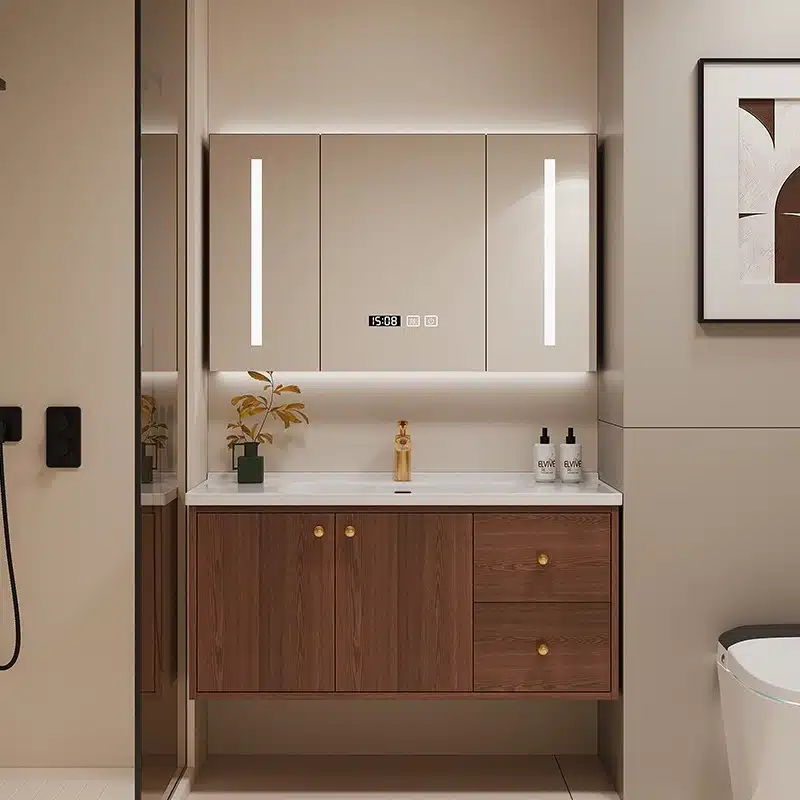
Mistake 2: Choosing MDF for High-Traffic Hotels
MDF vanities in hotels fail within 18 months — saving $4,000 costs $40,000 to fix.
The call comes 14 months after the hotel opens. Not from the contractor who installed the vanities. Not from the FF&E specifier who signed off on the pre-production sample. From the hotel GM, staring at swollen cabinet bases in 30% of guest bathrooms. Housekeeping complaints have been piling up for weeks — doors that no longer close, drawer fronts that scrape against frames, a musty smell coming from under the sink. The sample approval process caught nothing. The mass production run didn’t match.
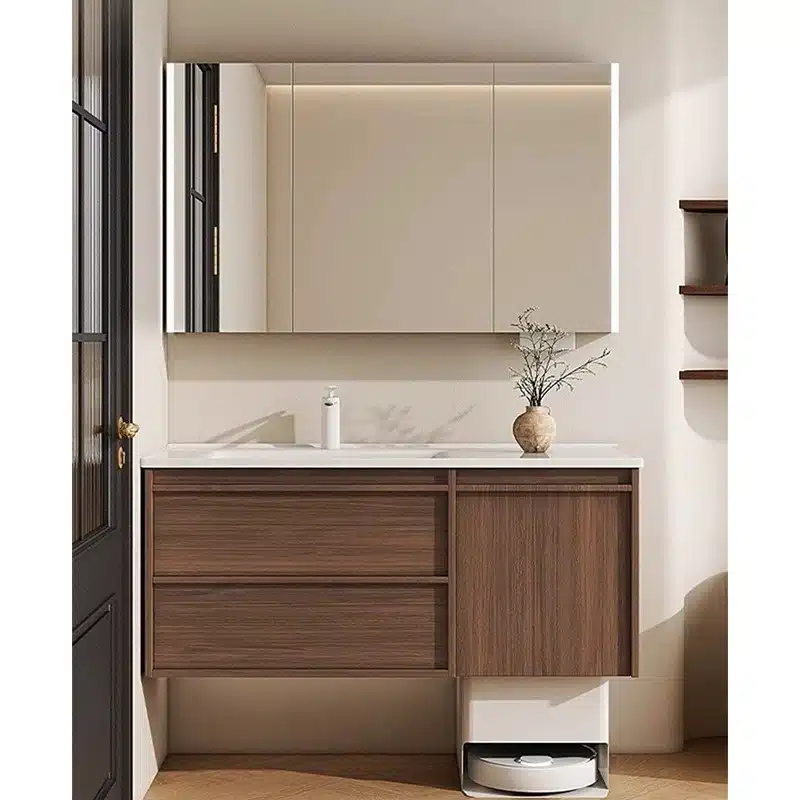
Here’s what happened inside those cabinets. MDF is wood fiber compressed with urea-formaldehyde resin under heat and pressure. The laminate or veneer surface provides moisture resistance — but only while it stays fully sealed. In a hotel bathroom cleaned two to three times daily with wet cloths and chemical cleaners, water finds every micro-gap. The toe kick takes splashes from mopping. The sink cutout edge wicks condensation. The back panel sits against a wall that never fully dries. Once moisture breaches the surface layer, the MDF core absorbs it like a sponge. The fibers swell, increasing board thickness by 15% to 25%. That expansion is permanent. MDF does not dry back to its original dimension. The swollen edge becomes a new entry point for more moisture, accelerating the failure cycle.
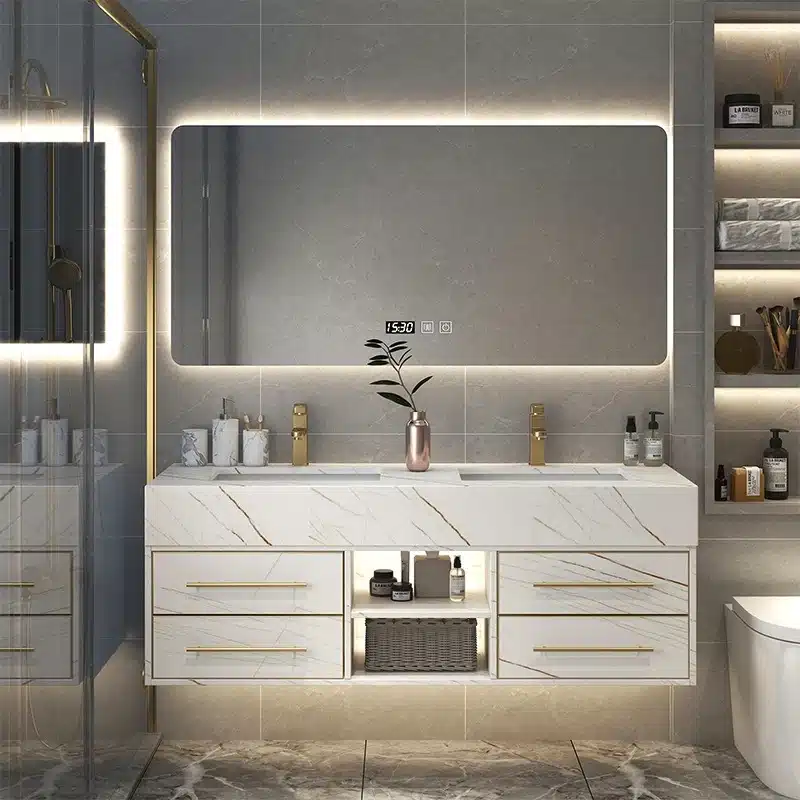
The economics compound the problem. An MDF vanity might save $15 to $25 per unit on FOB pricing compared to a marine-grade plywood alternative. On a 200-room hotel, the upfront savings land between $3,000 and $5,000. The remediation math tells a different story: removing and replacing 60 failed vanities — factoring in labor, guest room downtime, priority shipping, and installation — starts at $40,000. That number doesn’t include the soft cost of negative guest reviews mentioning mold smells or broken cabinet doors. The quality tolerance on MDF in high-moisture commercial environments is simply too narrow for the real-world abuse hotel bathrooms dish out.
-
- Toe kick delamination: The first visible failure point. Mops and floor cleaners splash water onto the bottom edge repeatedly. Any gap in edge banding at the toe kick becomes a moisture entry wound. Check for continuous, unbroken edge banding along the entire bottom perimeter during sample approval.
- Sink cutout swelling: Around the basin rim, silicone sealant degrades over time. Water seeps between the sink and the vanity top, soaking into the exposed MDF substrate on the cutout edge. Plywood survives this. MDF doesn’t.
- Drawer box failure: MDF drawer boxes in humid environments bind against runners as the material swells. Hotel guests force them, breaking hardware or cracking the drawer front. Specify plywood drawer boxes even if the vanity body uses another material.
Mistake 3: Overlooking Edge Banding Quality
Over 60% of distributor returns trace back to moisture entry through unsealed edges.
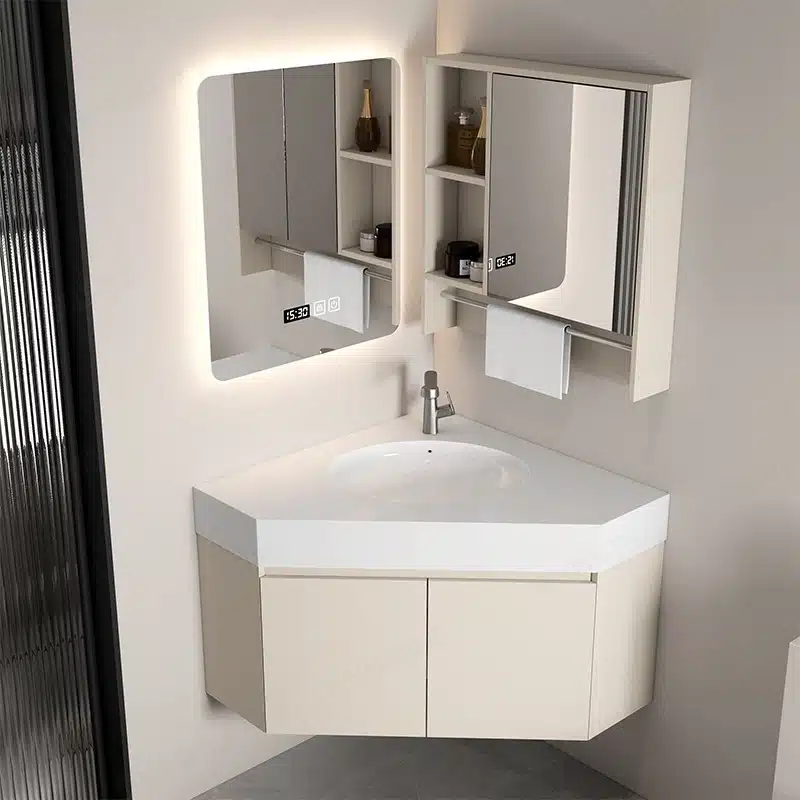
Most distributors spend hours comparing core panel materials—plywood, MDF, PVC—but never ask about the edge banding. That’s a $50,000 mistake waiting to happen. In a bathroom environment where humidity regularly hits 90%, the edge is not a cosmetic detail; it is the primary defense against water ingress. When a standard EVA glue bond fails, even the best marine-grade plywood will swell, split, and destroy the cabinet from the inside out. I’ve audited returns in Southeast Asia where the doors looked pristine on the outside but had delaminated internally because water vapor crept through a micro-gap in the banding.
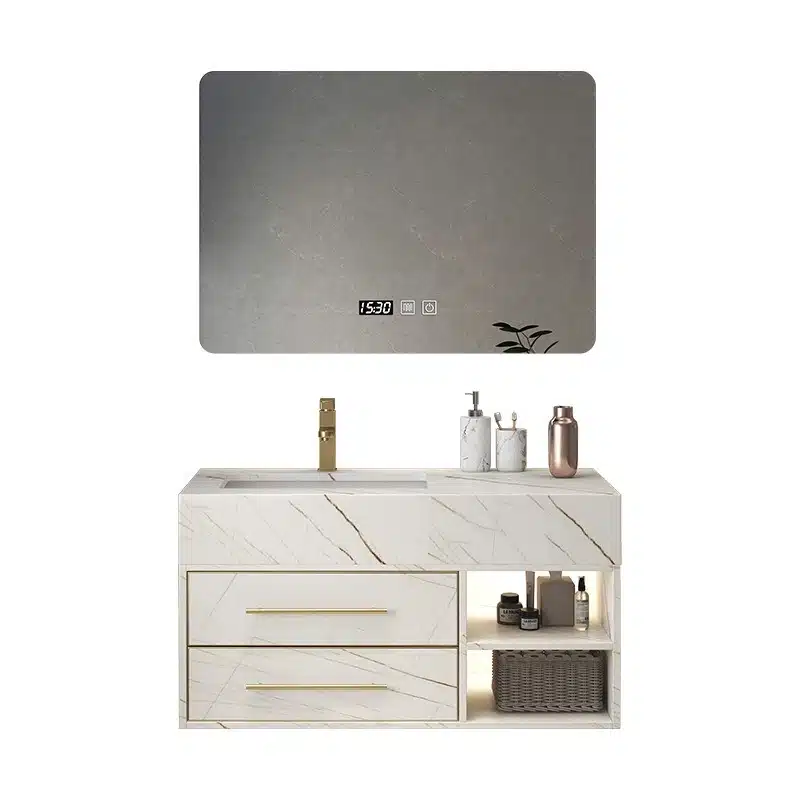
The silent killer is temperature cycling. Hot showers followed by air conditioning create a vacuum effect that pulls moisture into any unsealed seam. Standard 0.4mm PVC edge tape with a generic hot-melt adhesive lacks the elasticity to handle these expansion-contraction cycles. Within 12 to 18 months, that tape lifts at the corners—the classic peeling-eyebrow failure that ruins the perceived quality for your retail customer.
-
- Material: 1.2mm thick ABS edge banding with UV inhibitors, not generic PVC. ABS resists impact cracking better and holds its color longer under bathroom lighting.
- Adhesive: Moisture-cured polyurethane (PUR) hot-melt creates a near-zero joint line that is waterproof, not just water-resistant. PUR bonds chemically, unlike EVA which relies on physical adhesion and softens with heat.
- Process: Laser edge banding or zero-joint PUR technology eliminates the glue line entirely. This is what we specify for Focuscabinet orders heading to coastal or high-humidity regions.
Focuscabinet’s documented five-stage QC protocol includes a dedicated edge adhesion pull test on every production batch. They use a silicone-infused edge banding sealant on the substrate edge before applying the tape, a step most factories skip to save 15 seconds per door. This pre-treatment saturates the exposed core fibers, creating a secondary moisture barrier. For distributors importing containers to markets like Lagos, Florida, or Singapore, this single specification change cuts after-sales claims by nearly two-thirds.
Mistake 4: Ignoring Formaldehyde Emission Standards
A CARB Phase 2 label means nothing if the board sat in humid storage for 6 months.
Last August, a distributor in Long Beach had a container of ‘E1’ bathroom vanities held at the port. The customs inspector flagged formaldehyde, and the lab result came back at 0.11 ppm — double the CARB Phase 2 limit of 0.05 ppm. The FOB invoice was $47,000. Demurrage and a lost hotel contract pushed the total loss past $55,000. The culprit? The supplier’s sample approval certificate was from a dry inland factory. After six weeks in a humid container, the cheap MDF core off-gassed far beyond the spec.
-
- E1 (European standard): Maximum 0.124 mg/m³ (0.1 ppm) measured by the chamber method. Widely used in Asia and Europe, but not sufficient for the North American market.
- E0 (voluntary, tighter than E1): Typically ≤0.050 mg/m³ (0.04 ppm). No official EN standard enforces ‘E0’ — it’s a marketing term. Without a quality tolerance and batch test, it’s just a promise.
- CARB Phase 2 (California Air Resources Board): Mandatory for any composite wood product sold in California and increasingly enforced across the U.S. The limit is 0.05 ppm for hardwood plywood and MDF. CARB P2 requires third-party certification and chain-of-custody documentation.
Here’s the real risk that most distributors miss: formaldehyde emissions don’t stay constant. Panels that pass E1 in a 20°C, 50% RH lab can spike after 3–6 months in Southeast Asian humidity. I’ve seen ‘E1’ MDF panels degrade to 0.14 ppm after a monsoon season. If your supplier tests only at the mill, you’re effectively gambling on your container’s climate history. At Focuscabinet, every batch of MDF and plywood runs through a formaldehyde gas analyzer inside the factory’s QC lab — not just a once-a-year certificate. The test is integrated into the five-stage inspection before the edge banding even gets applied. When you set your quality tolerance at <0.04 ppm on the FOB inspection report, you’re not just buying compliance; you’re buying a margin of safety that keeps your product out of customs quarantine.
Mistake 5: Not Matching Material to Climate
MDF cabinets shipped to Lagos arrive swollen before they clear the port.
I’ve watched a distributor in Dubai unload a container of MDF vanities bound for a five-star hotel project. Sixteen units—nearly 40% of the shipment—had base panels that swelled past the point of salvage. The spec sheet checked every box. The pre-production sample looked flawless. The problem? Nobody checked whether the material could survive 90% humidity and 45°C ambient heat cycling through a non-climate-controlled warehouse for three weeks before installation.
The material that works in a ventilated Frankfurt bathroom will fail in a Singapore condo within 18 months. Not because of a manufacturing defect. Because the substrate was never designed for that environment. This is the mistake that separates buyers who run product returns from buyers who run repeat business.
-
- Coastal & Tropical (Gulf States, Southeast Asia, West Africa): PVC is the only substrate that genuinely resists salt-laden humidity and fungal growth without requiring perfect sealing. Plywood with marine-grade adhesive works as a secondary option, but only if every edge—including the back panel—is fully sealed. MDF has no place here. I’ve seen E2-grade MDF labeled as ‘moisture resistant’ delaminate in under 60 days.
- Temperate with Seasonal Humidity (Northern Europe, Pacific Northwest, Japan): Multi-layer plywood with birch or eucalyptus core performs well. The critical variable is the glue line. If the supplier uses urea-formaldehyde adhesive, hydrolysis begins the moment relative humidity crosses 65%. Demand phenolic resin or specify E0-grade adhesive even if local regulations only require E1.
- Dry & High-Altitude (MENA inland, Andes region, Central Asia): Solid wood can work here, but only if kiln-dried to 8-10% moisture content. If the moisture content at packaging is 12% or higher, those doors will crack when the dry air pulls residual moisture out. Rubberwood is the most common failure point—it absorbs moisture fast during manufacturing and releases it even faster in arid conditions.
The threshold I tell every distributor to write down: if your destination market averages above 75% relative humidity for more than four months a year, eliminate MDF from your spec sheet entirely. Not ‘upgrade to better MDF’—eliminate it. The cost difference between PVC and MDF is roughly 15-22% at FOB pricing, but the return rate differential makes that premium disappear inside the first container.
One more thing most spec sheets won’t tell you: the edge banding adhesive matters as much as the substrate. EVA hot-melt adhesive softens at 70-75°C. If your container sits on a dock in Jeddah in August, internal temperatures hit 80°C. The banding peels. The panel edges are exposed. And the moisture wicks in. PUR adhesive holds to 120°C. Ask for it specifically in the sample approval stage.
| Region | Climate Challenge | Recommended Material | Why It Excels | Avoid (Costly Mistake) |
|---|---|---|---|---|
| Southeast Asia | 80-90% RH year-round; monsoon seasons; mold proliferation | Marine-Grade Plywood + PVC Core | Zero water absorption; anti-fungal core treatment; dovetail joints prevent structural failure | Standard MDF — swells 15-30% within 6 months; edge banding delaminates |
| Middle East / Gulf States | Extreme dry heat (45°C+); near-zero humidity; rapid thermal cycling | Solid Rubberwood with UV-Cured Multi-Layer Lacquer | Low thermal expansion coefficient; UV-stable finish prevents surface checking and color shift | Unstabilized PVC — warps above 50°C; joint separation in container transit |
| Northern Europe / Scandinavia | Sub-zero winters; indoor radiator heating; humidity swings from 20% to 70% | E0-Grade 11-Ply Birch Plywood | Exceptional dimensional stability across humidity range; CARB P2 / E0 formaldehyde compliance mandatory | Solid hardwood panels — crack along grain lines; visible shrinkage gaps at drawer fronts |
| North America (Coastal / Florida) | Salt-laden air; hurricane-season humidity spikes; HVAC-induced dry cycles | Marine-Grade Plywood + Silicone-Infused ABS Edge Banding | Salt-mist corrosion resistance; silicone-infused edges seal 100% against moisture ingress — eliminates the 60% return rate from unsealed edges | Standard plywood with EVA hot-melt edge — moisture penetrates within 90 days; blistering and peeling |
| Oceania / Coastal Australia | Intense UV radiation; salt spray; arid-coastal humidity contrast | Sintered Stone Basin + UV-Stable PVC Cabinet Body | Mohs 7 hardness resists etching; non-porous surface withstands salt and sunscreen residue; UV inhibitors prevent polymer degradation | Natural marble or cultured stone basins — surface etching from acidic cleaners; color bleaching within one season |
| Sub-Saharan Africa | Tropical wet-dry cycles; intermittent high humidity; limited climate control in storage | PVC Cabinet with Reinforced Dovetail Joints + Anti-Mold Additive | Impervious to mold and termites; dovetail construction maintains structural integrity through humidity swings; no formaldehyde off-gassing risk in poorly ventilated spaces | Unsealed particleboard or low-grade MDF — mold colonization within 3 months; formaldehyde levels spike 2-3x after humid storage |
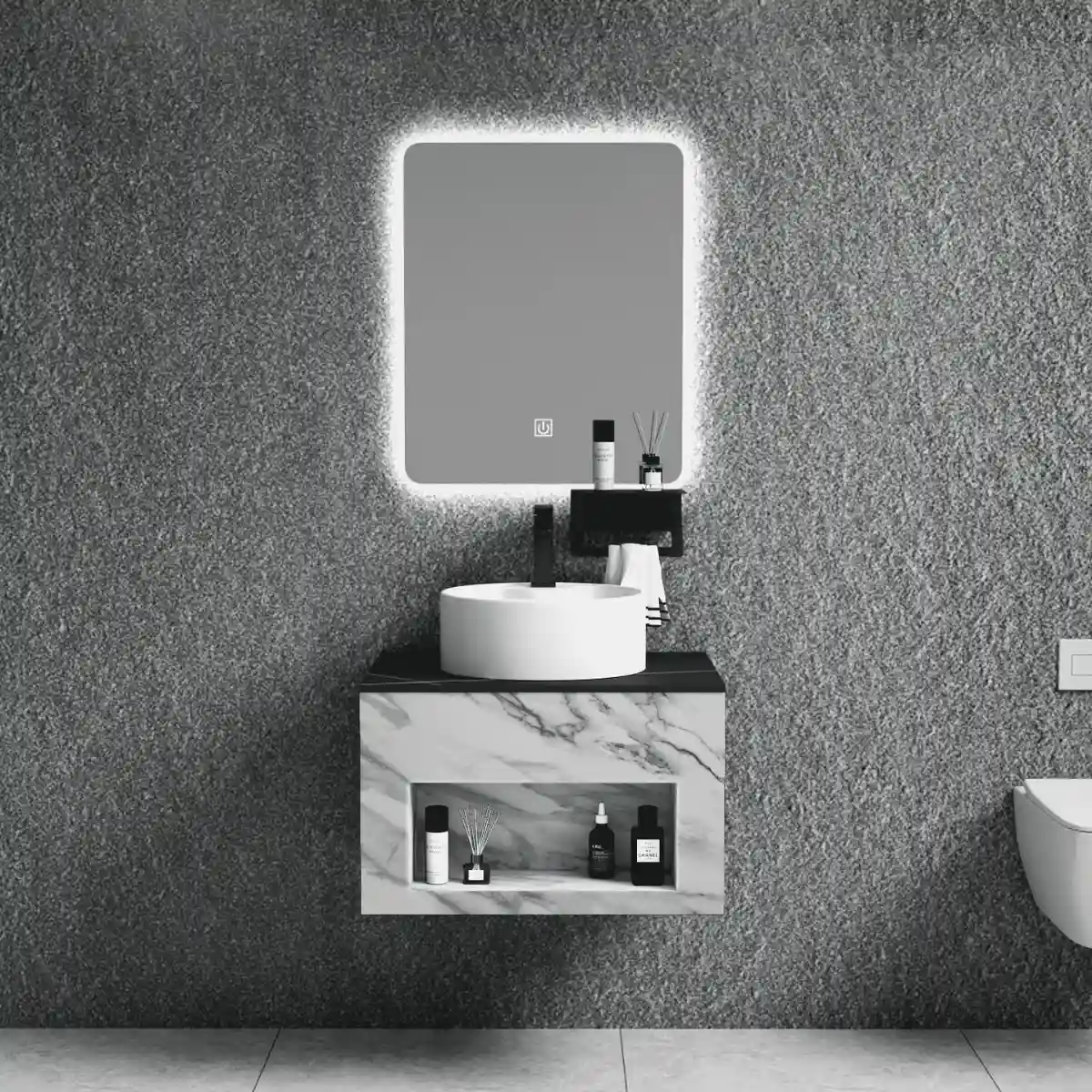
How Focuscabinet’s Region-Ready Strategy Eliminates These Mistakes
Region-specific material protocols stop 60% of the most common returns.
The five mistakes I just outlined share one root cause: applying a one-size-fits-all material specification to markets with wildly different conditions. A vanity that survives a dry Arizona bathroom will delaminate in six months in coastal Lagos. Focuscabinet’s region-ready strategy starts with a mandatory climate and compliance audit before any production order is confirmed.
For example, a distributor in Dubai ordering 200 units for a hotel project will not receive the same substrate recommendation as a buyer in Toronto. The Dubai spec automatically shifts to PVC or marine-grade plywood with silicone-infused edge banding — the same edge banding that, based on internal return data, cuts moisture-related returns by over 60% compared to standard laser edge banding. The Toronto spec, meanwhile, leans on CARB P2-certified plywood and a reinforced finish that withstands dry winter heating cycles.
-
- Material preselection by region: North America defaults to CARB P2 plywood; Southeast Asia and Africa use PVC or multi-layer board with moisture-resistant core; Europe prioritizes E0 board and soft-close hardware.
- Hardware and joint specification: Humidity-prone regions get dovetail joints instead of staples. Drawer slides are upgraded to 304 stainless steel where salt air is a factor.
- Post-production gas testing: Every batch undergoes formaldehyde gas analyzer testing before packing. Labels that read E1 are verified against actual emission data, not supplier certificates. This solves the problem of drift after six months in humid storage.
None of this is theory. The five-stage quality control inside the 10,000sqm facility in Changge, Henan, catches edge-sealing failures and emission outliers before the container door closes. The result is a bill of lading that matches the pre-production sample you approved — not a roll of the dice.
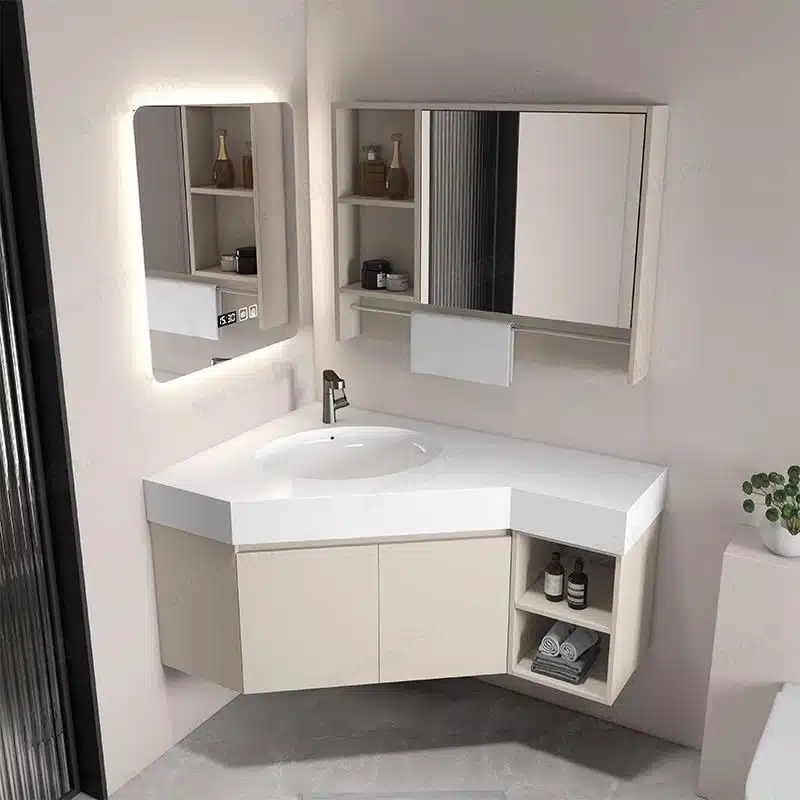
Quick Reference: Material Selection Flowchart
Stop picking materials from a spec sheet.
After auditing supplier factories across Southeast Asia, the Middle East, and Northern Europe, I can tell you the same material that survives perfectly in a Riyadh hotel will delaminate within 8 months in a Singapore condo. The material itself matters less than the match between material and actual operating conditions. Here is the decision sequence I use when specifying for new projects.
-
- Question 1: What is the ambient humidity level?: Measure, do not guess. Bathrooms with poor ventilation or coastal proximity need marine-grade plywood or high-density PVC board with a minimum 650 kg/m³ density rating. Avoid standard MDF entirely here — edge swelling starts at 70% relative humidity within 120 days.
- Question 2: Is this a commercial or residential installation?: Hotels and rental properties see 3-5x the daily use cycles of a residential bathroom. For 50+ room properties, 15mm minimum panel thickness with silicone-infused edge banding is non-negotiable. Over 60% of distributor returns trace back to unsealed edges wicking moisture into the core material — a failure mode invisible during unboxing inspection.
- Question 3: What formaldehyde standard does the destination market enforce?: CARB Phase 2 for California-bound shipments. E0 for EU markets with formaldehyde-sensitive consumer bases. Do not accept a supplier claiming E1 compliance without a batch-specific formaldehyde gas analyzer report. Some E1-labeled panels tested after 6 months in humid transit conditions actually exceed the 0.124 mg/m³ limit.
- Question 4: What is the target retail price point?: If your FOB target is under $85 per unit for a 600mm vanity, focus on quality-controlled moisture-resistant MDF with full-wrap PVC edge banding rather than downgrading solid wood to an unreliable species. A proper wood veneer over multi-layer plywood with dovetail drawer joints will outperform stapled solid rubberwood at a comparable landed cost.
One variable most buyers skip: construction joint method. Dovetail joints hold drawer boxes together through seasonal expansion cycles. Staples do not. A solid teak vanity assembled with staples will fail faster than a plywood vanity with proper joinery. When you request a pre-production sample, cut open one drawer and look. If you see staples anywhere, flag it before the mass production run begins.
| Application Scenario | Recommended Material | Avoid | Q-Spec Check | Region-Ready Note |
|---|---|---|---|---|
| High-Humidity / Coastal Markets (SE Asia, Gulf, Oceania) | PVC with silicone-infused edge banding | Standard MDF, unsealed solid wood (e.g., untreated rubberwood) | Fully sealed edges, 4-side PUR hot-melt banding, ASTM G154 UV resistance | Focuscabinet deploys 360° edge sealing + humidity chamber testing at 95% RH for 72h |
| High-Traffic Hospitality / Hotels | Marine-grade 11-ply plywood + waterproof laminate; Teak or thermally modified ash for prestige projects | MDF (edge-wicks moisture; fails within 12-18 months under daily housekeeping) | Dovetail drawer joints (≥7 dovetails/side), Blum GRASS-grade soft-close runners, 100,000-cycle tested | Plywood cores match E0/E1 CARB P2 by market; STC-tested for acoustic-sensitive bathrooms |
| E-Commerce / Retail-Ready Lines (Low MOQ, High Visual Impact) | Sintered stone basin + LED smart mirror + MFC/PVC cabinet combo | Natural marble (vein mismatch = high photo return rate); bulky solid wood (shipping DIM weight penalty) | Templated consistency ±1mm color ΔE<1.5 across batches; CRI≥90 mirror lighting; 3C-certified LED drivers | Flat-pack KD design reduces volumetric freight; Focuscabinet’s 5-stage QC ensures batch-to-batch repeatability |
| EU & North American Code-Compliant Projects | E0 MFC or CARB P2 plywood core; water-based UV lacquer | Uncertified E1/E2 boards (post-shipment formaldehyde spike risk in containerized storage) | Batch-level formaldehyde gas analyzer report (EN 717-1); FSC CoC optional; REACH SVHC declaration for adhesives | Focuscabinet’s ‘Region-Ready’ dossier includes lab reports per destination regulation before container sealing |
| Budget-Conscious Distributor Markets (Africa, South America) | High-density moisture-resistant MFC (≥680 kg/m³ core) + ABS thick edge banding | Raw particleboard, thin 0.4mm PVC edge tape, staple-only joinery | Cam-lock + dowel assembly (no exposed fasteners); 48h water immersion test on edge samples; ISO 22196 antimicrobial optional | Focuscabinet applies silane-modified adhesive at edge-banding stations — prevents delamination in unventilated containers |
Conclusion
A spec sheet can list “solid wood” and “E1 board” without telling you anything about the unsealed bottom edge or the formaldehyde spike that shows up after six weeks in a container. The gap between what the sample approval promised and what lands at the port is where margin gets eaten — and it almost always traces back to one of the five mistakes covered here.
Before you sign off on the next FOB pricing sheet, pin your supplier down on three yes/no questions: (1) Does the edge banding carry a silicone seal and can you send video of the application line? (2) Will you provide a batch-specific formaldehyde test with a quality tolerance of no more than 0.3 mg/L drift from the labeled grade? (3) Can you show a climatic durability report for the exact material stack you’re quoting, not a generic brochure? If those answers stall
Frequently Asked Questions
Is all solid wood moisture-proof?
No, most solid wood vanities use rubberwood, which rots fast in humidity. Only dense, naturally oily species like teak resist moisture well enough for daily bathroom use. Always specify the wood species, not just ‘solid wood’.
Why does MDF fail in hotels?
MDF absorbs moisture and swells within 18 months under heavy traffic, causing door misalignment and delamination. It lacks the structural integrity needed for daily cleaning and steam exposure. Use plywood or PVC for high-traffic commercial bathrooms.
How important is edge banding quality?
Edge banding is the primary moisture barrier; over 60% of returns come from unsealed edges. Poorly applied banding opens a direct path for water to reach the core material. Reject any unit with visible gaps or thin edge banding.
Which formaldehyde standard should I specify?
Specify CARB P2 or E0 for North American and European markets. E1 is the minimum legal floor but still releases enough emissions to fail modern indoor air quality requirements. Request batch-specific formaldehyde test certificates.
How to match vanity material to climate?
For humid coastal markets, choose PVC or multilayer plywood, not solid wood or MDF. For dry climates, engineered wood with proper sealing can work if edge treatment is robust. Share your target market’s climate data with the factory before finalizing specs.





0 Comments