

copper free mirror advantages is the first checkpoint buyers should lock before they approve a supplier, budget, or production slot. The pre-production sample for a 200-room hotel looked flawless. The general manager signed off. Then, nine months into operation, the first black edges appeared on the mirrors in the west wing bathrooms. That $50,000 order turned into a $140,000 headache – three replacements over eight years, plus guest complaints and a renegotiated maintenance contract.
The cause? Standard copper-backed mirrors let moisture seep under the edge seal, oxidising the copper layer and turning the reflective surface black. Copper-free mirrors eliminate that reactive copper layer entirely, replacing it with an inert passivation film and a direct silver-to-epoxy bond. That’s the core of copper free mirror advantages – a measurable difference in lifespan and maintenance costs.
At 90% relative humidity, standard mirrors show visible edge darkening after 200 hours. Copper-free mirrors exceed 500 hours without degradation. The 120-hour CASS test (ISO 9227) is the benchmark; a copper-free mirror passes with zero corrosion, while standard mirrors fail within 24 to 48 hours.
For a project procurement manager, the question isn’t whether to pay a $3–5 per square foot premium. It’s whether you can afford the replacement cycles, the punch-list items, and the liquidated damages that come with a standard mirror in a high-humidity bathroom.
What Causes Mirror Black Edge Corrosion?
Copper layer oxidation, not silver degradation, is the root cause of black edge corrosion.
Moisture from steam and ammonia-based cleaners seeps behind the mirror’s edge seal, contacting the copper layer that standard mirrors use to bond silver to glass. Copper acts as a galvanic cell anode, releasing electrons that reduce silver ions and simultaneously forming black copper oxide (CuO) spots. Once the seal is compromised, the reaction accelerates inward, permanently ruining the reflective surface. Ammonia-based cleaners and 75%+ bathroom relative humidity accelerate this corrosion 3× faster than dry environments.
The industry standard accelerated aging test at 90% relative humidity quantifies the gap. Standard copper-backed mirrors show visible edge darkening after 200 hours—equivalent to 2–3 years in a ventilated hotel bathroom. Copper-free mirrors under the same conditions remain edge-clear after 500+ hours, correlating to a 10–15 year residential lifespan and 8–10 years in heavy commercial use.
-
- 90% RH Humidity Chamber: Standard mirrors show edge darkening at 200 hours; copper-free mirrors exceed 500 hours with no edge degradation.
- CASS Salt Spray (ISO 9227): Copper-free mirrors pass 120 hours with zero corrosion. Standard mirrors fail within 24–48 hours, confirming the copper layer is the failure point.
Most mirror failures in humid bathrooms trace to copper layer oxidation, not silver degradation. Suppliers who omit the copper layer and bond silver directly to a passivation film backed with epoxy remove that electrochemical pathway entirely. However, many importers bypass this to save $2–3 per unit, ignoring the long-term project liability—a decision that shows up in maintenance calls within three years.
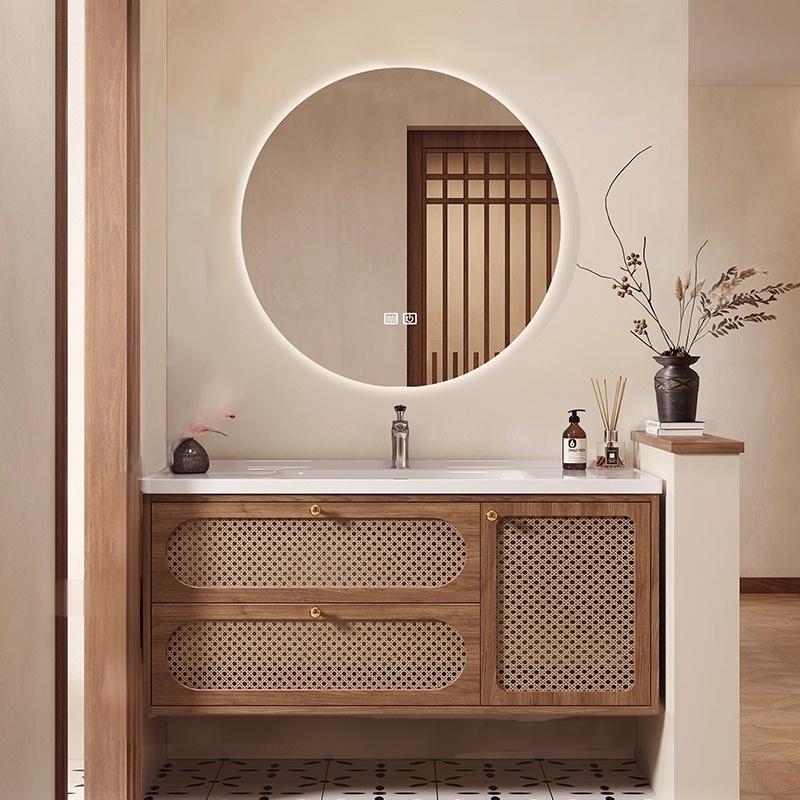
How Copper-Free Mirrors Are Built
Removing the copper layer eliminates the corrosion trigger entirely.
The construction starts with float glass that receives a molecular silver coating via chemical deposition. Instead of applying a copper layer, a passivation film is chemically bonded directly to the silver. This film seals the silver without introducing the reactive copper that causes black edge corrosion in standard mirrors. The final stage applies a two-part paint system — an adhesion primer followed by a protective topcoat — that locks the entire stack against moisture ingress.
-
-
- Layer stack: Float glass → silver coating → passivation film (no copper) → primer → topcoat. No copper means no galvanic cell formation at the edge.
- CASS validation: Copper-free mirrors pass 120-hour ISO 9227 CASS salt spray with zero edge corrosion. Standard copper-backed mirrors fail within 24–48 hours under identical conditions.
-
For LED mirrors, the backing paint must handle thermal cycling from the defogger pad and LED driver. Standard alkyd paints become brittle after repeated heat cycles, forming micro-cracks that let moisture reach the silver. Focuscabinet uses a flexible dual-layer epoxy back paint — an adhesion primer plus a heat-resistant topcoat — that stays elastic and maintains the seal through continuous expansion and contraction.
-
- Thermal risk: Alkyd paints crack after 300–500 thermal cycles (typical in a hotel bathroom over 2 years). Epoxy paints remain intact beyond 2000 cycles.
- Supplier check: Ask specifically whether the back paint is epoxy or alkyd. Many brochures omit this detail because alkyd is cheaper by $0.20–$0.40 per square foot.
Copper-Free vs Standard Mirror in Real Bathroom Use
Copper-free mirrors pay back the premium before the first standard mirror replacement.
The lifespan gap between standard copper-backed mirrors and copper-free mirrors is not incremental — it’s categorical. In controlled humidity chamber tests at 90% relative humidity — the typical condition inside a hotel bathroom after three showers — standard mirrors show visible edge darkening at 200 hours. Copper-free mirrors under identical conditions remain edge-clear past 500 hours. That four‑year head start in accelerated time translates directly to real-world service life.
In residential bathrooms, standard mirrors last 5–7 years before black edge corrosion becomes noticeable. Copper-free mirrors commonly exceed 10–15 years. In commercial hotel environments with daily steam exposure and cleaning chemicals, the gap widens: standard mirrors fail in 2–3 years; copper-free mirrors hold for 8–10 years. For coastal or high‑steam installations, standard mirrors often degrade in under two years, while copper-free mirrors equipped with CASS‑passed backing maintain a 10‑year track record. The 120‑hour CASS test (ISO 9227) correlates to more than 10 years of non‑coastal hotel service — the only test that separates a genuine copper-free mirror from a marketing label.
-
- Residential standard vs copper-free: 5–7 years vs 10–15 years.
- Commercial hotel standard vs copper-free: 2–3 years vs 8–10 years.
- Coastal/high-steam standard vs copper-free: <2 years vs 10+ years (CASS-validated).
- Key failure mechanism: Copper layer oxidation, not silver degradation. Copper-free eliminates that reactive layer entirely.
Now run the numbers for a 100‑room hotel. Standard mirrors cost roughly $40 per unit installed; copper-free mirrors run $48 — a 20% premium. But that premium pays back within the first replacement cycle. Standard mirrors require three full replacements over a 10‑year building lifecycle. Each replacement involves $60 per room in labour and disposal. That makes the 10‑year cost per room for standard mirrors $40 + (3 × $60) = $220. Copper-free mirrors: $48 once, zero replacements. For the entire project: $4,800 versus $22,000 — a $17,200 savings.
The real cost risk is not the per-unit premium — it’s the liability of edge‑corrosion punch lists five years after handover. Many importers bypass copper-free to save $2–3 per unit, pushing that risk downstream to the project owner. That decision ignores the fact that copper-free mirrors also require flexible epoxy back paint, especially in LED models where thermal cycling from drivers and defoggers can micro‑crack standard alkyd paints and open a moisture path. A genuine copper-free mirror is not just a different topcoat; it’s a different construction stack — and the only way to verify it is a 120‑hour CASS report.
How to Verify Copper-Free Certification
A copper-free claim without an ISO 9227 report is just marketing.
-
-
- Test Standard: ISO 9227 (CASS) at 120 hours minimum. Request the raw data showing zero corrosion on the edge. Some suppliers offer a 72-hour test — that’s insufficient for commercial bathroom conditions where relative humidity stays above 75% and ammonia-based cleaners speed up corrosion threefold.
- Additional Report: ASTM D1003 for luminous transmittance after humidity exposure. This ensures the silver layer hasn’t degraded in parallel with the edge seal. A mirror can pass edge inspection while losing reflectivity, which triggers guest complaints about ‘cloudy’ mirrors within 18 months.
-
Now, warranty language. A genuine copper-free mirror supplier will offer a minimum 3-year commercial warranty that explicitly covers edge corrosion. Not ‘workmanship’ or ‘defects’ — specifically edge corrosion. I’ve seen warranties that exclude environmental damage, which is code for ‘we don’t cover the one failure mode that matters.’ Read the exclusions carefully. A 3-year warranty signals confidence: the manufacturer knows the inert passivation layer and dual-layer epoxy backing will hold. If they only offer 1 year, they’re expecting failure within that window.
-
- Inspection Protocol: Before shipment, demand photo or video evidence of the edge seal condition. A proper QC process includes a cross-hatch adhesion test on the backing paint, a 100% visual edge check under bright light, and batch CASS testing. Focuscabinet’s five-stage QC pulls samples from every production run and sends the CASS report with the shipment. That’s the benchmark you should write into your purchase order.
- What to Avoid: Avoid suppliers who cannot provide a batch test report from the last 90 days. Avoid vague warranties that mention ‘moisture resistance’ without tying it to a specific test standard. If the warranty doesn’t reference ISO 9227 or an equivalent ASTM standard, it’s legally soft.
Conclusion
Skipping the copper-free spec means accepting three full mirror replacements in a 100-room hotel over 10 years—at a total-installed cost of $22,000 versus $4,800 for copper-free. Black edge damage doesn’t show up during commissioning; it hits in year three, right as the client’s warranty expectations peak. The cost of inaction is measured in liquidated damages and lost repeat bids, not just unit dollars.
Start your next specs package by demanding a supplier’s 120-hour CASS test report (ISO 9227) and a written 3-year edge-corrosion warranty. Review the copper-free LED mirror specifications from Focuscabinet to see certified models that meet those thresholds.
Frequently Asked Questions
What is a copper-free mirror?
A copper-free mirror replaces the traditional copper layer with an inert passivation film and epoxy backing, stopping the electrochemical reaction that causes black edge corrosion. This design allows the mirror to pass 120-hour CASS salt-spray. Verify the CASS test report before purchasing.
How can I tell if my current mirror is copper-free?
Check the edge of the mirror: a copper-free mirror shows a dark grey or black edge instead of the reddish-brown copper layer. You can also request the manufacturer’s CASS. Always ask for the test report rather than relying on visual checks alone.
Do copper-free mirrors still have silver?
Yes, copper-free mirrors still use a silver reflective layer for brightness and clarity. The copper layer is removed to prevent corrosion, while the silver remains protected by the passivation film and epoxy. Confirm that the mirror passes CASS testing before assuming durability.
Is copper-free worth it for a guest bathroom?
Yes, it is worth the 15–20% price premium because guest bathrooms see high moisture and cleaning chemical exposure that accelerate black edge corrosion. Copper-free mirrors avoid replacement costs. For a guest bathroom, the payback comes before the first standard mirror would fail.
How does copper-free affect mirror weight?
Copper-free mirrors weigh nearly the same as standard mirrors because the copper layer is only a few microns thick. The replacement passivation film and epoxy add negligible weight, so handling and. Check the product spec sheet for exact weight per square foot.





0 Comments