


The real cost of a bathroom cabinet thermofoil peeling fix isn’t the $15 tube of contact cement — it’s the lost trust when a container of vanities arrives with foil lifting at the bottom edges. Most sourcing guides tell you to check sample approval before mass production. But the pre-production sample never sits in a steamy bathroom for six months. The gap between what the spec sheet says and what actually shows up in the container is where the money gets burned.
Consider the distributor who lost a $50K order because the mass production run’s edgebanding didn’t match the approved sample. The FOB pricing looked great. The sample passed the visual check. But the factory had switched to a thinner adhesive layer to save cents per door. Three months after installation, steam had crept past the unsealed MDF edge, and the doors started delaminating from the bottom up. That’s not an adhesive failure — it’s a substrate failure.
The conventional repair advice focuses on re-gluing. That misses the root cause. According to EN 317 thickness swell testing, standard MDF can absorb up to 30% water by weight before the thermofoil separates. The core swells, physically tears the plastic from the inside out. No amount of glue fixes a swollen core. The quality tolerance on moisture resistance is set at the factory, not in the field.
That’s why the three fixes in this article start with a hard assessment: is the MDF still sound? Then the article covers the short-term re-bond, the medium-term edge patch, and the long-term replacement math. And finally, how to prevent the problem entirely by choosing cabinets withPUR-bonded thermofoiland sealed edges — the kind of factory engineering that makes aftermarket fixes unnecessary.
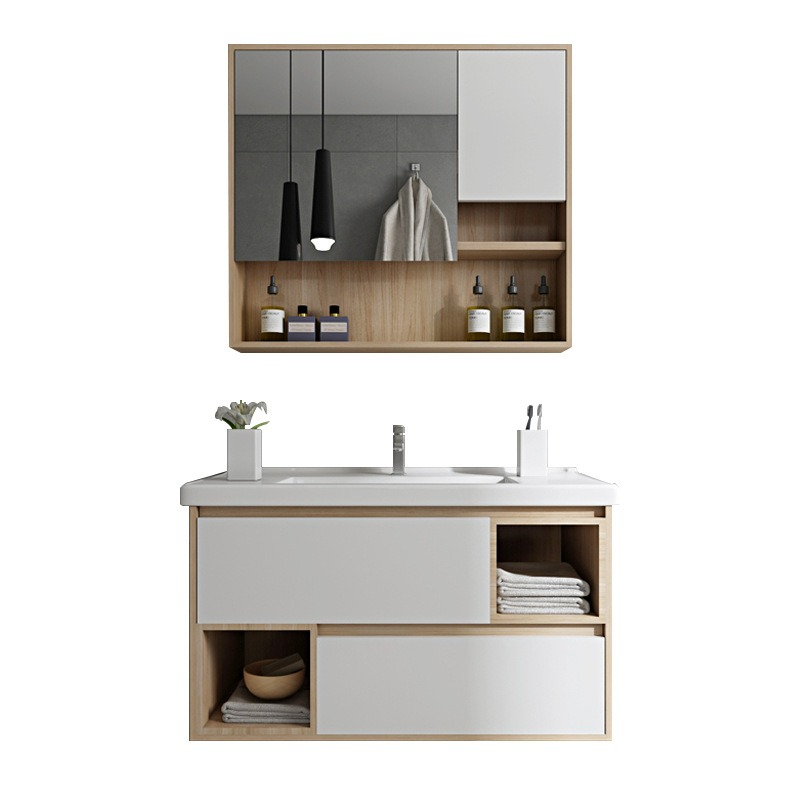
Why Bathroom Cabinet Thermofoil Peels: Moisture at the Seam
90% of thermofoil peeling starts at the bottom edge where steam penetrates the unsealed MDF.
A thermofoil door is a 0.4–0.6 mm PVC film vacuum-pressed onto an MDF core. The foil itself is waterproof. The weak point is the cut edge — where the foil ends and raw MDF is exposed. In a bathroom, steam condenses on that edge, wicks into the substrate, and causes the MDF to swell. The foil cannot stretch to accommodate the expansion, so it separates at the seam.
-
- EN 317 Thickness Swell Test: Standard MDF absorbs up to 30% water by weight before the substrate expands enough to tear the thermofoil. Focuscabinet’s sealed edge construction holds swell to under 12% after a 72-hour water soak — well below the failure threshold.
- Peeling Is a Mechanical Failure, Not Adhesive Failure: Most repair guides assume the glue gave out. It didn’t. The foil lifts because the MDF underneath softened and swelled, physically pushing the film off. Re-gluing a swollen edge is a temporary patch — the substrate is already compromised.
The fix isn’t stronger glue. It’s stopping moisture at the seam. Standard manufacturing leaves the MDF edge unsealed — one millimeter of exposed fiber is enough. Focuscabinet applies a moisture-resistant edge primer, then encapsulates the entire rim with 120 g/m² PUR hotmelt under zero-gap laser edgebanding. No micro-crevice, no steam path, no swell.
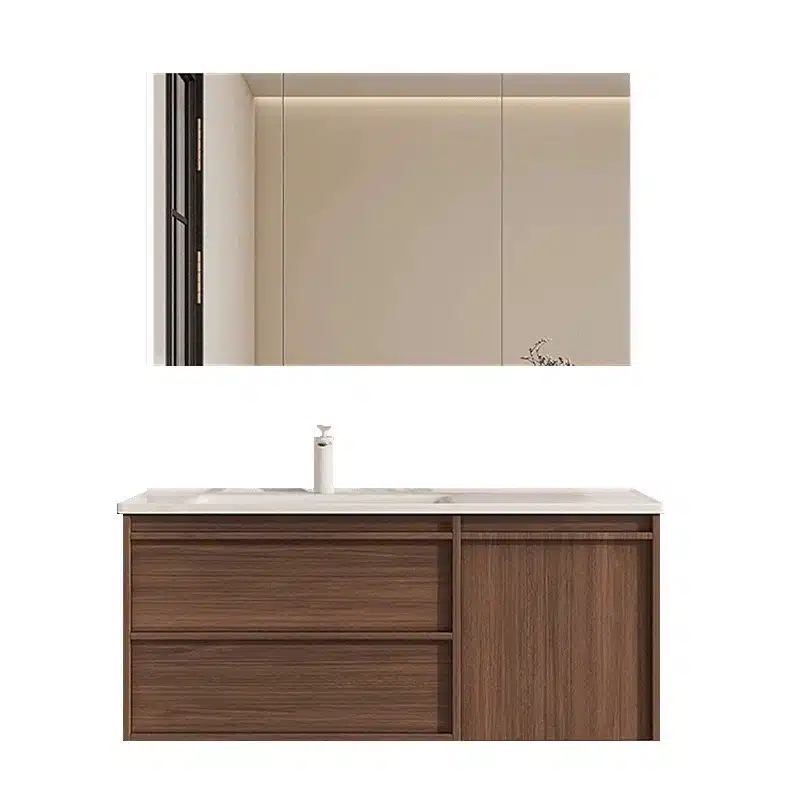
3 Field Repairs for Peeling Thermofoil Cabinet Doors
If the MDF feels mushy beyond 2mm deep, no glue job will save it — replace the door.
Before you break out the contact cement, understand what you’re actually fixing. 90% of thermofoil peeling starts at the bottom or back edge where bathroom steam has soaked into the MDF. The foam swells, the foil tears away from the edge, and the adhesive — which is usually still intact — is irrelevant. Re-gluing without resealing the edge buys you 6–12 months at best.
Here are the three field repairs, ranked by effort and longevity.
-
- Contact cement re-bond (lifted corner):: For a clean, dry edge that hasn’t softened. Heat the foil with a heat gun to 140–160°F (60–71°C) until pliable. Apply a thin layer of solvent-based contact cement to both the MDF edge and the foil. Wait until tacky (5–10 minutes), then press firmly. Use a C-clamp with a padded caul to apply 15 psi clamping force for 4–6 hours. Cost: $15–40 per door (adhesive + clamp). Time: 30 min active + 4 hr cure. Lifespan: 6–12 months if the edge isn’t sealed against moisture — and you can’t seal it in the field because the absorption has already started.
- Vinyl edge patch (small tear):: For tears up to 3 inches long where the MDF is still firm. Clean the area, cut a piece of iron-on edge banding (min 0.2mm gauge — thinner film won’t hold) slightly oversized. Use a household iron set to cotton setting (approx 300°F/150°C) and press for 15 seconds. Trim the excess with a sharp utility knife. Cost: $10–20 per door (roll of banding). Time: 20 min. Lifespan: 6–12 months — the patch itself holds, but the seam between patch and original foil is still vulnerable to steam.
- Full door replacement (mushy substrate):: Perform the pick test: stick a razor blade into the MDF edge 2mm deep. If it sinks without resistance or the edge crumbles, the core is compromised. No glue or patch will stick. Measure and order a replacement door — expect $50–150 per unit including freight for small quantities. Time: 2–4 weeks for delivery, plus installation. Lifespan: same as original if the door has standard edgebanding, or longer if you source from a manufacturer that uses PUR adhesive and moisture-resistant primers.
None of these repairs recreates the factory moisture barrier. The exposed MDF edge remains the weak point. If you’re managing a large portfolio of units (hotel, multifamily, distributor inventory), the total cost of chasing peeling doors — labor, materials, tenant disruption — quickly surpasses the premium for a door that was engineered to resist moisture from day one.

How to Prevent Bathroom Vanity Door Peeling Long-Term
No aftermarket fix seals the edge like factory PUR bond.
You’ve seen it happen: a $50K container lands, doors look perfect at sample approval, but six months post-installation the bottom edges lift. That’s not an adhesive defect — it’s MDF edge-swelling physically tearing the PVC foil. 90% of thermofoil peeling starts at the bottom or back edge where steam condensate pushes MDF moisture content above 12%. The only way to stop it permanently is to eliminate moisture ingress at the seam itself.
-
-
- Zero-gap laser edgebanding: Standard edgebanding leaves a 0.1-0.2 mm micro-crevice at the foil-to-edge interface. Laser edgebanding eliminates that gap entirely, preventing the capillary action that pulls moisture into the substrate.
- Reversible MDF core with water-repellent additive: This core reduces moisture absorption by up to 40% compared to standard MDF. In Focuscabinet’s 72-hour water-soak test, sealed edges swell <12% — standard MDF exceeds 30% under the same condition, which is when the foil tears.
- Factory-applied moisture-resistant edge primer: Before the foil is vacuum-pressed, the entire MDF edge receives a chemical primer that blocks steam ingress at the primary failure point. This primer is impossible to replicate on-site with brush-on sealants.
-
On-site measures — humidity-sensing extractor fans, aftermarket edge sealants — can reduce the rate of failure but cannot recreate the factory’s complete moisture barrier. An applied-on-site acrylic edge sealant costs $5 per door in labor and materials, but without the PUR-hotmelt base and laser-sealed interface, it lasts only 6–12 months before reapplying. Meanwhile, a cabinet with factory-sealed PUR edges and sealed bottom panels will outlast the bathroom’s first remodel cycle.
-
- Cost of skipping factory sealing: Per-door DIY repair runs $15–40 but only delays the swelling. Full door replacement costs $50–150 per unit. For a 40 HQ container (100–120 vanities), that translates to $5,000–18,000 in remedial work — before factoring in your customer’s loss of trust and warranty claim overhead.
- Time cost: Each replaced door requires sample approval matching, shipping delays, and installation labor. A single peeling incident can eat the margin on an entire order.
The hard truth: if you’re importing containers of thermofoil vanities for distribution and your current supplier uses standard EVA edgebanding on standard MDF, you are building a warranty claim pipeline that will hit 18–24 months after installation. Upgrading to PUR-bonded thermofoil with sealed bottom edges is not a premium — it’s the baseline for any bathroom application that expects to last. Focuscabinet’s manufacturing spec exists because we’ve managed supplier audits across twelve countries and watched too many distributors lose their shirts on boards that looked good in the showroom but couldn’t hold up to real steam.

Conclusion
You now have three real-world fixes for peeling doors — each with a known cost, lifespan, and failure point. But if you’re importing container loads, the math changes. Treat each future order as a decision framework. Before you approve final samples, ask your supplier three yes/no questions: (1) Is the MDF core formulated with a water-repellent additive that drops moisture absorption by at least 40%? (2) Does the edgebanding use 120 g/m² PUR hotmelt applied under zero-gap laser conditions? (3) Will every door bottom receive a factory-applied moisture-resistant edge primer before foil lamination? If the answer to any of those is no, you’re accepting a failure pattern that starts at the edge seam — and the warranty claim will land on your desk, not theirs.
That checklist is the same one we use at Focuscabinet during our own sample approvals and pre-shipment quality tolerance reviews. It separates a door that lasts five years from one that peels after twelve months. If you want to compare the spec sheets side by side, browse the thermofoil cabinet line and pull the factory test reports — they include the EN 317 swell data, PUR application weight, and sealed-edge primer detail so you can verify each point before you commit to FOB pricing.
Frequently Asked Questions
What causes bathroom cabinet thermofoil to peel?
Steam ingress at unsealed bottom or back edges causes the MDF core to swell beyond 12% moisture, lifting the foil. The failure is substrate-driven, not adhesive breakdown, so sealing the edge is critical. Check bottom edges for sealing before repair or replacement.
Can I glue down lifted thermofoil permanently?
You can reglue it with contact cement, but the fix will last only 6–12 months if the exposed edge isn’t resealed against moisture. Factory-applied PUR adhesive provides a permanent moisture barrier that no field glue. Expect temporary results without resealing the edge.
What is the best adhesive for thermofoil repair?
Contact cement applied with heat and 15 psi clamping is the most effective field adhesive for small lifts. For any long-term solution, only factory PUR hotmelt bonds the. Use contact cement for small repairs, but plan for replacement if moisture damage persists.
How much does it cost to replace a peeling bathroom cabinet door?
Replacement door cost depends on material, finish, and custom dimensions, typically ranging from $50 to $150 per door from a manufacturer. Labor for installation adds another $20–40 per door. Request a direct quote from your supplier for exact pricing on your spec.
How do you tell if the MDF under thermofoil is too damaged to repair?
Perform a pick test: if you can push a sharp tool deeper than 2mm into the MDF and it feels mushy, the substrate is beyond repair. At that point, no glue. Replace the door if the MDF is soft deeper than 2mm.





0 Comments