

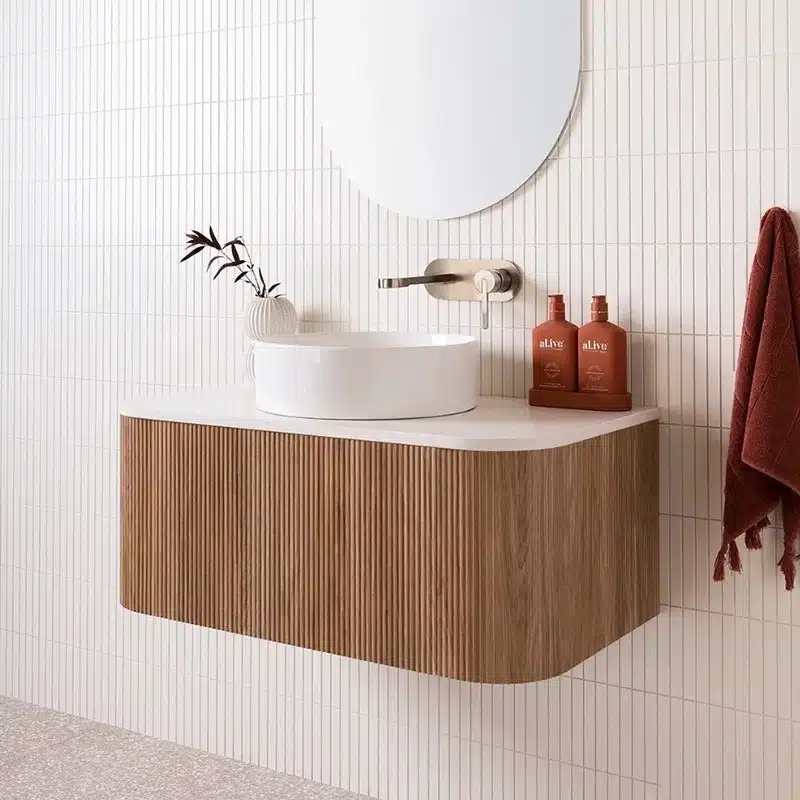
A successful hotel bathroom vanity project often fails on a detail many suppliers avoid: the substrate’s reaction to daily commercial cleaning. The dimensions in your CAD drawings can be perfect, but if the core is standard MDF, the vanities across 200 rooms will have swollen, delaminated edges within two years. This isn’t just a maintenance headache. It’s a premature replacement cycle that wrecks the operational budget.
The solution goes beyond just specifying waterproof PVC or marine-grade plywood. It’s about ensuring the factory’s process aligns with hospitality demands. This means demanding proof that the materials meet regional compliance—like UL/CSA in North America or CE in Europe—and getting photographic updates from the production line. Critically, you need the option to approve a small pre-production run of 10-20 units to validate the fit, finish, and MEP alignments before committing to the full order.
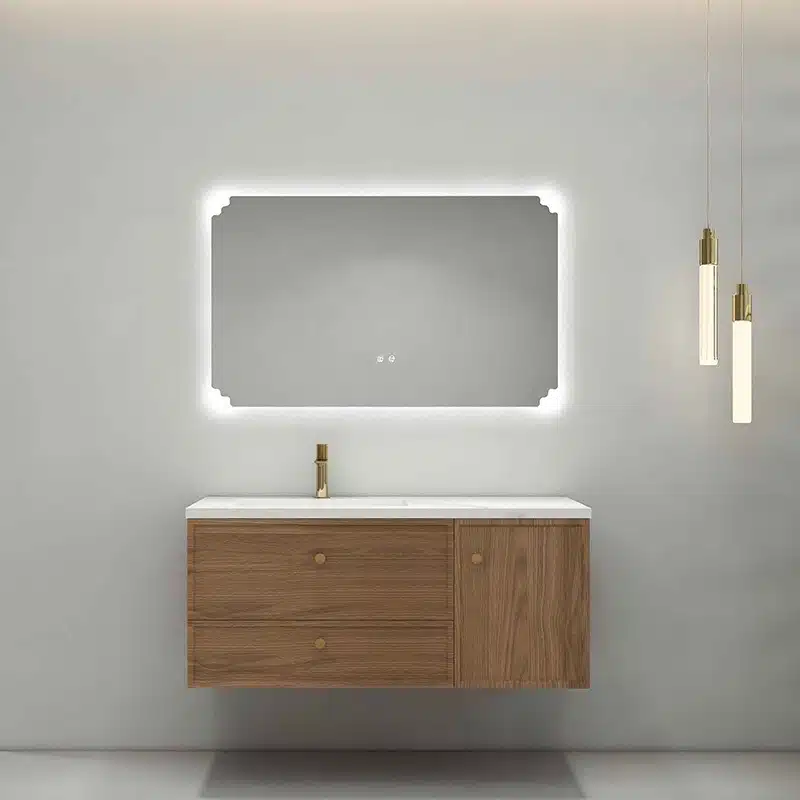
Why Standard Hotel Vanities Fail
A 10mm fit discrepancy on a stock vanity can stall an entire hotel floor, adding over 20% to installation labor.
Specifying standard retail vanities for a hotel project is a common but costly mistake. They are engineered for residential use, not the relentless humidity, aggressive cleaning schedules, and high traffic of a hospitality environment. The two primary failure points are material degradation from chemicals and dimensional inaccuracies that derail installation schedules.
Most off-the-shelf units use MDF (Medium-Density Fiberboard) as a core material. While stable in a dry home, it acts like a sponge in a hotel bathroom. The failure isn’t just from steam; it’s accelerated by commercial cleaning agents that attack the adhesive on edge banding, creating an entry point for moisture. Our internal tests show standard MDF can swell and delaminate after fewer than 50 cleaning cycles.
Even minor fit discrepancies become major problems at scale. A stock vanity that is 10mm too short for the alcove doesn’t just create an aesthetic gap; across 200 rooms, it means fabricating and finishing 200 filler strips on-site. This unplanned labor blows budgets and pushes back timelines, directly impacting the project’s profitability.
-
- Specify Waterproof PVC: This material is 100% waterproof and inert to the high-alkaline chemicals used in commercial cleaning. Our internal data confirms zero swelling or degradation after 500+ cleaning cycles, making it ideal for bathroom vanity for hospitality projects.
- Demand Moisture-Resistant Plywood: As an alternative, specify multi-layer, moisture-resistant plywood. Its cross-grained structure resists swelling and maintains structural integrity far better than MDF. Ensure it meets regional compliance like CARB P2 or CE E1 for formaldehyde emissions.
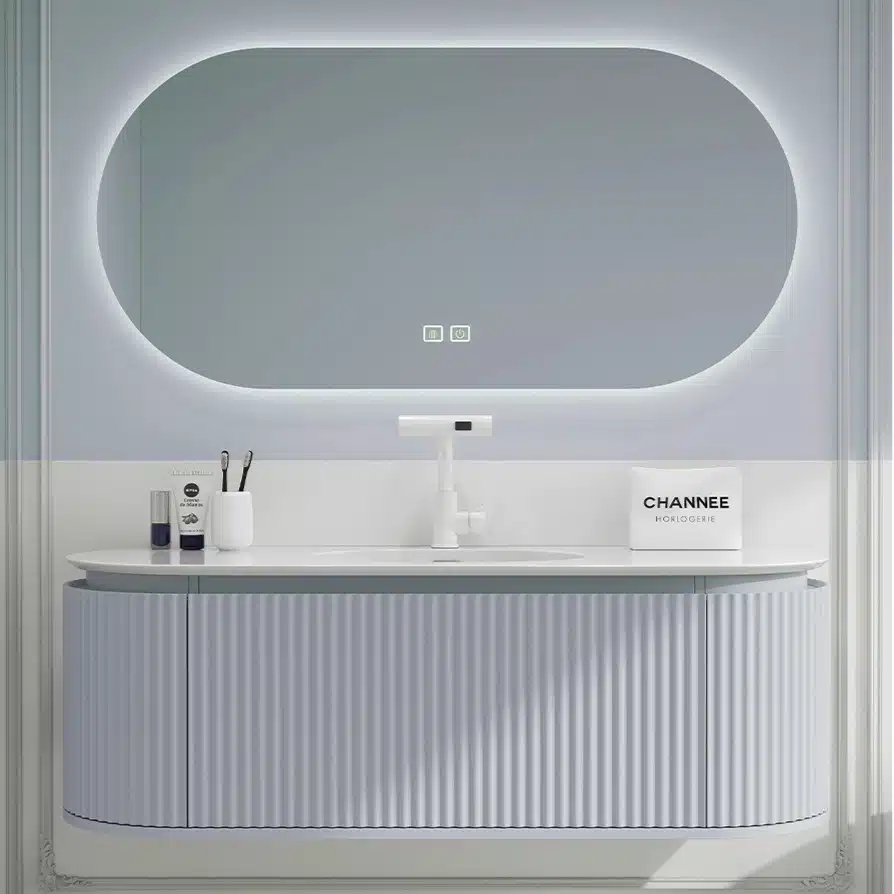
Hotel Vanity Costs: Custom vs Stock
Custom vanities have a higher unit price but a lower total installed cost, with savings coming from labor, not materials.
Specifiers often focus on the per-unit price, where stock vanities appear cheaper. This is a classic budget trap. For any hotel or multi-unit project, the real number to watch is the total installed cost, which includes on-site labor and modifications—areas where custom-built vanities create significant savings.
Off-the-shelf vanities are rarely a perfect fit. They almost always require on-site adjustments by expensive skilled labor. These modifications, like cutting filler strips to hide gaps, shimming uneven cabinets, or re-routing plumbing to fit standard knockouts, add unexpected costs and project delays. This isn’t pocket change; it’s a predictable expense that stock suppliers don’t advertise.
Factory-built custom vanities, engineered from your CAD drawings, eliminate this waste. They arrive milled to the exact dimensions of each room, ready for fast installation. When you’re installing hundreds of units, cutting installation time per room from two hours down to one translates into thousands of dollars saved on labor alone. The fit is perfect, the finish is consistent, and the project stays on schedule.
Finally, sourcing custom vanities directly from the factory cuts out the middleman. The typical 15-25% margin pocketed by a domestic distributor is removed from your project cost. This direct-sourcing advantage often completely offsets the higher initial price of a custom-built product, delivering a superior, purpose-built vanity for a comparable or even lower total cost.
| Attribute | Custom Vanities (Factory-Direct OEM) | Stock Vanities (Retail/Distributor) | Hidden Project Cost / Benefit |
|---|---|---|---|
| Estimated Price | $200 – $500+ | $100 – $300 | Custom pricing is all-inclusive; stock pricing hides significant downstream costs. |
| Installation & Labor | Fast, precise fit. Reduces labor time by up to 50%. | Requires on-site modifications (shims, fillers, cutting). Adds 20%+ to labor costs. | Custom saves an average of $50-$150 per unit in labor, preventing timeline delays. |
| Design & Fit | Milled to exact CAD specs for perfect consistency across all rooms. | Standard sizes lead to gaps, aesthetic compromises, and inconsistent installation. | Custom eliminates the risk of fit discrepancies that can halt an entire floor’s installation. |
| Material Durability | Engineered for hospitality: 100% waterproof PVC or moisture-resistant plywood. | Often uses standard MDF, which swells and delaminates under hotel cleaning cycles. | Custom materials prevent costly replacements and protect the hotel’s brand reputation. |
| Total Cost of Ownership | Higher initial cost but lower total project cost due to savings on labor and longevity. | Lower initial cost but higher total project cost due to modifications and shorter lifespan. | Factory-direct custom sourcing removes distributor margins of 15-25%, further reducing the total cost. |
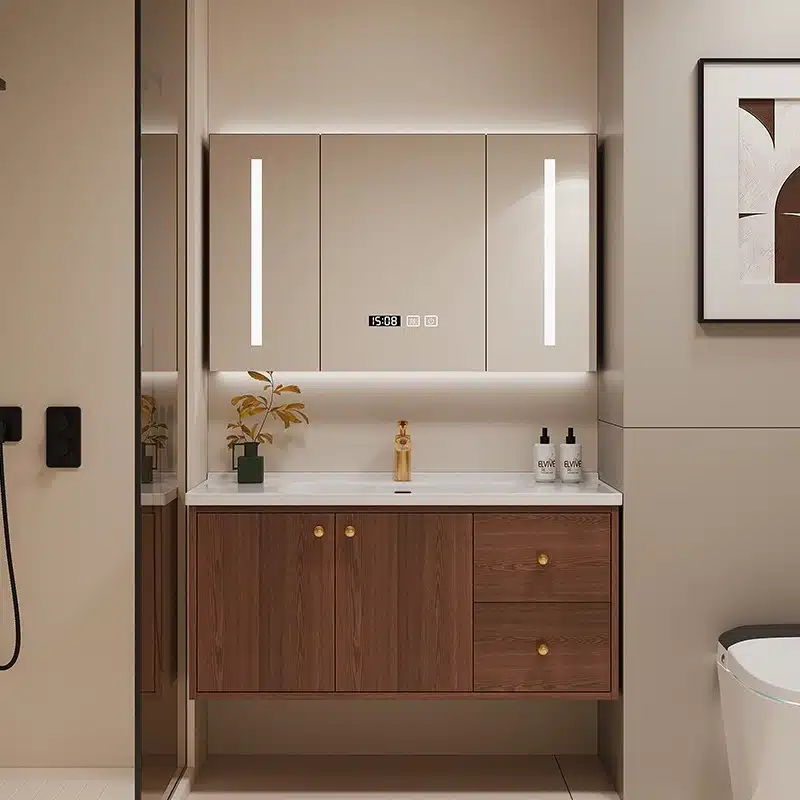
Custom vs Semi-Custom Vanities Guide
True custom builds to your CAD file; semi-custom just lets you change the paint color on a standard box.
In hospitality projects, the terms ‘custom’ and ‘semi-custom’ have serious financial and timeline implications. Semi-custom means you are altering finishes—color, hardware—on a pre-determined, standard-sized vanity carcass. The core dimensions are fixed, which is a critical limitation for professional projects.
True custom, which is the factory’s standard for OEM partners, means every dimension is variable. The factory builds directly
-
- True Custom: Essential for large-scale hotels with hundreds of identical rooms. It guarantees absolute consistency and eliminates the need for costly on-site modifications, ensuring every unit installs identically and on schedule.
- Semi-Custom: Can be a budget option for boutique properties where each room may have a unique footprint. However, you risk compromising the design to fit a pre-set cabinet size, which can create awkward gaps or plumbing conflicts.
The choice impacts more than just fit. A true custom specification allows you to mandate performance-tested materials like 100% waterproof PVC for humid resort environments, not just the aesthetic finish. This level of material control is impossible with a semi-custom program built on a stock chassis.
| Attribute | Semi-Custom Vanity | Full Custom (OEM/ODM) | Project Fit |
|---|---|---|---|
| Dimensions & Sizing | Based on pre-set cabinet sizes. Limited adjustments to width and depth. | Fully adaptable to any dimension (width, depth, height) to match exact CAD drawings and MEP layouts. | Best for standard room layouts where minor gaps are acceptable. |
| Material & Finish | Choose from a manufacturer’s curated catalog of colors and finishes. | Over 40,000 combinations, including Pantone/RAL color matching and client-specified materials (PVC, Plywood, Sintered Stone). | Best for projects with flexible design guidelines. |
| Hardware & Integration | Standard selection of handles, hinges, and drawer slides. | Client-specified hardware (e.g., Blum), branded logo engraving, and custom cutouts for plumbing or electrical. | Best for achieving a unique, high-end branded hotel experience. |
| MOQ & Prototyping | May require larger initial order commitments. | Low MOQ of 10-20 units allows for cost-effective pre-production samples to validate design intent. | Ideal for designers needing to approve a physical prototype before a full-scale rollout. |
| Cost & Installation | Lower upfront unit cost but may incur significant on-site labor costs for modifications and fitting. | Higher upfront unit cost but eliminates on-site modification labor, reducing total installed cost by up to 20%. | Best for projects where minimizing total project cost and installation time is critical. |
Specify Hotel Vanities Without Delays
Vague specifications are the number one source of project delays; a detailed factory process is your best insurance policy.
For hospitality projects, ‘close enough’ is a failure. A 10mm discrepancy in a vanity’s plumbing cutout, multiplied across 200 rooms, results in thousands of dollars in on-site labor and project delays. The key to avoiding this isn’t hope; it’s a rigorous specification and verification process that locks in design intent before mass production ever begins.
Your specification document is the legal and technical blueprint. It must go beyond simple dimensions and a photo. A production-ready document eliminates ambiguity and makes the factory an extension of your design team, not a source of problems.
-
- CAD Drawings with MEP: Provide drawings that show not just vanity dimensions, but also precise locations for plumbing and electrical rough-ins. This prevents conflicts with wall infrastructure during installation.
- Material Certifications: Specify the exact material (e.g., 100% waterproof PVC, E1-grade plywood) and the required compliance standard (e.g., UL/CSA for North America, CE for Europe). This is non-negotiable for passing inspections.
- Finish & Hardware Codes: Use universal codes like Pantone or RAL for colors. Specify the exact model and finish for all hardware, from pulls to hinges, to ensure perfect consistency.
Insist on photographic proof at key production milestones. This isn’t about micromanaging; it’s about quality assurance. At our facility, this is a standard part of the five-stage inspection process. You should see photos of raw material batches, post-cutting CNC accuracy, assembly, finishing, and final packaging. This allows you to catch any deviation from the spec long before the product is on a container ship.
Finally, never waive the pre-production sample. This is the ‘golden sample’ that serves as the physical contract for the entire order. A low Minimum Order Quantity (MOQ) is critical here. Our MOQ of 10-20 units is designed specifically to allow architects and designers to procure a final, production-grade sample for stakeholder approval without committing to the full project volume. This single step protects your design integrity and the project budget more than any other.
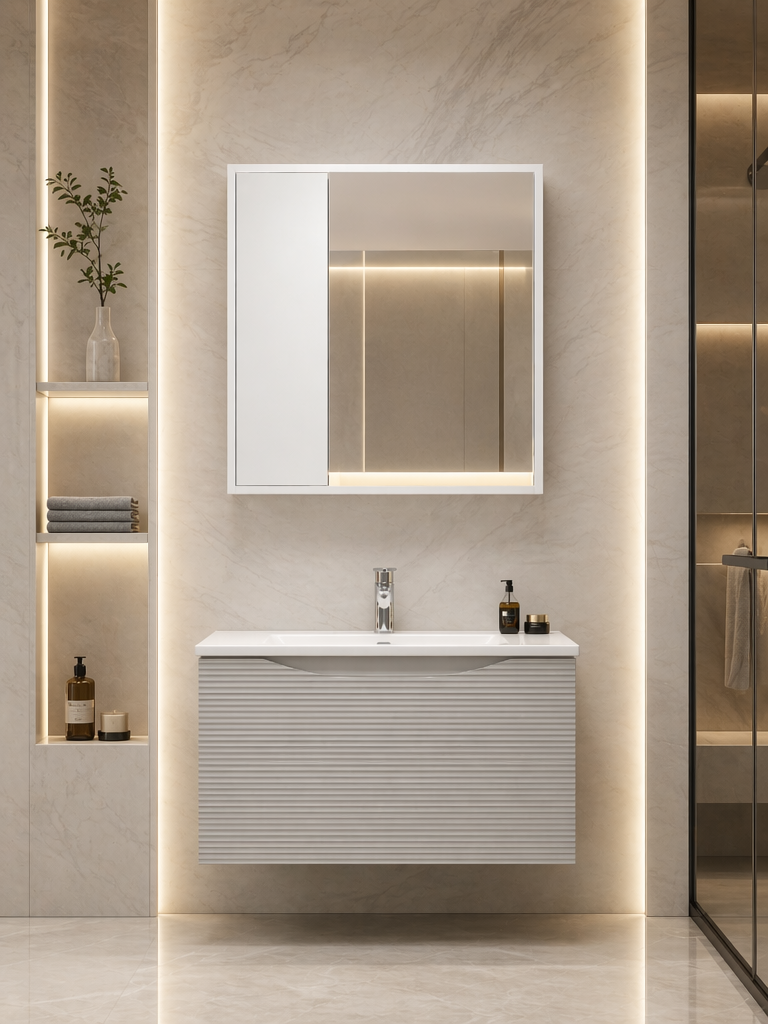
Hotel Vanity Materials: Durability Picks
Hotel vanity specification is engineering for relentless use, not just choosing a finish.
A hotel bathroom environment is uniquely hostile. Vanities must endure daily exposure to aggressive cleaning chemicals, constant high humidity, and physical abuse. Materials that work in a home, like standard MDF or particleboard, will delaminate and swell within months under this operational tempo.
-
- PVC Cabinetry: This is the baseline for any high-humidity or coastal resort project. As a material, PVC is 100% waterproof, not just ‘water-resistant’. It is completely inert to moisture and will not swell, warp, or delaminate, making it a zero-risk specification for wet zones.
- Plywood with HPL: For projects requiring a balance of structural strength and cost-effectiveness, multi-ply plywood sealed with a High-Pressure Laminate (HPL) is the correct choice. The plywood core provides superior screw-holding power for hardware, while the HPL surface offers robust protection against scratches and cleaning agents.
- Sintered Stone Tops: For countertops, this material is the commercial standard. It is non-porous, meaning it won’t harbor bacteria or stain from spilled cosmetics. Our internal testing confirms sintered stone surfaces withstand over 10,000 cleaning cycles with harsh chemicals without degradation, and they are impervious to heat from hair styling tools.
A final verification step, often missed by designers, is regional climate suitability. For projects in tropical or subtropical zones like Oceania or South America, material specifications must include verification of termite resistance. Likewise, for arid regions like the Middle East, materials must be stable in temperatures reaching 50°C.
| Material | Performance Highlights | Best Application | Project Suitability |
|---|---|---|---|
| PVC (Polyvinyl Chloride) | 100% waterproof, immune to swelling. Withstands aggressive cleaning chemicals and high humidity. | High-traffic hotels, coastal resorts, and humid climates where water exposure is constant. | Cost-effective solution for large-scale projects requiring maximum water resistance and low maintenance. |
| Plywood (Moisture-Resistant) | Multi-layer construction offers superior structural strength and screw-holding power. Resists moisture and warping. | Mid-range to luxury hotels needing a balance of durability, cost, and design flexibility with wood veneers or laminates. | A versatile and reliable choice for most hotel environments, outperforming standard MDF or particleboard. |
| Solid Wood (Oak/Walnut) | Unmatched premium aesthetic and natural strength. Properly sealed to resist bathroom humidity. | Luxury suites, boutique hotels, and high-end properties aiming for a classic, sophisticated ambiance. | The top-tier choice for projects where luxury feel and timeless design are the primary specifications. |
| Sintered Stone | Extremely durable: scratch-proof, non-porous, and heat-resistant (up to 50°C). Tested for 10,000+ cleaning cycles. | Vanity cabinets, countertops, and integrated basins in modern, minimalist, or high-end commercial projects. | Ideal for projects demanding ultimate durability and a sleek, contemporary look that withstands heavy use. |
Conclusion
A hotel bathroom vanity project succeeds or fails long before installation. Choosing materials tested for hospitality use—like PVC that withstands 500+ cleaning cycles—and confirming regional compliance (UL/CSA or CE) prevents costly rework and protects your design intent. This turns a detailed specification sheet into a predictable, on-budget outcome.
Frequently Asked Questions
What is the size of a vanity in a hotel?
Hotel vanity sizes are custom-specified per project, but common dimensions are 34-36 inches in height and 21 inches in depth. These dimensions must also meet regional accessibility standards, such. Always provide final CAD files to the manufacturer for a precise, project-specific fit.
What are the key design elements of a hotel style bathroom?
The key design elements are durability and a cohesive, high-end aesthetic achieved through specific material choices. This includes using non-porous surfaces like sintered stone and integrated technology like anti-fog. Specify materials based on the hotel’s brand positioning and the local climate’s demands.
What is the average cost to install a bathroom vanity?
Installation cost is part of a project’s overall labor budget, not a fixed per-unit price. However, factory-customized vanities can reduce on-site installation labor by over 20% by eliminating the. Evaluate the total installed cost, not just the unit price, when comparing suppliers.
How to make your bathroom look like a hotel bathroom?
Achieve a hotel look by using integrated, high-performance components like a floating vanity and a large smart LED mirror. Using a single, durable material like sintered stone for both. Select a single material family for the main surfaces to ensure visual cohesion.
What is the current trend for bathroom vanities?
The dominant trend for hotel projects is the use of durable, engineered materials like sintered stone and waterproof PVC. Functionally, integrated smart mirrors with anti-fog and adjustable lighting are. Prioritize material performance and regulatory compliance over purely aesthetic trends for long-term success.


0 Comments