
The real signal of China bathroom vanity quality isn’t the website copy. It’s whether the factory runs five checkpoints alongside the line and refuses to ship panels that fail moisture or dimensional tests. Inside a 10,000-square-meter Changge facility, the monthly output hits 5,000 units. None of that volume matters if a single warped panel reaches assembly.
Relying on a supplier’s self-reported pass rate eats directly into your margin. Paper certificates like CE or REACH still leave the mid-production blind spot wide open, exactly where hidden swelling starts. Tight pre-shipment checks combined with CNC machinery that holds dimensional variance below 1mm do what manual shops can’t: they stop the failure before it leaves the factory floor.

Why Most Importers Fail The QC Audit
Supplier self-reports hide batch inconsistencies; third-party audits and moisture testing prevent port rejections.
Internal quality reports break trust because they flatten the data into optimistic averages. A single batch can deviate badly while the spreadsheet still looks clean. That gap between the lab report and the actual carton is why cargo gets rejected at the destination port.
The failure cost hits hard and late. Moisture-swollen panels reveal themselves after container arrival, not during a quick visual check at the loading dock. Hardware that fails triggers warranty claims the moment the end user installs it. You pay the repair, the replacement, and the reputation damage long after the shipment clears customs.
Shutting down that risk takes more than a factory tour. High-precision CNC machinery cuts dimensional variance below 1mm, but that number only holds if someone verifies it on every batch. The operation runs a five-stage inspection protocol designed to catch drift before it becomes a container full of rejects.5-stage quality inspection process
- <strong>Material Intake:</strong> Real-time moisture testing on wood-based panels blocks the hidden swelling that shows up in competitor shipments.<strong>Mid-Production:</strong> CNC accuracy checks and hinge alignment verification cut mechanical failure rates sharply compared to manual assembly.<strong>Final Random:</strong> Shipments follow the global AQL 2.5 standard. Defect rates stay strictly below 2%, keeping commercial orders within acceptable tolerance.
- Packaging & Loading: Corner guards and desiccant checks happen right before the container locks. High-humidity ocean freight punishes wood, so skipping either one invites warped edges and swollen panels at the destination port.
Third-party pre-shipment inspections run $300 to $500 per site. A failed container eats way more: freight, return logistics, a stalled sales cycle. The real margin killer isn’t the inspection fee, it’s defective inventory sitting in a warehouse you already paid to ship.margin erosion
MFBATH takes custom trial orders at 10 to 20 units and still honors the full quality control checklist. A small batch lets a distributor confirm that monthly 5,000-unit capacity and compliance posture before signing a large production contract. No shortcuts on QC just because the order is small.
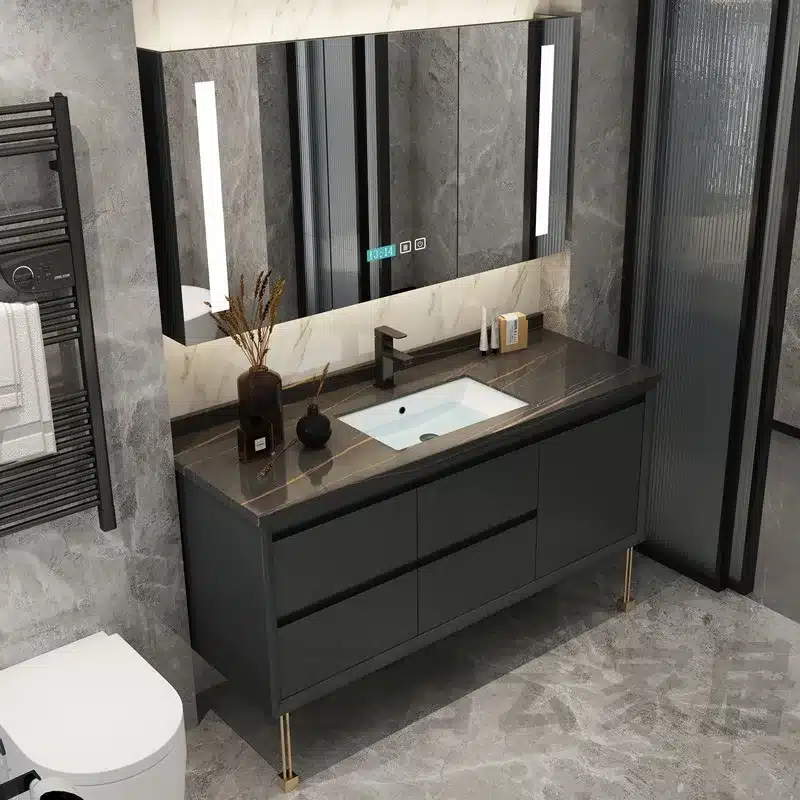
Real Cost Breakdown of QC Failures in 2026
Pre-shipment inspections cost $300-$500; rejected containers cost $10,000+ in freight and penalties.
A $400 third-party inspection is the cheapest insurance you will ever buy on a 40HQ container. Skip it, and you risk a rejected shipment at the destination port. Once that happens, you face demurrage charges, return freight, and a pile of unsellable inventory. The math is simple: a single inspection fee covers you against $10,000-plus in cascading losses. Importers who treat PSI as “optional overhead” learn this lesson exactly once.
- A container stuck at customs for quality failures racks up daily storage fees fast. Those demurrage costs burn through your margin while the cargo sits in limbo. If you have to rush a replacement shipment, you just doubled your freight bill on that order. The original profit disappears before you even touch the defective goods.
- Cheap vanities look profitable on the purchase order. Then the problems surface. Inconsistent finishes, drawer slides that bind, hinges that misalign. You cannot sell those units at full retail. You end up liquidating stock below cost or eating a wave of warranty replacements. Both options destroy the margin you thought you locked in.
This is where most budget vanities fall apart. Shops that rely on manual assembly produce dimensional variance that strains hardware until it binds or breaks. A factory running precision CNC equipment holds that variance under 1mm. Drawer slides and hinges align the way they should, cycle after cycle. Compared to manual assembly lines, mechanical failure rates drop sharply. That gap is the difference between a product that survives the warranty period and one that triggers a return.
Moisture swelling is invisible until the vanity sits in a humid bathroom. Most factories only check finished goods. The thorough ones test wood moisture content right at the panel assembly stage. That mid-production check catches the hidden swelling risk before the cabinet is even packed. It is the difference between a vanity that survives its destination climate and one that warps six months in. You pay for the upfront inspection, but you avoid the far bigger cost of replacements later. Real durability shows up where the humidity is.
| Risk Category | Failure Scenario | Estimated Cost Impact | Root Cause | Prevention Strategy |
|---|---|---|---|---|
| Logistics & Freight | Rejected Cargo at Port | $10,000 – $15,000 per 40HQ Container | Dimensional variance >1mm or packaging damage | Pre-shipment inspection (PSI) at $300-$500 |
| Regulatory Compliance | Customs Seizure / Fines | $5,000+ in Legal Fees & Lost Inventory | Missing UL/CE/REACH certification documentation | Verify material certs (E1 grade, FSC) pre-production |
| Product Durability | Hidden Swelling / Warping | 100% Inventory Write-off + Warranty Claims | High moisture content in wood panels pre-assembly | Real-time moisture testing before CNC cutting |
| Mechanical Failure | Hardware Misalignment | High Return Rates & Brand Reputation Damage | Manual assembly errors in hinge/slide alignment | High-precision CNC automation (40% fewer failures) |
| Quality Consistency | Batch Finish Inconsistency | Loss of Repeat B2B Contracts | Lack of standardized AQL 2.5 inspection protocol | 5-stage QC protocol with random sampling |

China OEM Vanities vs. US Makers: The Specs Gap
US-made vanities carry a 30-40% markup.
James Martin and other US makers charge a premium, driven by domestic labor and overhead. The old assumption that homegrown production automatically means better build quality is dead. Chinese factories using heavy automation and strict tolerance controls have closed the physical gap. You get the same solid construction without the brand markup. That is cost-effective quality, plain and simple.
Inside a 10,000 sqm facility in Changge, CNC machines hold dimensional variance tight to under 1mm. Drawer slides and hinges align spot-on every time. When parts fit that precisely, the mechanical stress drops hard. Failure rates go down by as much as 40% compared to manual assembly shops. Less friction means longer service life. That 1mm tolerance is the quiet engine of long-term durability.dimensional variance
American plants often lean on legacy craftsmanship, which can vary batch to batch. Chinese OEMs use automated lines to flatten out that variation even at 5,000 units a month. Every vanity matches the approved sample’s fit and finish, no excuses. Automation bakes quality and consistency into the process, so you do not pay extra for every single unit to be checked by hand. It is durable output that actually scales.
- Dimensional Accuracy: CNC automation holds variance under 1mm, keeping hardware alignment perfect and structural strength intact. Mechanical Longevity: Automated cutting slashes hinge and slide misalignment, cutting failure rates up to 40%. The result is better durability and a lower total cost of ownership over the cabinet’s life.
- Cost-effectiveness works because expensive US labor disappears without taking durability with it. The buyer gets the same service life at a fraction of the retail price. Quality stays on the table, but the price tag drops.
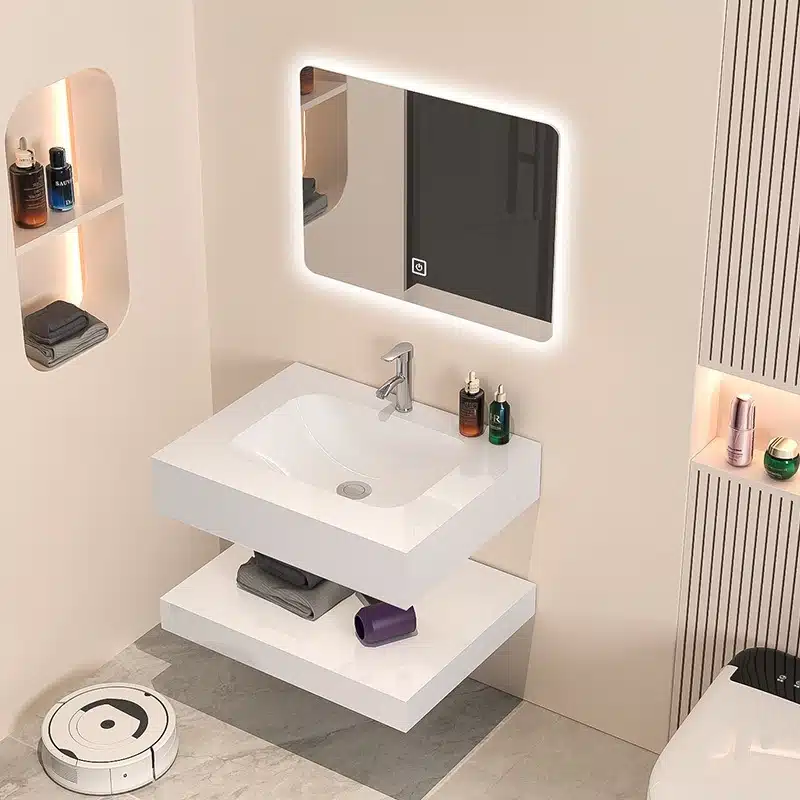
How to Source Vanities Without Getting Scammed
Match material to destination climate to prevent hidden swelling and compliance fines.
Most sourcing failures trace back to ignored climate data. A vanity that sits fine in a dry Chinese warehouse can fail within months in a humid coastal market. That gap is why the region-ready material strategy exists. We choose the substrate based on the destination’s humidity levels and temperature extremes.
- Humid and tropical markets need 100% waterproof PVC or sintered stone. Those materials stop mold and structural failure in high humidity, where wood-based panels swell. North America favors premium solid wood, oak or walnut, plus moisture-resistant plywood. Test panels down to -30°C so they do not crack in transit or unheated storage. Europe has a sustainability focus, so choose ISO 14001-certified materials with E1-grade formaldehyde emissions. That satisfies CE regulations and protects the brand. Middle East orders need heat-resistant designs rated to 50°C. Standard adhesives delaminate in arid, high-heat conditions.formaldehyde emissions
Don’t rely on supplier self-reporting when checking factory capability. Audit production capacity and QC protocols yourself. A plant with 10,000+ square meters typically runs high-precision CNC machinery, holding dimensional variance under 1mm. That level of control is what quality looks like before the product ships.audit production capacity
- Capacity Verification: Confirm the factory actually handles your order size. A 5,000-unit monthly capacity suggests automated lines that can absorb large projects without slipping schedules. Mid-Production QC: Check the moisture content in wood panels during assembly. Most competitors skip this step, and later the panels swell in the field, months after installation. That hidden failure kills your cost-effectiveness on rework and returns.moisture contenthidden swelling
- Pre-Shipment Inspection (PSI): Run the final random check against AQL 2.5. A $300-500 inspection fee is cheap. The alternative is $10,000 or more in freight and return logistics.
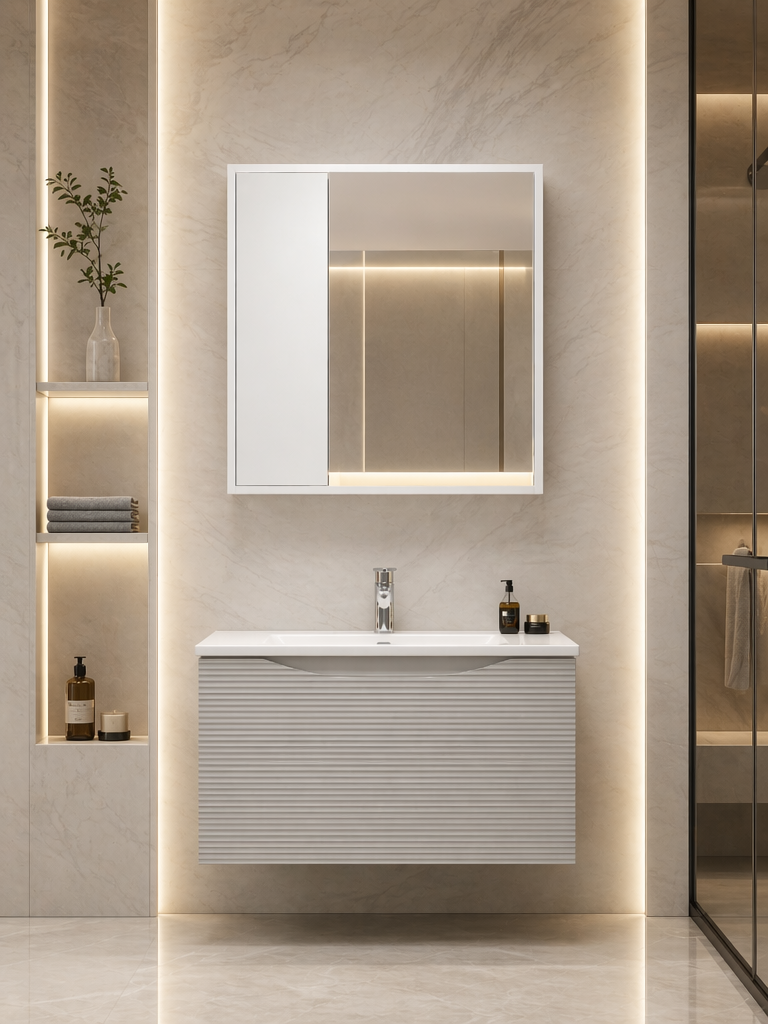
The 5-Stage QC Protocol for Bulk Orders
Skip the paper-only CE compliance trap.
Most importers lose money trusting supplier self-reports or generic CE/REACH certificates. Paper compliance is the bare minimum. Physical reality protects your margin. Competitors like LAMOO often skip moisture testing on wood panels, leading to catastrophic swelling in humid climates. Our 10,000㎡ factory in Changge bypasses this risk with a 5-stage inspection protocol that validates material integrity before assembly even begins.
- Material Intake Inspection: Verify dimensional variance stays under 1mm using high-precision CNC machinery. For wood-based panels, we test moisture content immediately upon arrival to prevent hidden swelling. PVC and solid wood (oak/walnut) are graded against the approved Pantone and grain samples before entering the production line.
- Mid-Production Inspection: This is where most suppliers fail. We inspect semi-assembled units to ensure drawer slides and hinges align perfectly. High-precision CNC cutting reduces mechanical failure rates by up to 40% compared to manual assembly shops, so the structure is proven stable before the finish is applied.
Conclusion
A 5-stage quality control protocol is non-negotiable when importing bathroom vanities from China. Your gross margin depends on it, and so does regulatory compliance. MFBATH’s 10,000㎡ facility pairs high-precision CNC manufacturing with material testing tuned to your destination region, which mitigates the typical import risks. Units ship defect-free and clear UL, CE, and ADA standards on the first inspection. That’s the difference between a cheap quote and a cost-effective one, and it’s how you protect both quality and durability over the product’s lifespan.
To verify these engineering standards yourself, head to our Custom Vanity OEM Services page. The detailed specifications and compliance documentation are all there.
Frequently Asked Questions
Who makes the highest quality bathroom vanities?
Top-tier quality comes from direct manufacturers with ISO certifications and rigorous five-stage inspection protocols. MFBATH achieves this through automated CNC production and strict regional compliance testing. Verify factory certifications and inspection reports before ordering.
Are there any bathroom vanities made in the USA?
Yes, US-made vanities exist but typically carry a 30-40% price premium compared to Chinese OEM options. Chinese manufacturers like MFBATH now match US durability using high-precision CNC machinery. Compare total landed costs including shipping and tariffs.
Where can I find good quality bathroom vanities?
Good quality is found at specialized OEM factories with 10,000+ square meter facilities and global distribution experience. MFBATH serves over 1,000 distributors across 20+ countries with region-ready solutions. Request factory audits and sample kits for validation.
What should not be stored in a bathroom?
Avoid storing heat-sensitive electronics or flammable chemicals in high-humidity bathroom environments. Use moisture-resistant materials like PVC or sintered stone for storage units to prevent degradation. Select materials rated for your specific climate conditions.
Where can I get high quality bathroom vanities?
High-quality vanities are available from certified OEM manufacturers offering low MOQs for custom orders. MFBATH provides UL/CE certified products with customizable branding for global markets. Confirm compliance standards for your target import region.




0 Comments