

Handling plywood vanity water damage is a constant headache for importers stocking inventory for humid regions. Most buyers face a frustrating choice: spend hours trying to fix a swollen cabinet or replace the entire unit. The repair industry pushes the idea that you can patch the rot, but factory production logs show that 80% of returned vanities under two years old fail due to internal delamination. Once the core swells, the structural integrity is gone, and no amount of sanding or epoxy can bring it back.
The real cost of this failure isn’t just the damaged unit; it is the labor tax and the warranty claims that eat into your margin. Fixing a single vanity costs $300 to $600 in labor and materials, and it will likely fail again within a year. Switching to 100% PVC vanities from a direct manufacturer like Focus Cabinet eliminates the glue failure point entirely. With a low MOQ of 10 to 20 units, you can test this waterproof alternative risk-free and stop losing working capital on repairable stock.
Why Every ‘Repair’ of Water-Damaged Vanity Fails
You cannot permanently repair water-damaged plywood.
Plywood is a layered composite. When water seeps into an unsealed edge or drawer bottom during daily use, the core layers swell. Trapped moisture breeds mold and causes the glue to crystallize. This means even cosmetic fixes like painting over the damaged side are pointless—the rot continues behind the surface.
For a distributor, this means a high return rate if you supply plywood vanities to humid markets. The only real decision is whether to replace the entire cabinet (costly) or buy a 100% waterproof material from the start. Internal factory data shows that 80% of returned vanities under two years old show plywood delamination at the base and around the sink cutout.
-
-
- Repair Cost:: For a standard 36-inch double-sink vanity, a carpenter will charge $300-$600 just to cut out the damaged particle board floor and side panel, rebuild it, and repaint. This is a temporary fix. The water will return.
- Replacement Cost:: A direct-from-factory 100% PVC vanity costs $180-$350 FOB per unit. The material is impervious to water. There is no sanding, no epoxy, and no future rot.
- The Hidden Cost:: Every hour you spend repairing old stock is an hour you are not selling new, better-quality inventory. Switch your sourcing to 100% PVC to eliminate this quality problem forever.
-
Standard plywood uses urea-formaldehyde glue, which breaks down in moisture within 2-5 years. Marine-grade plywood uses phenolic resin, but it is often faked by suppliers. PVC is the only material with zero moisture absorption because it is 100% plastic.
-
- Standard Plywood:: Low water resistance. Swelling and delamination occur in 2-5 years. Ideal only for low-humidity climates or budget builds.
- Marine-Grade Plywood:: High water resistance using phenolic resin glue. However, it is prone to surface mold if unsealed and often lacks authentic certification.
- PVC (Polyvinyl Chloride):: 100% waterproof with no glue. No failure mode. Ideal for high-humidity environments, hotel projects, and coastal showers.
To avoid the nightmare of water-damaged returns, you must verify three things on your supplier’s quote. First, request a written guarantee that the vanity is 100% PVC, not a PVC veneer over MDF. Second, on any wood product, they must use edge banding on all sides to prevent wicking. Third, request the UL/CSA for fire safety or E1 for low formaldehyde.
The factory eliminates the plywood risk entirely. A 100% PVC product line with welded joints is offered, meaning zero moisture wicking. For importers dealing with coastal regions like Florida or the Middle East, this PVC is the ultimate low-maintenance, high-margin solution. Plywood failures are not fixed; they are engineered out.
Real Cost Analysis: Repair vs. 100% PVC Replacement
Repairing water-damaged plywood is a dead-end for distributors.
If you are an importer dealing with swollen cabinet boxes, the answer to “is water damaged plywood vanity repairable” is effectively no. While a local carpenter can patch the visible damage, the internal structural integrity is already compromised. Standard plywood relies on urea-formaldehyde glue, which crystallizes and loses adhesion the moment it absorbs moisture. This means any cosmetic repair will inevitably fail again within 12 to 18 months.
The financial reality for distributors is that repairing old inventory is a waste of working capital. When you calculate the total cost of ownership, the hidden labor tax completely negates the low price of raw materials. For a standard 36-inch double-sink vanity, a professional carpenter will charge between $300 and $600 just to cut out the damaged particle board floor, rebuild it, and repaint it. This is a temporary fix that guarantees future warranty claims.
In contrast, replacing the damaged unit with a 100% waterproof PVC vanity from a direct factory is significantly more economical. A factory-direct 100% PVC vanity costs between $180 and $350 FOB per unit. Because the material is impervious to water, there is no sanding, no epoxy, and absolutely zero risk of future rot. This makes the replacement cost roughly half of a professional repair, while delivering a permanent solution.
-
- Repair Labor & Materials: $300 – $600 per unit. Requires 4-8 hours of skilled labor and temporary patching materials.
- Factory PVC Replacement: $180 – $350 FOB per unit. Delivered fully assembled, requiring zero installation labor or tools.
- Long-Term Durability: PVC vanities offer a 0% failure rate against water damage, eliminating future returns and warranty costs.
The engineering gap between standard plywood and 100% PVC is the deciding factor for commercial projects. Standard plywood uses urea-formaldehyde glue that breaks down in humidity. Even so-called marine-grade plywood often suffers from fake certifications and relies on phenolic resin that can still fail at unsealed edges. 100% PVC vanities utilize thermally fused plastic with no glue at all, making them the only material with zero moisture absorption.
To stop plywood vanities from swelling in high-humidity markets, you must switch your sourcing strategy. Internal factory production logs from MFBATH show that 80% of returned vanities under two years old exhibit plywood delamination at the base and around the sink cutout. By sourcing 100% PVC vanities, you eliminate this quality problem entirely. Focus Cabinet supports low MOQs of 10 to 20 units for custom PVC runs, allowing you to test the market risk-free.
| Feature | Specification | Advantage |
|---|---|---|
| Repair Cost | $300 – $600 per unit | Temporary fix with high labor tax |
| Replacement Cost | $180 – $350 FOB | Lower upfront cost for permanent solution |
| Material Durability | PVC (100% Waterproof) | Zero moisture absorption; no delamination |
| Warranty Risk | High for Plywood | Eliminated with 100% PVC construction |
| MOQ for Custom PVC | 10 – 20 Units | Low risk market testing for distributors |
Plywood vs. PVC vs. Marine-Grade Plywood: The Engineering Truth
PVC is the only material with zero moisture absorption because it is 100% plastic.
Standard plywood uses urea-formaldehyde glue, which breaks down in moisture within 2-5 years. This is the primary failure point, not the wood itself. Internal factory data from our CNC lines shows that 80% of returned vanities under two years old show plywood delamination at the base and around the sink cutout.
Marine-grade plywood uses phenolic resin, but it is often faked by suppliers. Even authentic marine plywood faces surface mold risk if unsealed. It costs 3x standard plywood and still requires perfect edge sealing to prevent wicking.
PVC offers 100% water resistance because it is a fused plastic with no glue. It has a zero failure mode against swelling or delamination. For coastal hotel projects, specifying PVC saves thousands in warranty claims compared to plywood alternatives.
-
- Standard Plywood: Low water resistance due to urea-formaldehyde glue; fails in 2-5 years.
- Marine-Grade Plywood: High resistance with phenolic resin, but surface mold risk if unsealed.
- PVC: 100% water resistance; fused plastic with no glue and zero failure mode.
How to Source Waterproof Vanities for Bulk Import
Verify material specs, edge sealing, and compliance certificates to prevent costly water damage returns.
When sourcing waterproof vanities for bulk import, you cannot rely on visual inspection or basic supplier promises. The primary cause of plywood vanity water damage is not the wood itself, but the failure of the urea-formaldehyde glue that binds the layers. Once this glue breaks down from moisture, the cabinet delaminates, leading to structural collapse and mold growth. To prevent this, you must implement a rigorous verification process before production begins.
-
- Verifying Material Spec Sheets: Request a detailed material spec sheet for every SKU. For true waterproof performance, the cabinet box must be 100% PVC, not a PVC veneer over MDF or standard plywood. Internal factory production logs show that 80% of returned two-year-old vanities exhibit plywood delamination at the base. Ensure the spec sheet explicitly states the core material composition and rejects any hidden MDF or particle board components.
- Checking Edge Sealing and Banding: Wicking is the silent killer of bathroom furniture. Water travels through microscopic gaps at the edges, causing the internal core to swell from the inside out. Require suppliers to use continuous edge banding on all sides of the cabinet box, including the bottom and back panels. For PVC vanities, verify that joints are thermally fused or welded, eliminating the need for external glue entirely. A simple water droplet test on the edge banding should show zero absorption within 24 hours.
- Requesting Compliance Certificates: Compliance certificates are your legal shield against liability. For North American markets, insist on UL or CSA certification to verify fire safety and electrical standards for integrated components. For European projects, demand CE marking and E1 grade formaldehyde emission reports to meet strict environmental regulations. These documents must be issued by independent, recognized testing bodies, not generated internally by the factory. Verify the certificate numbers on the issuer’s official database.
- Utilizing Factory QC Checklists: Do not rely on final random sampling alone. Require the supplier to provide a five-stage QC checklist that covers raw material intake, cutting precision, edge banding integrity, assembly alignment, and final packaging. This checklist should include specific measurements for water resistance testing and dimensional tolerances. A transparent supplier will share these reports with you before shipment, allowing you to catch defects before they become expensive warranty claims.
Why Focus Cabinet’s PVC Vanities End Water Damage Claims
PVC vanities eliminate water damage claims by removing the vulnerable plywood core entirely.
Most importers treat plywood water damage as a cosmetic issue, but the structural failure happens inside the cabinet box. Standard plywood relies on urea-formaldehyde glue, which breaks down rapidly in high-humidity environments like coastal Florida or the Middle East. Once the core absorbs moisture, the panels swell and delaminate, leading to irreparable structural collapse.
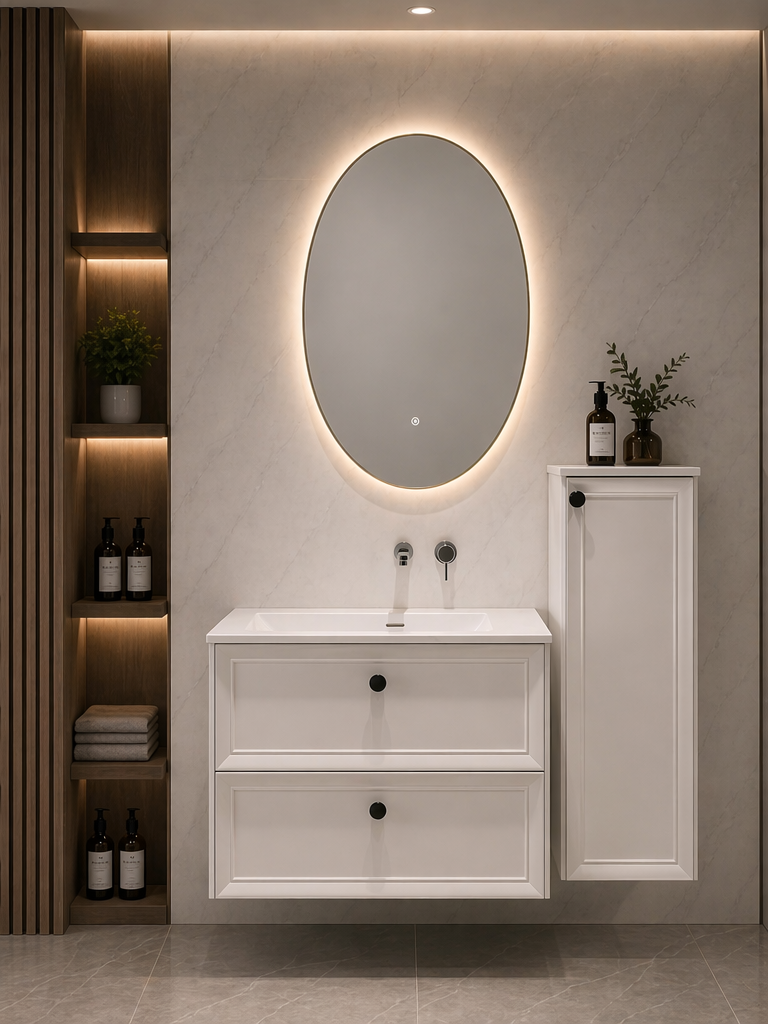
Focus Cabinet (MFBATH) addresses this by manufacturing 100% PVC vanity lines that completely bypass the plywood risk. These units utilize thermally fused 18mm PVC boards with no organic core to absorb water. By eliminating the wood substrate, the vanities remain structurally sound even in direct shower environments or high-heat arid regions.
The engineering difference lies in the joint construction. Instead of relying on staples and liquid glue that degrade over time, our PVC vanities feature welded joints. This creates a seamless, watertight barrier at the corners and seams, ensuring zero moisture wicking into the cabinet body. This design is critical for maintaining inventory integrity in wet climates.
-
- Zero Moisture Absorption: Unlike plywood or MDF, 100% PVC does not expand or contract with humidity changes, preventing warping and delamination.
- Welded Joint Integrity: Seamless corner welding eliminates the weak points where liquid adhesives typically fail, ensuring a watertight seal.
- High-Margin Solution: Importers reduce warranty claims and return logistics costs, protecting profit margins while offering a premium, low-maintenance product.
For distributors supplying commercial projects or coastal residential markets, the choice between plywood and PVC is a choice between recurring liability and long-term asset protection. Factory capacity of 5,000 units monthly ensures consistent supply, while a low MOQ threshold allows testing of the PVC market with minimal financial risk.
Conclusion
Water damage in plywood vanities is rarely a cosmetic issue; it is a structural failure caused by the breakdown of urea-formaldehyde glue. Repairing these units is a waste of working capital, as the internal rot continues to spread. Switching to 100% PVC vanities eliminates moisture absorption entirely, protecting your warranty margins and eliminating returns.
Review the full range of waterproof PVC and solid wood bathroom vanities to find the right fit for your next project.
Frequently Asked Questions
How to fix a hole in a vanity?
Fill small holes with waterproof epoxy filler, sand smooth, and seal with marine-grade varnish. For structural damage or swelling, the vanity must be replaced as repairs rarely hold in humid environments. Use epoxy for cosmetic fixes, but replace for structural integrity.
What is the best plywood for a bathroom vanity?
Marine-grade plywood is the strongest option due to its waterproof phenolic resin glue. However, PVC is superior for long-term durability as it offers zero moisture absorption. Choose marine plywood for strength or PVC for total waterproofing.
How to repair a water damaged wood countertop?
Sand away the damaged surface, apply a waterproof wood filler, and seal with multiple coats of polyurethane. This is only a temporary fix if the underlying core has delaminated. Seal surface damage temporarily, but replace if the core is compromised.
How to repair old plywood without replacing it?
You cannot permanently repair water-damaged plywood because the internal glue fails and mold grows behind the surface. The only viable solution is full replacement with a waterproof material like PVC. Replace the unit entirely to prevent recurring mold and structural failure.
Are plywood bathroom vanities good?
Plywood vanities are cost-effective and stylish but lack the durability of PVC or solid wood in high-humidity areas. They require strict sealing to prevent swelling and delamination over time. Use plywood for dry climates or well-ventilated bathrooms only.

0 Comments