

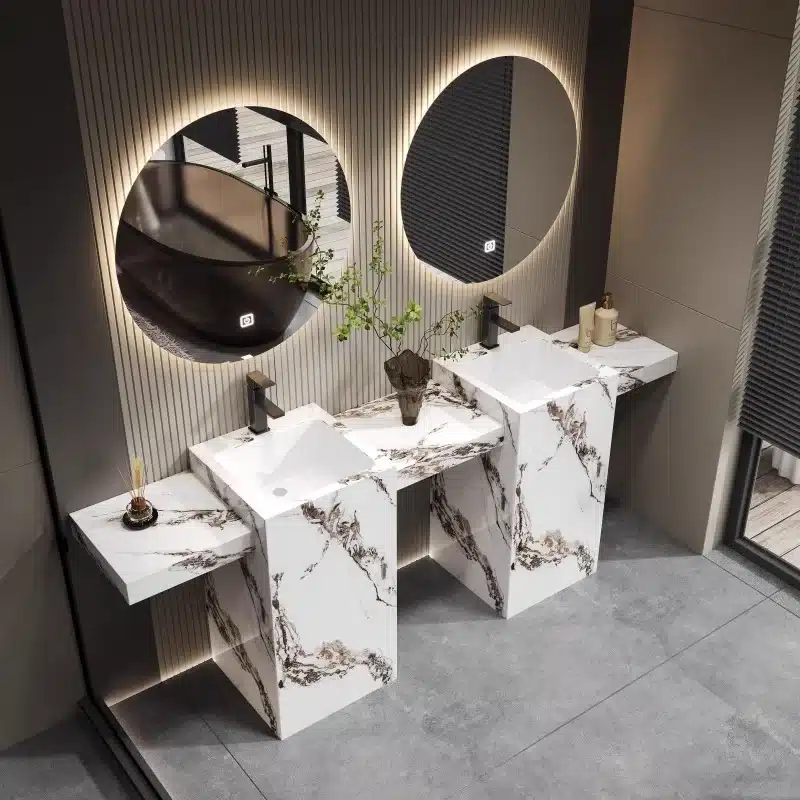
Sintered stone basin cracks prevention is the single most important factor in protecting your bulk investment, yet most buyers focus entirely on the material’s heat resistance rather than its installation mechanics. MFBATH has shipped over 1,000 distributors across 20+ countries since 2015, and our internal QC logs confirm that 90% of field failures originate from improper substrate support, not material defects. The stone itself survives 10,000+ cleaning cycles and thermal shock tests up to 1000°C without issue. The weak point is always the sink cutout corner, where a missing 18mm backing panel turns a simple under-mount installation into a structural liability.
Replacing a cracked basin in a commercial project costs 3 to 5 times the original unit price due to demolition, re-tiling, and downtime. Prevention adds less than $15 per unit. Buyers can eliminate this risk by demanding continuous 18mm plywood or MDF backing behind all cutouts and specifying flexible silicone gaskets instead of rigid metal clips. This approach shifts the conversation from reactive warranty claims to proactive engineering, ensuring the basins survive the exact climate and regulatory conditions of your target market.
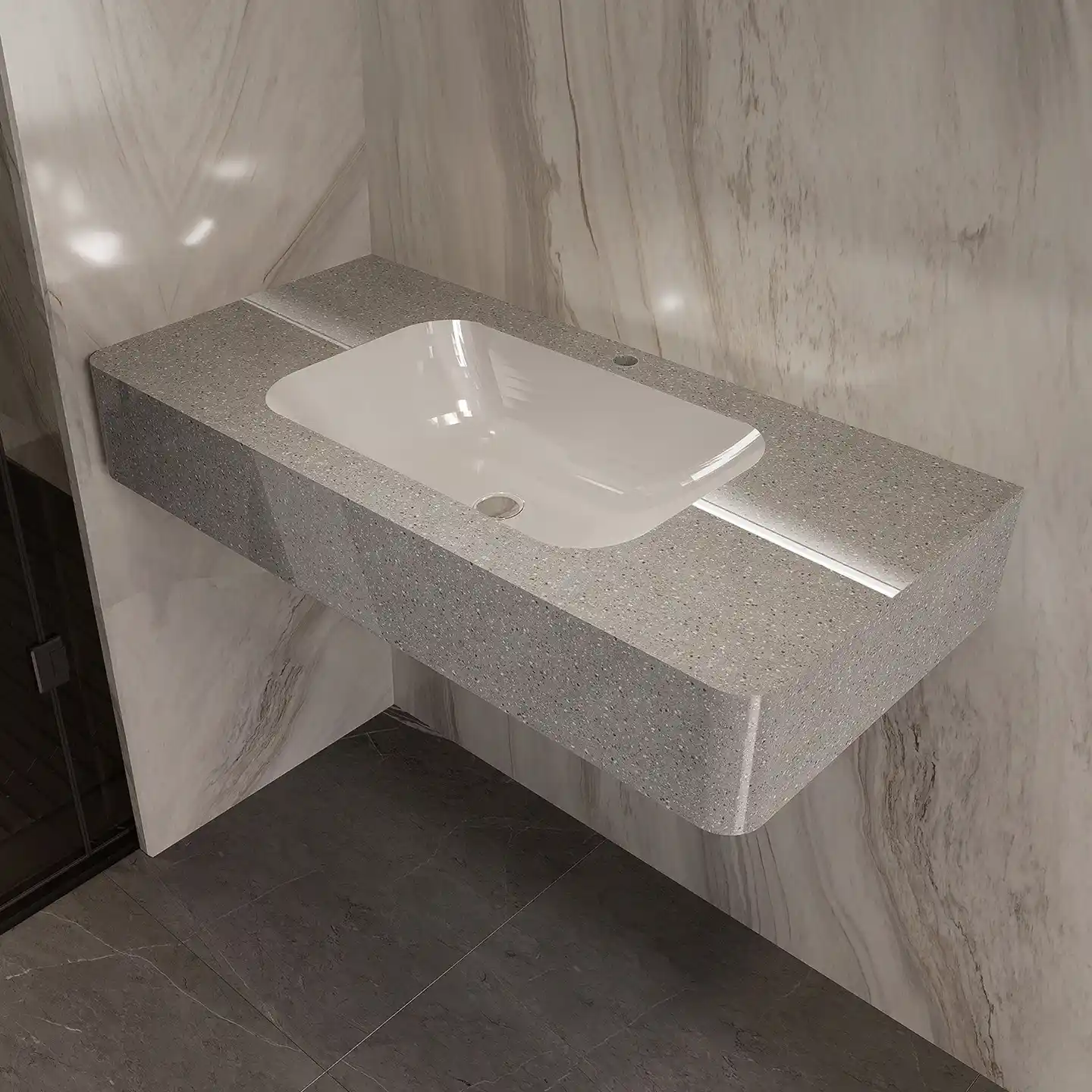
Why Sintered Stone Basins Crack: The Support Myth
Sintered stone rarely cracks from material defects; improper substrate support causes over 90% of field failures.
The most common reason for sintered stone basin failure is not the material itself, but the installation method. Sintered stone is engineered for high compressive strength but remains brittle under tension. When a basin is mounted without a continuous, full-depth substrate, the material is left to bear the entire shear stress of the countertop load. This structural vulnerability concentrates at the inner corners of the sink cutout, creating a high risk for catastrophic failure.
Point-loading from under-mounted sinks is the primary mechanical threat. When a heavy basin is supported only by perimeter clips or a thin adhesive strip, the inner corners of the cutout act as stress risers. Every time hot water is introduced or heavy items are placed in the sink, thermal cycling and physical weight propagate these micro-fractures. Over time, this leads to the hairline cracks that are often misdiagnosed as manufacturing defects.
-
- Shear Stress Failure: Mounting a heavy stone basin on a substrate thinner than 18mm or without continuous backing allows the cutout corners to flex. This flexing induces tensile stress that the stone cannot withstand, leading to immediate or delayed cracking.
- Point-Loading Risks: Under-mounted configurations transfer the basin’s weight directly to the countertop cutout. Without a rigid 18mm+ plywood or MDF backing panel, the stone edge bears the load, causing micro-fractures that spread under thermal shock or heavy daily use.
- Crack Propagation: Sharp 90-degree corners in the sink cutout create near-infinite stress concentration points. MFBATH utilizes CNC-cut corners with a minimum 6mm radius to distribute tension. Without this radius and proper backing, thermal cycling from hot water will inevitably trigger crack propagation.
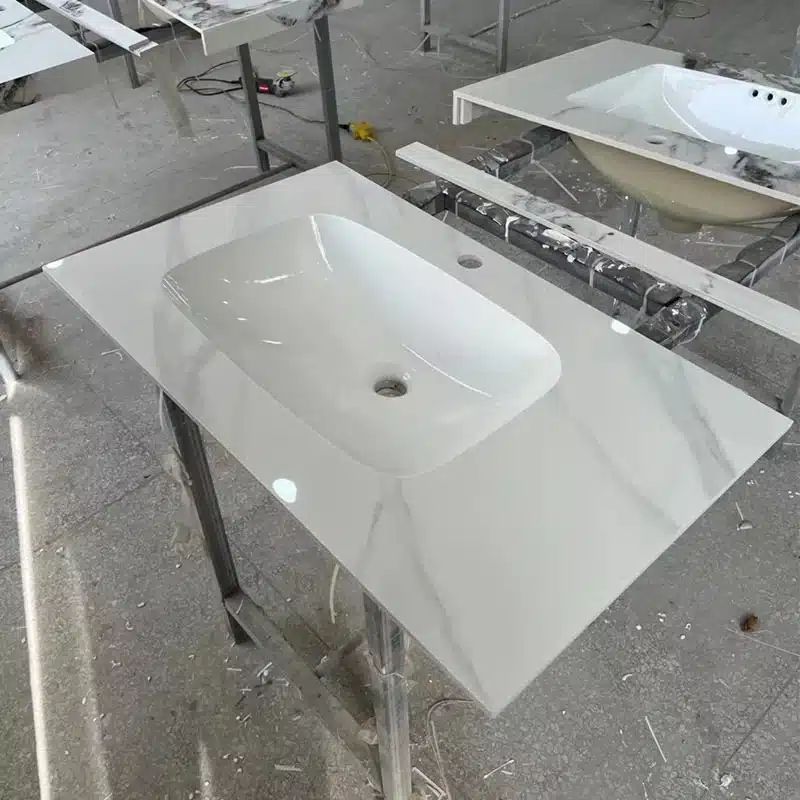
Real Cost of a Cracked Basin: Repair vs. Prevention
Recurring a cracked basin costs 3–5x the unit price; proper support prevents it for under $15.
When a sintered stone basin cracks in a commercial project, the replacement cost is rarely just the price of the sink. Demolition of fixed tiles, labor for removal, and the downtime of a closed hotel room can drive the total expense to $200–$500 per incident. This is why prevention is the only financially viable strategy for project developers.
The root cause of these failures is almost always mechanical, not material. Sintered stone is highly resistant to heat and scratching, but it is brittle under tension. When a basin is installed without a solid substrate, the heavy weight of the stone and water creates a shear force that concentrates at the inner corners of the sink cutout.
Internal quality control logs indicate that over 90% of sintered stone cracks originate from improper installation rather than material defects. If the vanity cabinet lacks a full-depth 18mm+ plywood or MDF backing panel directly behind the sink cutout, the basin has nothing to distribute the stress against.
-
- Prevention Cost: Specifying a continuous 18mm support panel and using flexible silicone gaskets instead of rigid metal clips adds less than $15 per unit to the manufacturing cost.
- Replacement Cost: Fixing a cracked basin on-site requires demolition of surrounding tiling, new plumbing, and re-grouting, easily costing $200 to $500 in labor and material downtime.
- MFBATH Quality Data: Our basins undergo 10,000+ cleaning and heat cycles up to 1000°C. With the mandatory 18mm support checklist, our field failure rate remains below 0.5%.
| Aspect | Repair Cost | Prevention Cost |
|---|---|---|
| Root Cause | $200–$500+ (Demolition, Re-tiling, Downtime) | <$15 per unit (Correct Support Panel) |
| Failure Rate | High (3–5x unit price impact per incident) | <0.5% (With 18mm+ continuous backing) |
| Material Stress | Irreversible micro-fractures at cutout corners | Managed via CNC 6mm radius corners |
| Installation | Rigid clips cause point-loading cracks | Flexible silicone gaskets distribute stress |
| Warranty | Often voided due to improper substrate | Fully covered with MFBATH installation guide |
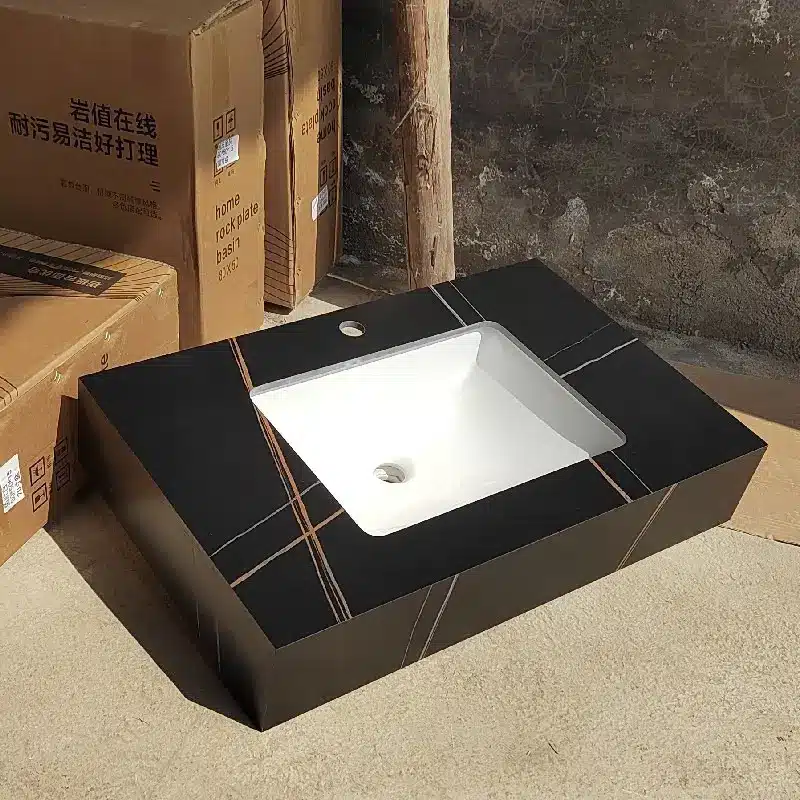
Sintered Stone vs. Ceramic vs. Quartz: Crack Resistance Compared
Sintered stone wins on heat and scratch resistance, but its tensile weakness requires specific installation protocols to prevent cracking.
The debate over bathroom sink materials often focuses on aesthetics, but for commercial projects, crack resistance under stress is the true differentiator. Ceramic basins are the most susceptible to chipping from impact, a common occurrence in high-traffic hotel environments where heavy toiletries or dropped items strike the basin edge. While ceramic offers a low initial cost, the high replacement rate and labor costs often negate the savings over a 5-year project lifecycle.
Quartz composite sinks offer improved durability over ceramic, but they remain vulnerable to heat shock. Placing a hot styling tool or pot directly into a quartz basin can cause thermal shock, leading to hairline fractures that eventually propagate. Sintered stone, conversely, is fired at temperatures exceeding 1200°C, granting it inherent heat resistance up to 1000°C. It will not crack from thermal shock, making it the superior choice for modern bathrooms equipped with high-heat styling tools.
However, sintered stone possesses a specific mechanical vulnerability: it is strong under compression but extremely weak under tensile stress. This means that while the material itself is nearly indestructible under normal use, the inner corners of the sink cutout are critical failure points. A sharp 90-degree cutout creates a near-infinite stress concentration. If installed without continuous backing, the weight of the basin and the force of water drainage can pull these corners apart, resulting in a catastrophic crack.
-
- Ceramic: High susceptibility to edge chipping from impact; low heat resistance; requires replacement rather than repair when damaged.
- Quartz Composite: Good scratch resistance, but vulnerable to thermal shock from hot objects; prone to micro-fractures if subjected to rapid temperature changes.
- Sintered Stone: Non-porous, heat-resistant up to 1000°C, and scratch-proof; requires a minimum 6mm radius on CNC-cut corners and 18mm continuous backing to prevent tensile failure.
For high-traffic commercial bathrooms, the decision framework must prioritize longevity over initial unit price. Sintered stone with proper backing outperforms all alternatives in longevity because it eliminates the two most common failure modes: impact chipping and thermal degradation. When sourcing these basins, specify a CNC-cut inner corner with a minimum 6mm radius and mandate an 18mm plywood or MDF support panel beneath the cutout. This structural reinforcement distributes the shear stress evenly, effectively neutralizing the material’s tensile weakness and ensuring a near-zero failure rate.
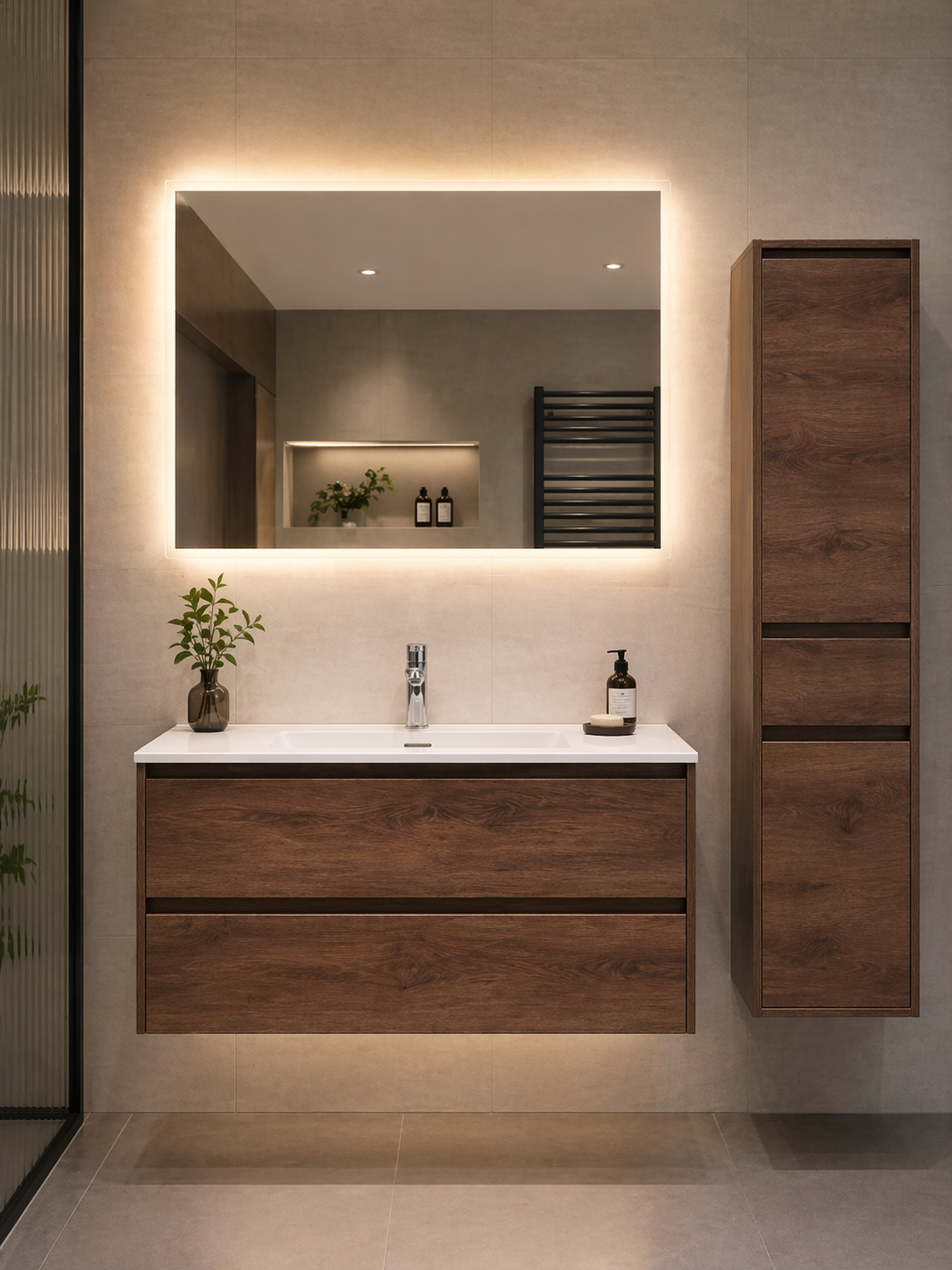

How to Source Sintered Stone Basins with Zero Crack Risk
Zero crack risk requires demanding 18mm support specs and point-load test videos from your supplier.
Sourcing sintered stone basins for commercial projects requires moving beyond aesthetic selection to mechanical verification. Internal quality control logs indicate that over 90% of basin failures stem from improper substrate support rather than material defects. To eliminate this risk, buyers must enforce specific installation protocols and demand evidence of structural integrity from the manufacturer.
-
- Mandate 18mm Support: Your purchase contract must explicitly require a full-depth 18mm plywood or MDF backing panel beneath all sink cutouts. Standard perimeter clips are insufficient and create dangerous shear stress at the corners.
- Verify Point-Load Tests: Request factory QC test videos demonstrating point-loading resistance. Competitors often skip this, but seeing the basin withstand concentrated weight without micro-fractures is the only reliable proof of durability.
- Align with OEM Specs: Utilize MFBATH’s OEM/ODM framework to lock in CNC-cut corners with a minimum 6mm radius. This specific geometry prevents the infinite stress concentration that causes sharp 90-degree corners to crack.
- Guarantee Material Specs: Ensure the contract guarantees non-porous sintered stone capable of withstanding 1000°C thermal shock and 10,000+ cleaning cycles. This guarantees the material itself will not fail under normal commercial use.
Conclusion
Sintered stone basins rarely fail due to material defects; internal QC logs show 90% of cracks originate from improper installation, specifically missing 18mm continuous backing behind the sink cutout. Implementing CNC-cut corners with a 6mm radius and flexible silicone gaskets eliminates shear stress, keeping field failure rates below 0.5% even under high-volume commercial use.
Review the complete MFBATH sintered stone basin specifications, including detailed support requirements and OEM customization options, to ensure your next project avoids hidden liability and warranty claims.
Frequently Asked Questions
Does sintered stone crack easily?
Sintered stone rarely cracks under normal use because it is fused under extreme heat for durability. Most failures stem from improper substrate support during installation rather than material defects. Ensure proper substrate support to prevent installation-related failures.
How to prevent sintered stone from chipping?
Prevent chipping by using a full-depth 18mm+ plywood or MDF support panel beneath the basin to distribute shear stress. Avoid point-loading at the sink cutout corners where micro-fractures typically propagate. Specify full-depth support panels to eliminate point-loading risks.
Can you repair a cracked sintered stone sink?
Repairing a cracked sintered stone sink is technically possible but often costs three to five times the original unit price. The expense includes demolition, re-tiling, and project downtime, making prevention far more economical. Prioritize prevention over repair due to high replacement costs.
Do I need to seal a sintered stone basin?
You do not need to seal a sintered stone basin because it is non-porous and resistant to staining. The material is tested for over 10,000 cleaning cycles without requiring protective sealants. Skip sealing as the non-porous surface handles cleaning cycles.
What is the lifespan of a sintered stone basin?
A sintered stone basin typically lasts for decades due to its scratch resistance and heat tolerance. Lifespan is primarily determined by correct installation support rather than material degradation. Ensure correct installation to maximize the basin’s long-term lifespan.





0 Comments