
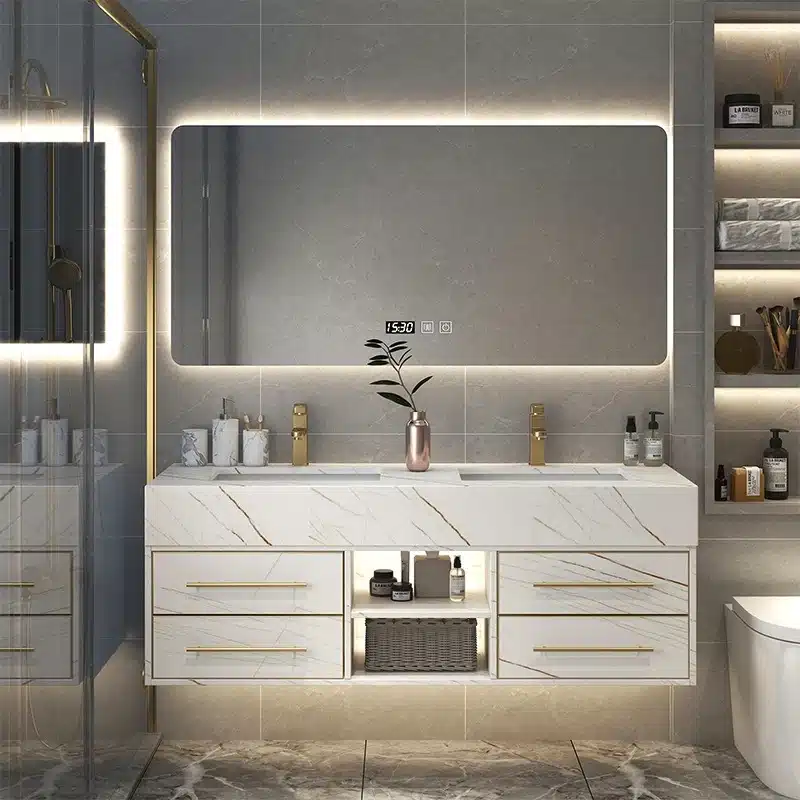
Sourcing a hotel vanity sourcing guide for a 200-room project demands more than just a unit price; it requires a supply chain that guarantees compliance and precise on-site alignment. Most contractors fail not because they pay too much, but because they accept standard CAD drawings that ignore actual wall conditions. Focus Cabinet, a direct manufacturer based in Changge, China, solves this by guaranteeing that every vanity matches your specific plumbing layout before production begins, saving 2-3 days of on-site rework per floor.
The real savings come from eliminating hidden project costs. A 36-inch plywood vanity with PUR edge banding and soft-close hardware costs $180 to $250 landed. This is 20-30% lower than comparable domestic options. The factory produces up to 5,000 units monthly, ensuring that your 200-unit order ships in synchronized batches that match your construction schedule, rather than arriving all at once and creating a storage nightmare.
The Real Crisis: Why Hotel Vanity Sourcing Fails
Misaligned specs and delayed deliveries cost contractors more than unit price.
The most expensive vanity is the one that never arrives on time. For a 200-room hotel project, a 60-day delay doesn’t just push the opening date; it triggers cascading financial bleeding. The core crisis in hotel vanity sourcing is rarely the sticker price—it is the hidden costs of technical misalignment and logistical failures. When a supplier fails to align with site-specific conditions, you face a 15% to 30% budget overrun in change orders and rush freight.
The industry is flooded with residential-grade manufacturers who claim they can handle commercial volume but lack the engineering capacity to deliver. The failure usually stems from two specific gaps: ignoring the ‘CAD Gap’ and falling for the ‘Batch Lie.’ Both of these errors stem from a supplier who is disconnected from the actual construction timeline and site conditions.
- Misaligned Specs & The CAD Gap: Most trading companies offer CAD support but do not guarantee alignment with existing site-level P-trap locations or non-standard wall thicknesses. If your vanity doesn’t match the rough-in, you face 2-3 days of on-site rework per floor. A direct manufacturer like Focus Cabinet writes this alignment guarantee into the pre-production process, preventing costly plumbing misalignment.
- Commercial-Grade Durability: Residential plywood vanities fail under the 200-room daily turnover. You need 18mm commercial-grade plywood with PUR seamless edge banding to prevent moisture ingress and a 10-year lifespan warranty. Soft-close hinges (DTC or Blum equivalent) are non-negotiable for guest satisfaction, yet many budget suppliers cut corners here, leading to immediate hardware failure.
- Site-Specific Drawing Accuracy: Generic factory drawings are useless on a construction site. You need a dedicated CAD team to optimize pre-cut holes for your specific architectural blueprints, not just standard sizes. This level of accuracy is what separates a smooth installation from a chaotic one filled with gaps and misfits.
- Financial Impact of Delays: Beyond the $180-$250 landed cost per unit, a delayed project incurs $25,000 in change orders, $15,000 in rush freight, and $10,000 in labor for onsite modifications. Competitors claiming ‘batch shipping’ often deliver everything at once, creating storage nightmares. Synchronized floor-by-floor delivery eliminates these storage costs and keeps your project on schedule.
The Hidden Costs of a Bad Vanity Supplier
Hidden costs from misaligned specs often exceed the unit price savings by 300%.
For a 200-room hotel project, the unit price of a vanity is the least of your financial worries. The real budget killer is the hidden cost of failure: plumbing misalignment, rush freight for replacement parts, and onsite labor for modifications. Most contractors assume that a ‘cheaper’ vanity from an unverified supplier saves money. In reality, a single floor of misaligned P-traps can trigger $25,000 in change orders and stall your critical path for weeks.
When a vanity supplier lacks a dedicated CAD team to verify your architectural blueprints against their pre-cut holes, you are essentially gambling with your installation schedule. A reliable direct manufacturer like Focus Cabinet eliminates this risk by running every custom order through a 5-stage quality control process and providing CAD optimization before production begins. This proactive engineering saves 2-3 days of onsite rework per floor, protecting your KPI for on-schedule completion.
- Plumbing Misalignment: Standard vanities often ignore site-level wall thicknesses and P-trap locations. Without CAD optimization, this forces carpenters to modify cabinetry onsite, costing $150-$250 per hour in labor and delaying handover.
- Rush Freight for Replacements: Missing parts or warped plywood due to poor moisture-proofing (like missing PUR edge banding) require emergency air freight. This often costs $15,000+ per container, instantly wiping out any initial FOB discount.
- Onsite Modification Labor: If a vanity doesn’t fit the rough opening, contractors must pay for specialized carpentry to cut and seal the units. This not only incurs direct labor costs but also risks damaging the vanity’s finish during onsite cutting.
- 5-Stage QC & CAD Benefits: Focus Cabinet’s 5-stage QC ensures 18mm plywood vanities meet commercial standards. Their dedicated CAD team guarantees that every pre-cut hole matches your exact plumbing layout, preventing the $25,000+ change orders common with generic suppliers.
| Feature | Specification | Advantage |
|---|---|---|
| Compliance & Certification | UL/CSA (NA), CE (EU), AS/NZS (Oceania), E1/E0 Grade | Eliminates customs delays and ensures legal installation in target markets |
| Material Durability | 18mm Moisture-Proof Plywood or 100% Waterproof PVC | Prevents warping and mold in high-humidity hotel bathrooms, extending lifespan |
| Technical Precision | Dedicated CAD Optimization for P-Trap & Wall Alignment | Saves 2-3 days of on-site rework per floor by ensuring perfect fit before production |
| Logistics & Delivery | Synchronized Floor-by-Floor Batch Shipping | Eliminates on-site storage costs and prevents construction schedule bottlenecks |
| Quality Control | 5-Stage Rigorous Inspection Process | Guarantees consistent commercial-grade quality, reducing replacement costs and warranty claims |
Accuracy Over Lowest Price: Why Focus Cabinet Wins
Direct manufacturing eliminates middleman markups and ensures consistent 5-stage quality control.
In the commercial bathroom vanity market, the distinction between a direct manufacturer and a trading company is the single biggest factor in project success. Trading companies like Source Direct act as middlemen, sourcing from generic factories. This introduces consistency risks and opaque pricing structures that often lead to hidden costs during production. Focus Cabinet operates as a direct manufacturer in Changge, Henan, with a 10,000㎡ facility. This structure guarantees that every vanity meets strict commercial-grade specifications without the markup or communication delays of a third party.
Factory capacity and production consistency are critical for large-scale projects. Focus Cabinet produces up to 5,000 units monthly, ensuring reliable delivery for large-scale developments. This high capacity prevents the bottlenecks common with smaller suppliers. The facility utilizes high-precision CNC machines and automated production lines for precise material cutting and assembly. Every product undergoes five rigorous inspections throughout the production stages to ensure durability and aesthetic perfection. This level of control is rarely available from trading companies that outsource production.
When comparing suppliers, a Factory Audit Checklist is essential. Focus Cabinet provides a documented process for projects like the Moxy Times Square, offering transparency that competitors like George Build Shop lack. George Build Shop pitches ’20+ years’ power but lacks accessible case studies and transparent material sourcing. In contrast, Focus Cabinet provides verifiable evidence of its 5-stage QC process and region-ready compliance. This transparency allows contractors to verify quality before production begins, reducing the risk of costly on-site rework.
- Factory Capacity: Focus Cabinet produces up to 5,000 units monthly, ensuring reliable delivery for large-scale developments without the bottlenecks of smaller suppliers.
- Quality Control: Every product undergoes five rigorous inspections throughout the production stages to ensure durability and aesthetic perfection, a standard not always guaranteed by trading companies.
- Competitor Comparison: Unlike George Build Shop, which lacks accessible case studies, Focus Cabinet provides verifiable evidence of its 5-stage QC process and region-ready compliance.
| Feature | Specification | Advantage |
|---|---|---|
| Supply Chain Model | Direct 10,000㎡ Factory | Eliminates middleman markups and ensures consistent quality control |
| Production Capacity | 5,000 Units Monthly | Guarantees on-time delivery for large-scale 200+ unit hotel projects |
| Quality Assurance | 5-Stage Rigorous Inspection | Prevents on-site installation failures and reduces warranty claims |
| Technical Compliance | UL/CSA, CE, AS/NZS Certified | Ensures regulatory adherence across North America, Europe, and Oceania |
| Customization Flexibility | 40,000+ Configurations | Allows precise aesthetic matching with low MOQs (10-20 units) for testing |
How to Source 200 Hotel Vanities Without Project Delays
Synchronized logistics and CAD optimization prevent the $25,000 change orders that destroy hotel project margins.
Sourcing 200 vanities for a hotel project requires more than a competitive unit price. The real financial risk lies in site misalignment and logistical bottlenecks. A standard commercial plywood vanity must be engineered to your specific architectural blueprints, not just generic dimensions. Focus Cabinet’s dedicated CAD team guarantees alignment with existing site-level P-trap locations and non-standard wall thicknesses. This pre-production verification saves contractors 2-3 days of on-site rework per floor.
Once engineering is locked, the manufacturing phase demands rigorous oversight. Every unit undergoes a five-stage quality control process to ensure durability and aesthetic perfection. This includes verifying the 18mm plywood core, multi-layer moisture-proof finish, and PUR seamless edge banding. The hardware is tested for soft-close functionality, typically utilizing DTC or Blum equivalent hinges. This level of scrutiny ensures the vanities meet the 10-year lifespan warranty required for commercial hospitality projects.
- Regulatory Compliance: Ensure the supplier provides UL/CSA certificates for North America or CE compliance for Europe. Materials must meet E1/E0 formaldehyde emission standards to satisfy health codes.
- Batch Shipping Strategy: Avoid suppliers who deliver everything in one massive container. Focus Cabinet coordinates floor-by-floor delivery to match your construction schedule, eliminating costly on-site storage issues.
- Production Capacity: Verify the factory can handle your volume. Focus Cabinet produces up to 5,000 vanities monthly, ensuring reliable delivery for large-scale 200-room developments.
A synchronized logistics plan is the final safeguard against project delays. By coordinating freight-forwarder neutral deliveries, the supplier ensures that materials arrive exactly when the installation crew is ready. This prevents the inventory nightmares that plague general contractors and keeps the project within the 1% budget variance target. The lead time for 200 units, including sample approval, typically ranges from 45 to 60 days.
Hotel Vanity Specification: Material, Finish & Compliance Guide
Commercial vanities fail when material specs ignore humidity and local compliance codes.
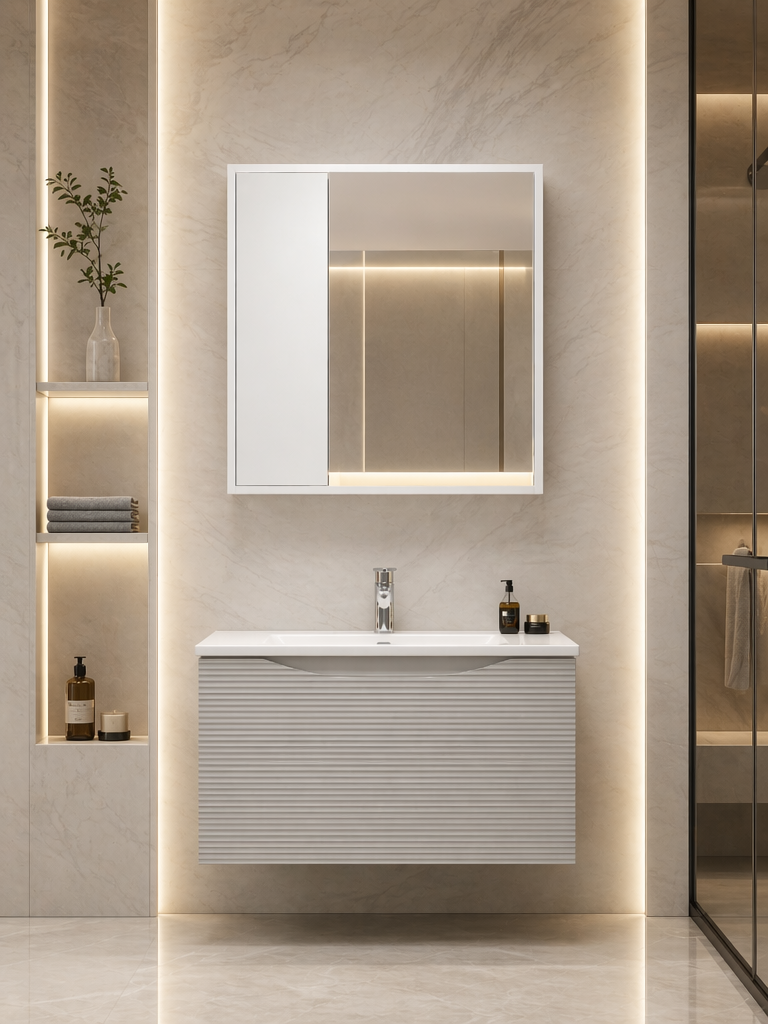
For a 200-room hotel, vanity sourcing is a balance between durability and cost. Plywood vanities with PUR seamless edge banding provide the best moisture resistance for standard guest rooms. For high-humidity environments, PVC vanities are 100% waterproof, while solid wood and sintered stone are reserved for premium suites.
- Material Specs: Use 18mm plywood with a multi-layer moisture-proof finish for cost-effective durability. Ensure all edges use PUR banding to prevent swelling. Hardware must include soft-close hinges (DTC or Blum equivalent) to withstand high guest traffic.
- Finish Standards: Specify Low-VOC, E1 or E0 grade finishes to ensure indoor air quality compliance. Sintered stone or quartz tops are recommended for high-traffic areas due to their scratch and heat resistance.
- Regional Compliance: North American projects require UL/CSA certification and CARB/ULEF formaldehyde limits. European projects demand CE compliance and ISO 14001 sustainability standards. Oceania projects must meet AS/NZS and WELS water efficiency standards.
- Proactive Certification: Do not wait for audits. A direct manufacturer like Focus Cabinet proactively provides region-specific compliance certificates (UL, CE, CARB) before production begins, preventing costly customs delays or on-site rejections.
| Feature | Specification | Advantage |
|---|---|---|
| Core Material | 18mm Plywood (Moisture-Proof) / PVC / Sintered Stone | Commercial-grade durability with 100% waterproof options for high-humidity hotel environments. |
| Edge Banding | PUR Seamless Edge Banding | Prevents moisture ingress and delamination, extending vanity lifespan in wet bathroom conditions. |
| Hardware | Soft-Close Hinges (DTC/Blum Equivalent) | Ensures quiet operation and heavy-duty cycling resistance for high-traffic guest room usage. |
| Environmental Compliance | Low-VOC, E1/E0 Grade Finishes | Meets strict indoor air quality standards (CARB/ULEF) for immediate hotel occupancy without odor issues. |
| Regional Certification | UL/CSA (NA), CE (EU), AS/NZS (Oceania) | Guarantees regulatory compliance for global projects, eliminating customs delays and rework risks. |
Conclusion
Sourcing a 200-room hotel vanity project requires more than unit pricing. You need a manufacturer that guarantees CAD alignment with your P-trap locations and synchronizes deliveries floor-by-floor. Focus Cabinet eliminates on-site rework and storage costs through direct factory control and region-ready compliance, protecting your margin and schedule.
Frequently Asked Questions
What are the 7 pillars of hospitality?
The 7 pillars are typically defined as service, quality, value, image, product, price, and place. These elements form the strategic framework for delivering consistent guest experiences and operational excellence. Align sourcing specs with these pillars to ensure product-market fit.
What are the sourcing strategies for affiliated hotels?
Affiliated hotels typically use centralized procurement to leverage volume discounts and enforce brand-standard specifications across all properties. This ensures consistency in quality, aesthetics, and regulatory compliance while simplifying supply chain management. Verify brand-specific compliance requirements before initiating vendor negotiations.
What is a 3 key hotel?
A 3-key hotel is not a standard industry term, but likely refers to properties with three key amenities or a three-tier service model. In some contexts, it may denote a specific. Clarify the specific brand or service tier definition with the client.
What is the 10 5 3 rule in hospitality?
The 10-5-3 rule is a guest service guideline where staff acknowledge a guest at 10 feet, smile at 5 feet, and greet verbally at 3 feet. It is designed to enhance guest perception. Apply this service standard to complement physical product quality.
What are the 10 C’s of sourcing?
The 10 C’s of sourcing are Cost, Quality, Capacity, Control, Commitment, Culture, Communication, Consistency, Compliance, and Continuity. These criteria help buyers evaluate suppliers beyond just price to ensure long-term partnership viability. Use these criteria to vet manufacturers like MFBATH for complex projects.




0 Comments