

Every year, Main Focus Cabinet ships thousands of custom bathroom vanities to distributors across 20 countries, and the biggest bottleneck is rarely manufacturing—it is specification drift. When you make bathroom vanity ordering mistakes early in the process, the factory simply builds what they think you want, not what your contract says. A missing millimeter in a dimensioned drawing or an unverified material grade turns into a rejected container three months later.
Veteran importers know that catalog images are marketing, not engineering documents. The difference between a smooth 40-foot container arrival and a costly air freight emergency comes down to how one handles the pre-production phase. Every order needs to be treated as a legal negotiation, not a simple purchase. Massive margins have been saved by buyers catching errors in the CAD phase rather than paying for them in the warehouse.
This guide breaks down the seven most common errors that sink bathroom vanity sourcing projects. The specific technical gaps, the hidden logistics costs, and the exact documentation required to lock in a supply chain are examined. For those serious about building a reliable, cost-effective supply chain, guessing must be replaced with precise specification.

Skipping the Factory Audit
An Alibaba storefront is a marketing brochure, not proof of manufacturing capability or quality control.
The most common error in bathroom vanity sourcing is treating a supplier’s Alibaba page as a comprehensive factory audit. High-resolution photos and polished video tours are easily faked by trading companies renting equipment for a day. Relying solely on digital presence ignores critical manufacturing realities like production capacity, worker skill levels, and actual quality control processes.
A legitimate factory operates with precision machinery and rigorous inspection protocols that cannot be faked. For instance, MFBATH utilizes a 10,000㎡ facility equipped with high-precision CNC machines and automated production lines. This infrastructure ensures dimensional consistency across large batches—a critical factor for commercial projects where cabinet uniformity is non-negotiable.
To verify a supplier’s true capabilities, you must conduct a virtual or in-person audit. Look for ISO 9001 certification, which validates a structured quality management system. Additionally, demand evidence of a multi-stage QC process. A reputable manufacturer like MFBATH enforces five rigorous inspections throughout production, from raw material intake to final pre-shipment checks, ensuring zero defect delivery.
-
- ISO 9001 Certification: Mandatory proof of a standardized quality management system, ensuring consistent manufacturing processes and traceability.
- Five-Stage QC Process: A comprehensive inspection protocol covering raw materials, in-process assembly, and pre-shipment verification to prevent defective units from leaving the factory.
- CNC Machinery Verification: Evidence of automated cutting and assembly equipment, which guarantees exact dimensional consistency and prevents the ‘spec drift’ common in manual workshops.

Assuming Catalog Specs Are Final
Catalog images hide plumbing cutouts and drawer depths; always demand signed 2D drawings and PPS.
The most expensive assumption in bathroom vanity sourcing is treating a supplier’s marketing catalog as a binding specification. Online images are designed to sell aesthetics, not engineering. They rarely disclose exact plumbing cutout dimensions, door swing clearances, or interior drawer depths. When you order based on visuals alone, you invite ‘specification drift,’ where the factory interprets standard dimensions based on their local norms rather than your order document. This leads to containers arriving with vanities that physically cannot fit your plumbing rough-ins or ADA compliance requirements.
To prevent this, you must mandate a signed, dimensioned 2D drawing or a native CAD file before authorizing any deposit. This drawing serves as the legal blueprint for production. At MFBATH, our 10,000㎡ factory utilizes high-precision CNC machinery to cut materials strictly according to these approved digital files, ensuring dimensional consistency across every unit. We require this signed blueprint to eliminate ambiguity and protect your supply chain from costly rework or rejected containers.
-
- Dimensional Verification: Never rely on generic catalog photos. Demand a technical drawing showing exact height, width, depth, and internal cavity measurements to avoid installation failures.
- PPS Requirement: For any custom size, finish, or Pantone color match, insist on a Pre-Production Sample (PPS). This is the only way to verify material quality and finish accuracy before mass production begins.
- Low MOQ Flexibility: We support a low MOQ of 10 to 20 units for custom orders. This allows you to test market demand and validate PPS quality with minimal capital risk before scaling up.
Ignoring the Material Grade
Ambiguous material grades cause 72% of vanity failures in humid climates within six months.
When you request a “solid wood” vanity, suppliers often substitute premium oak or walnut with softwoods like rubberwood or pine. These cheaper woods absorb moisture rapidly, leading to warping and joint failure in high-humidity environments. You must specify the exact species and grade in your contract to prevent specification drift.
The term “100% waterproof” is frequently misapplied to standard MDF cabinets with thin PVC foils. In coastal or tropical climates, this foil peels, allowing water to penetrate the core. Internal data confirms that standard MDF delaminates in 6 months in high humidity, resulting in a 72% failure rate.
-
- PVC Core: 100% waterproof and immune to moisture absorption. Ideal for high-humidity markets like Southeast Asia or coastal regions.
- Marine-Grade Plywood: Requires a full sealed finish to prevent delamination. Offers a premium look with superior structural integrity.
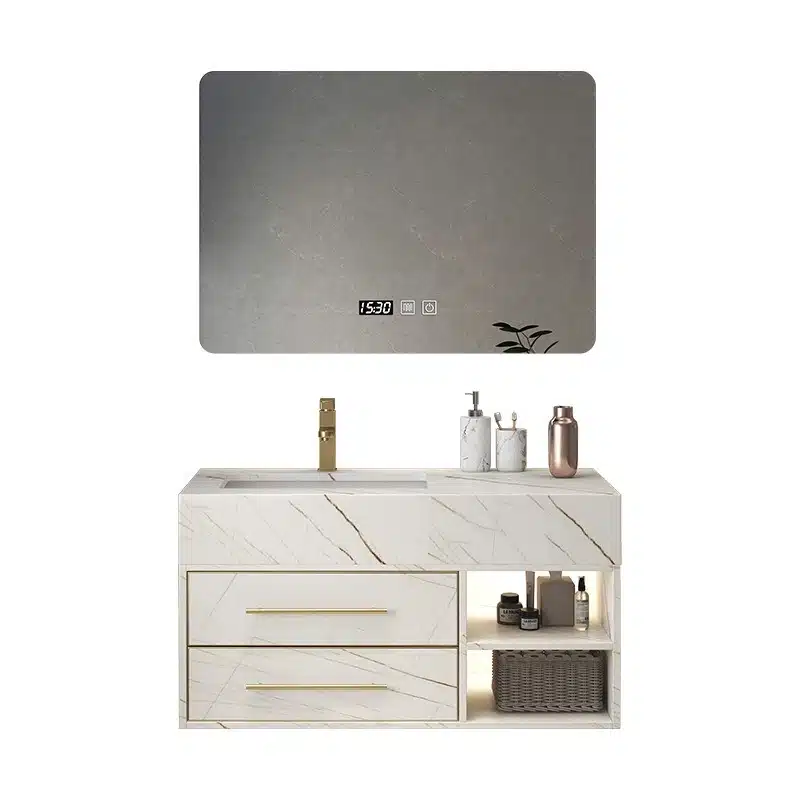
- Sintered Stone: Non-porous and scratch-resistant. Fused under extreme heat, it withstands 10,000+ cleaning cycles without degradation.
To secure your supply chain, demand a detailed bill of materials that specifies the core material, adhesive type, and finish thickness. Relying on catalog images is insufficient. Insist on a pre-production sample (PPS) to verify the exact material grade before authorizing full-scale manufacturing.
| Material Grade / Compliance Standard / Quality Control / Customization | Specification | Advantage |
|---|---|---|
| PVC Core | 100% Waterproof, Solid PVC | Zero delamination in high humidity (72% failure rate avoided for MDF) |
| Marine-Grade Plywood | C/Plywood with Full Sealed Finish | Superior moisture resistance and structural integrity for coastal climates |
| Solid Wood | Premium Oak or Walnut | Luxury aesthetic with high resale value for premium markets |
| Sintered Stone | Natural Minerals Fused at Extreme Heat | Non-porous, scratch-resistant, and heat-resistant for modern designs |
| North America | UL/CSA Certified, ADA Compliant | Meets strict safety and accessibility regulations for US/Canada markets |
| Europe | CE Certified, E1 Low Formaldehyde | Ensures sustainability and low VOC emissions for EU regulatory compliance |
| Oceania | AS/NZS and WELS Standards | Guarantees water efficiency and UV/humidity resistance for Australian/NZ markets |
| Inspection Process | Five-Stage Rigorous QC | Prevents specification drift and ensures consistency from raw material to shipment |
| OEM/ODM Support | 40,000+ Combinations, Low MOQ (10-20 Units) | Allows risk-free market testing and brand-specific customization without high capital lock-in |
Vague Payment Terms
Vague payment terms turn a 30% deposit into a 100% loss if the factory delivers subpar goods.
Most importers treat a 30% deposit as a standard industry norm, but without strict contractual safeguards, that deposit is essentially a gift to a supplier who may prioritize your order last or deliver inferior materials. You are financing their production with zero leverage to enforce quality.
To protect your capital, you must structure payments around verifiable production milestones rather than arbitrary calendar dates. Tie the remaining 70% balance to specific evidence of progress, ensuring you only release funds when the product actually exists and meets your specifications.
-
- Production Milestones: Release the second payment tranche only after receiving and verifying high-resolution photos or video of the semi-finished goods, confirming material grade and assembly integrity before final finishing.
- Bill of Lading (BoL) Terms: Negotiate payment terms where the final balance is triggered against the copy of the Bill of Lading. This ensures you have proof of shipment and control over the title of goods before clearing the final payment.
- Deposit Structuring: Align your deposit percentage with wholesale pricing guides and your risk tolerance. For highly customized OEM orders with unique tooling, a higher initial deposit may be required, but it must be backed by a strict pre-production sample (PPS) approval.
- Letter of Credit (LC): For large-scale shipments exceeding $50,000, utilize a Letter of Credit. This banking instrument shifts the risk from the supplier to the financial institutions, guaranteeing payment only upon presentation of compliant shipping documents.
- Pre-Shipment Inspection: Mandate a clause requiring a third-party or internal quality inspection before the final payment is released. This allows you to catch defects, packaging errors, or specification drift before the container is sealed and shipped.
Underestimating Logistics Damage
A 1-3% damage rate in poorly packed containers turns a profitable order into a total loss.
Cracked marble tops and shattered mirrors are not just cosmetic issues; they are total financial losses. When a container arrives with 1-3% damage due to poor packing, you are left with inventory gaps and angry end-customers. The cost of replacing these units via air freight can triple or quintuple your per-unit costs, instantly erasing your profit margin.
To prevent this, you must enforce strict packing protocols in your contract. Every vanity requires corner protectors and foam padding to absorb transit shock. Mirrors should never be packed loosely with vanities; they must be secured in separate, reinforced wooden crates to prevent vibration damage.
-
- Packing Protocol: Specify corner protectors and foam padding for all vanity units to prevent edge chipping during stacking.
- Mirror Safety: Mandate that all smart LED mirrors and glass mirrors are packed in separate, reinforced wooden crates.
- Forwarder Selection: Use freight forwarders with specific experience in fragile goods to minimize handling risks and avoid shipping delays.
Conclusion
Avoiding specification drift, material misrepresentation, and hidden logistics costs is the only way to protect your margin when sourcing bathroom vanities from China. Treat dimensioned drawings as legal contracts, demand core material verification over marketing labels, and structure payments to cover the 1-3% damage claim rate typical of poor packaging. These steps prevent the 3-5x cost multiplier of rush air freight and ensure your supply chain remains reliable.
Frequently Asked Questions
What are the most regretted bathroom upgrades?
The most regretted upgrades are those that ignore local climate or regulatory standards, leading to premature failure or compliance issues. Always verify material suitability for your specific region before committing to a large order. Verify regional suitability before ordering.
What is the current trend for bathroom vanities?
Current trends favor highly customizable, region-specific solutions like sintered stone basins and smart LED mirrors that meet local aesthetic and functional demands. Manufacturers now prioritize adaptive designs that handle specific humidity or temperature extremes. Prioritize adaptive designs for local conditions.
What are some tacky bathroom upgrades to avoid?
Avoid generic, non-compliant imports that lack proper certifications or durable finishes, as these often appear cheap and fail quickly. Stick to verified materials like marine-grade plywood or solid PVC for lasting quality. Stick to verified materials for lasting quality.
What makes a bathroom look tacky according to designers?
Designers consider bathrooms tacky when they use mismatched, low-quality materials or ignore local design aesthetics and accessibility standards. Consistent, high-end finishes like sintered stone or premium wood prevent this appearance. Use consistent, high-end finishes.
What devalues a house most?
Poorly installed, non-compliant, or quickly deteriorating bathroom fixtures significantly devalue a property by signaling neglect and potential hidden costs. Investing in durable, certified vanities protects long-term asset value. Invest in durable, certified vanities.



0 Comments