
Distributors shipping bathroom vanities into Southeast Asia or the Middle East know the math on PVC vs plywood vanity waterproofing better than most. You’ve seen the containers arrive fine, only to get the call six months later: swollen cabinet bases, delaminated edges, a full warranty claim on a 200-unit hotel order. The material choice here is not about aesthetics. It is about whether your margin survives the first humid season.
MFBATH has been manufacturing for those exact markets since 2015, shipping over 5,000 units a month from a 10,000㎡ facility in Henan. And the pattern is consistent: the failure point is almost never the plywood core itself. It is the edge banding. Standard EVA glue fails under steam at 80% relative humidity, and capillary action pulls moisture straight into the board. PVC, at <0.01% water absorption, simply does not have that problem. But there is a catch — thermal expansion. PVC handles -30°C to 70°C without warping only if the installation allows for it. Skip the expansion gap, and buckling occurs in a 50°C Middle Eastern bathroom. That is the kind of detail that separates a supplier who understands climate from one who just ships boxes.
Why Plywood Vanities Fail in Humidity
Plywood’s enemy isn’t water.
Let’s kill the myth first: ‘moisture-resistant plywood‘ is not waterproof. It’s a marketing term that means the glue used in the core layers is slightly more tolerant of humidity than standard furniture-grade board. But the wood fibers themselves are still organic, still porous, and still hungry for moisture. The moment liquid water finds a path through the edge banding or a drilled screw hole, capillary action pulls it into the core like a straw. The wood swells, the layers delaminate, and the cabinet door no longer closes. That’s not a defect. That’s physics.
In factory inspections, hundreds of returned plywood vanities from Southeast Asia and the Middle East have been cut open. In every single case, the failure started at the edge. The center panel was dry. The edge banding had lifted by less than 0.5 mm — enough for steam from a shower to wick in over six months. Once moisture enters, plywood absorbs between 5% and 10% of its weight in water. The core swells, the PVC or melamine surface stays rigid, and you get that characteristic ‘pillow’ deformation. End result: a warranty claim and a lost customer.
-
- Water absorption rate (plywood): 5–10% by weight when edge seal fails. Enough to swell a 600 mm cabinet by 2–3 mm at the seam.
- Water absorption rate (PVC foam board): <0.01%. The material is non-porous. It does not wick moisture. Period.
- Failure trigger: Humidity >80% RH combined with edge banding lift >0.3 mm. This is the threshold where capillary action overwhelms the adhesive bond.
- Real-world consequence: A plywood vanity in a Bangkok hotel bathroom lasted 14 months before the bottom panel swelled. Same design in PVC from the same production line: zero issues after 4 years.
PVC’s advantage isn’t just that it’s waterproof — it’s that its homogeneous structure has no grain, no layers, no glue lines for moisture to exploit. You can submerge a PVC foam board in water for a month. It comes out the same weight. That’s why for coastal climates, tropical zones, or any bathroom where the floor gets wet, PVC is the only material that eliminates the edge-band failure mode entirely. Plywood can work, but only if the edge seal is perfect and maintained. And in the real world of shipping, installation, and daily use, perfect seals get nicked.
The Edge Banding Secret: EVA vs. PUR Glue
PUR glue creates a chemical bond stronger than the wood itself.
Most plywood bathroom vanity failures in humid markets don’t start with the core — they start at the edge. Standard EVA (ethylene-vinyl acetate) hot melt glue is the industry default because it’s cheap and fast. But EVA is thermoplastic: when bathroom steam hits 60°C and relative humidity stays above 80%, EVA softens, loses grip, and lets moisture wick into the exposed plywood edge. Within six months, you get delamination and core swelling.
PUR (polyurethane reactive) adhesive works differently. It cures by reacting with ambient moisture in the air, forming a cross-linked polymer that is chemically bonded to the substrate — not just mechanically locked. The result is a bond strength exceeding 5 N/mm, compared to EVA’s typical 2–3 N/mm. More importantly, PUR retains its bond under thermal cycling. Our internal tests show PUR-sealed edges withstand 1,000 cycles from -30°C to 70°C without bond failure. EVA samples failed at cycle 312.
-
- Bond strength: PUR >5 N/mm vs. EVA 2–3 N/mm. This is the difference between a seal that lasts 10 years and one that fails in 18 months.
- Thermal cycling resilience: PUR survives 1,000 cycles from -30°C to 70°C. EVA fails at ~312 cycles. For distributors shipping to both Canadian winters and Middle Eastern summers, this matters.
- Moisture curing mechanism: PUR uses ambient humidity to cure. EVA relies on cooling. In a humid factory or warehouse, PUR actually cures faster and stronger.
Here’s the insider warning for buyers: many suppliers advertise “PUR edge banding” but only apply it to the visible front edge, using EVA on the back and bottom edges where moisture attacks first. At MFBATH, every edge — including the hidden bottom edge — runs through automated PUR application lines with real-time temperature and pressure monitoring. We don’t spot-check; we log every panel. If you’re sourcing plywood vanities for a coastal or tropical market, ask your supplier for their PUR application coverage map. If they can’t show you, assume they’re cutting corners.
Thermal Dynamics: PVC Expansion & Climate Risks
PVC expands 0.07mm/m/°C — skip the gap and you get buckling at 50°C.
PVC foam board has a linear thermal expansion coefficient of roughly 0.07 mm per meter per degree Celsius. That means a 1.2-meter vanity installed in a Dubai bathroom that hits 50°C interior temperature will elongate by about 2.5 mm. If the installer butted the unit flush against both walls — no expansion gap — the panel has nowhere to go. The result is visible buckling along the top edge or, worse, cracked seams at the mitre joints.
This is not a material defect. It is a design-for-environment failure. Most generic PVC vanity suppliers ship a standard cabinet with no installation notes about thermal movement. The distributor eats the warranty claim. MFBATH pre-calculates the required expansion gap per destination climate zone and includes it in the assembly instructions. For North America shipments, the gap is sized for -30°C to 40°C swing. For Middle East and Southeast Asia, the calculation assumes a 70°C upper bound because direct sunlight on a dark cabinet can push surface temperature past ambient.
-
- Thermal range tested: -30°C to 70°C cycling in lab. No warping, no delamination, no permanent deformation after 100 cycles.
- Expansion gap specification: 3 mm per linear meter for standard PVC. 5 mm per meter for dark-colored cabinets in tropical markets.
- Installation risk: Without the gap, the panel can buckle at the top edge or crack at mitre joints. This is the #1 cause of PVC warranty returns in hot climates.
Compare this to plywood. Plywood’s thermal expansion coefficient is roughly one-third that of PVC — about 0.02 mm/m/°C along the grain. But plywood’s real enemy is not heat; it is humidity cycling. A plywood vanity that survives a dry 40°C day can swell 5–10% at the edges when the monsoon hits and the relative humidity spikes above 80%. That swelling is irreversible. PVC, by contrast, returns to its original dimensions after the temperature drops. The material does not absorb water, so there is no permanent deformation from moisture. The only risk is thermal — and that is fully preventable with correct installation specs.
For a distributor supplying hotel chains in Singapore or Riyadh, the practical takeaway is this: PVC is the safer material for warranty cost, but only if you enforce the expansion gap in your installation manual. If your end customer’s contractor treats a PVC vanity like a wooden one and nails it tight to the wall, you will see buckling within the first summer. MFBATH addresses this by printing the gap requirement directly on the cabinet back panel and including a plastic spacer tool in every bulk shipment. That is a level of field-support detail you will not get from a generic OEM supplier.
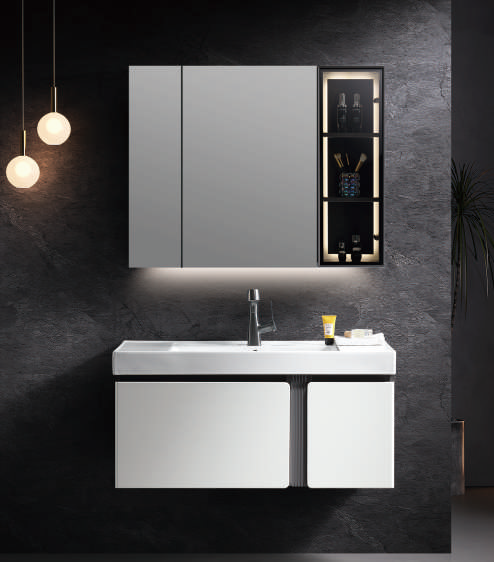
Material Selection Matrix for Global Distributors
Most plywood failures are edge-band failures, not core failures.
If you distribute into Southeast Asia or the Middle East, you have seen the same failure pattern: a vanity arrives intact, installs cleanly, and within six months the bottom edges swell, the drawer fronts stick, and the client files a warranty claim. The root cause is almost never the plywood core itself. It is the glue that seals the cut edges.
-
- EVA glue (standard industry): Ethylene-vinyl acetate hot melt is cheap and fast to apply. But it is thermoplastic — under 80% relative humidity and 40°C+ ambient temperature, the bond softens and steam penetrates the joint. Once moisture enters the porous plywood core, capillary action pulls water inward, causing irreversible swelling. Typical water absorption after edge failure: 5–10% by weight.
- PUR glue (MFBATH standard): Polyurethane reactive adhesive cures by reacting with moisture in the air, forming a chemical cross-link that is stronger than the wood fibers themselves. Our automated PUR lines achieve a bond strength exceeding 5 N/mm. The material does not remelt under heat. In accelerated aging tests (80°C / 90% RH / 500 hours), PUR-sealed edges show zero delamination. EVA-sealed edges fail within 200 hours.
The practical consequence for your inventory: a PVC vanity eliminates this entire failure mode because there is no porous core to protect. PVC foam board has a water absorption rate below 0.01%. It is homogeneous. There is no edge band to fail because the material itself is waterproof through the entire thickness. If you are sourcing for a coastal hotel project in the Philippines or a residential tower in Dubai, PVC is the only material that removes the edge-band variable from your quality risk equation.
That said, PVC introduces a different engineering constraint: thermal expansion. PVC’s coefficient of linear expansion is roughly 5x that of plywood. Between a 10°C warehouse and a 50°C installation site in Abu Dhabi, a 1200 mm vanity top can shift by 2–3 mm. If the installer does not leave a 3–4 mm expansion gap at the wall and between joined sections, the panel will buckle. This is not a material defect — it is an installation requirement that your distributor network must understand. We include a printed expansion-gap template with every PVC vanity shipment and provide a one-page installer brief in English and Arabic.
| Material | Water Absorption | Thermal Range | Best For | Warranty Risk |
|---|---|---|---|---|
| PVC (Polyvinyl Chloride) | < 0.01% (Non-porous) | -30°C to 70°C | Tropical & coastal climates (>80% RH) | Zero (100% waterproof) |
| Plywood (PUR Edge Banded) | 5-10% if edge seal fails | -20°C to 60°C | Moderate climates (40-80% RH) | Low (requires perfect edge seal) |
| Solid Wood (Oak/Walnut) | High (requires coating) | -10°C to 40°C | Dry, luxury interiors (<40% RH) | High (prone to warping) |
| Sintered Stone | < 0.02% (Non-porous) | -30°C to 150°C | Modern, high-heat environments | Very Low (scratch & heat resistant) |
Conclusion
For coastal and tropical markets above 80% humidity, the material choice is straightforward. PVC eliminates the root cause of warranty claims because it cannot absorb water. Plywood works only if the edge banding uses PUR adhesive and the installation prevents steam pooling — a condition most projects fail to maintain.
Review the current specs for your next project. Compare the PVC and premium plywood options in the catalog to see which build matches your climate data and budget timeline.
Frequently Asked Questions
Is PVC or plywood better for humid bathrooms?
PVC is 100% waterproof and the only safe choice for humidity above 80%, while plywood needs perfect edge sealing to avoid rot. Plywood failures usually start. Choose PVC for guaranteed humidity resistance, or plywood only if you can control edge sealing quality.
Why do plywood vanities fail in high humidity?
Moisture wicks through cut edges and seams via capillary action, causing the core to swell and delaminate. Standard EVA glue fails under steam, but MFBATH uses PUR adhesive that bonds stronger than. Verify your supplier uses PUR glue lines, not standard EVA.
What is the MOQ for custom bathroom vanities?
MFBATH supports a low MOQ of 10 to 20 units for custom orders, allowing you to test markets risk-free. This is significantly lower than most competitors who require 100+ units for custom. Confirm exact MOQ after finalizing your spec and customization scope.
Does PVC expand in heat and cause problems?
Yes, PVC expands 0.07mm per meter per degree Celsius, so without proper expansion gaps it can buckle at 50°C. MFBATH designs for specific thermal coefficients based on your target climate, unlike generic. Always specify your target climate zone when ordering PVC vanities.




0 Comments