

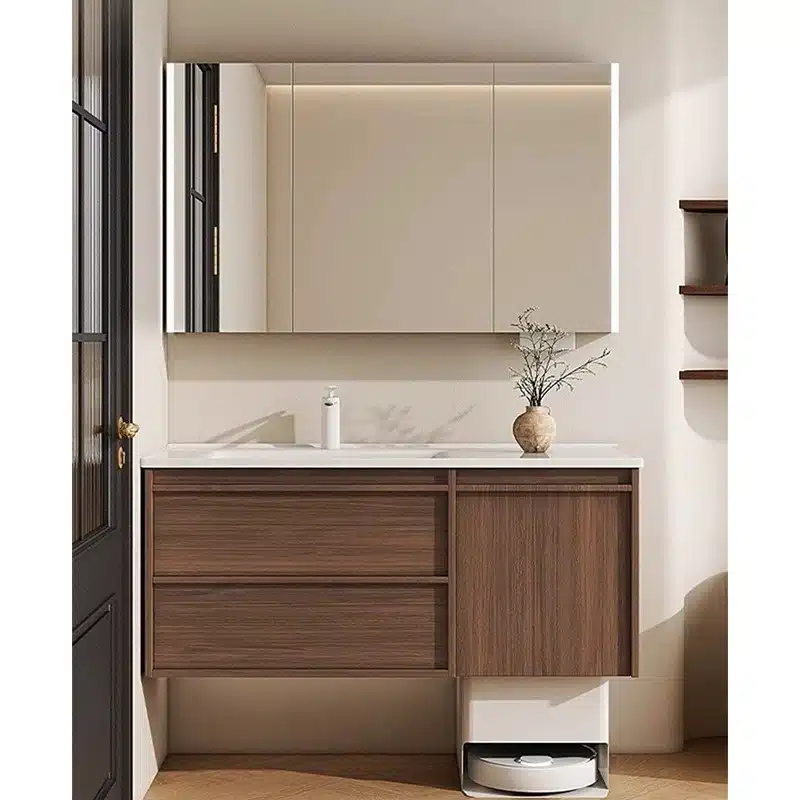
When you are evaluating the top China vanity suppliers for a 2026 project pipeline, the conversation usually starts with capacity and price. But for a veteran contractor or developer, the real vetting begins after you ask about regional compliance and batch consistency. Most factories can show you a catalog; the ones worth a long-term partnership can show you a UL/CSA certificate, a material test report for E1 emissions, and a documented five-stage QC process that covers edge-banding integrity.
The difference between a trading company and a direct manufacturer becomes obvious when you dig into the engineering details. A supplier operating a 10,000㎡ facility with automated CNC lines and a monthly capacity of 5,000 vanity units is a different class of partner than a workshop assembling parts from third parties. The real value lies in factories that offer OEM vanity suppliers with low MOQ, starting at 10-20 units, so you can test new designs without locking up capital. That flexibility, combined with region-ready adaptations like -30°C tested materials for Canadian winters or UV-resistant coatings for Australian sun, separates a reliable sourcing partner from a commodity vendor.
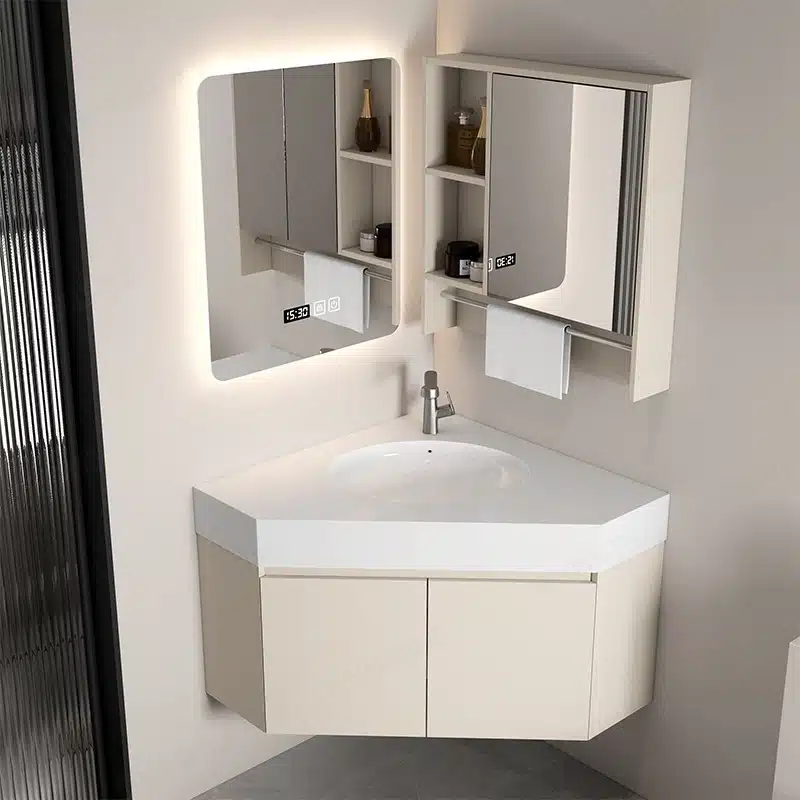
Why Vetting China Vanities Matters
A single batch failure can delay hotel openings or luxury residential deliveries by months. This guide filters out low-capacity workshops, focusing on manufacturers with proven export histories to 20+ countries and rigorous five-stage quality control protocols.
Project contractors and developers face high stakes when sourcing vanities. You need consistency across 500+ units and adherence to strict regional frameworks—ADA compliance for North America, WELS water ratings for Australia, or CE marking for the EU. A single non-compliant unit in a batch can derail an entire project timeline.
Unlike retail buyers, your failures are public and expensive. A developer in Toronto learned this the hard way: their supplier’s vanities warped during the first freeze because the MDF cores weren’t rated for -30°C. That’s a $50,000 redo plus lost reputation. Elite suppliers engineer for these conditions—they don’t just ship catalog products.
-
- Project Risks: Batch quality inconsistency, hidden logistics costs, non-compliance with building codes (UL/CE), and poor after-sales support kill margins and timelines.
- KPIs that Matter: ROI, on-time delivery, warranty coverage, and margin preservation. These aren’t retail goals—they’re project survival metrics.
- Supplier Red Flags:Trade companies without factory access, MOQ claims under 5 units without cost transparency, and vague certification language (e.g., “the supplier can get CE” vs. “the supplier holds current CE marks”).
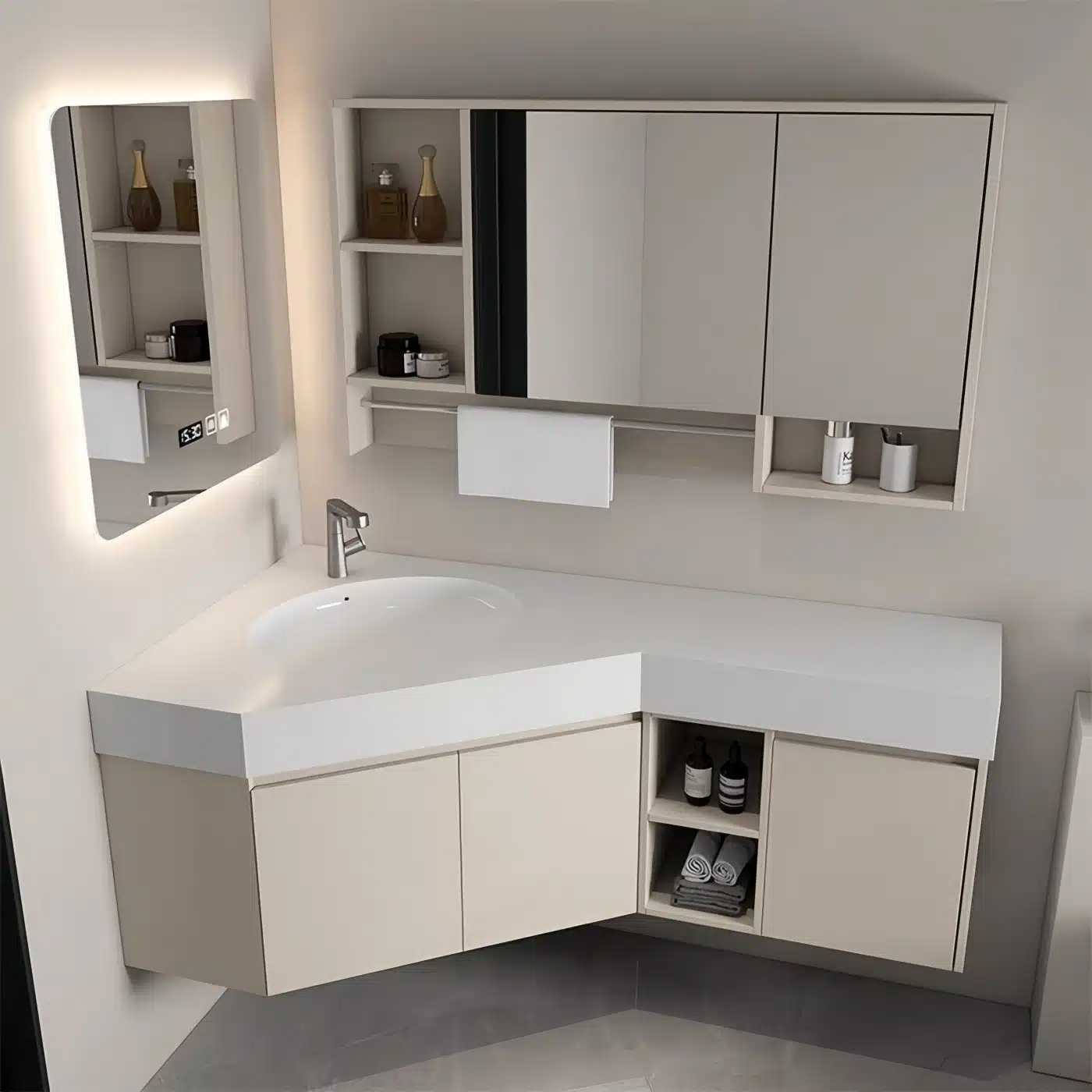
Top Criteria: Capacity and Compliance
Forget generic catalogs. The difference between a project that finishes on budget and one that bleeds margin is a supplier who engineers for your specific climate and code—not one who just ships boxes.
Every contractor has the same story: they sourced a vanity from a trading company, it looked great in the showroom photos, and then the first batch arrived with swollen edges because the MDF wasn’t sealed for the humidity in Miami. That’s a 3-week delay and a pissed-off client. Vetting isn’t about finding the cheapest quote; it’s about finding a manufacturer who can prove they understand the region’s specific demands.
The risk isn’t just quality—it’s compliance. A hotel project in Canada needs materials tested to withstand -30°C thermal cycling. A residential development in Sydney needs WELS certification for water efficiency. A commercial job in Berlin requires E1 formaldehyde levels. If your supplier doesn’t have the engineering data to back these claims, you’re gambling with your project’s acceptance certificate.
Here is the hard truth about the suppliers who make the cut for 2026:
-
- Factory Footprint: Look for a minimum of 10,000㎡ with automated CNC lines. Anything smaller is a workshop, not a factory. A workshop cannot guarantee batch consistency for 500+ units.
- Monthly Capacity: You need a partner who can handle 5,000 vanity units and 50,000 mirrors per month. If they can’t scale, your project timeline is at their mercy.
- Compliance Depth: This is the killer. The top tier holds UL/CSA for North America, CE/E1 for Europe, and AS/NZS/WELS for Oceania. If they only offer generic CE, they haven’t done the work for your market.
- Material Science: A supplier worth their salt will offer 100% waterproof PVC for humid climates (Southeast Asia, Middle East) and E1-grade plywood for European residential. They should be able to provide the test report, not just the claim.
The suppliers you want on your shortlist are the ones who proactively ask about your project’s climate and local building codes. If they don’t ask, they aren’t thinking about your risk. They are thinking about their margin. That is the single biggest red flag you can catch in the first conversation.
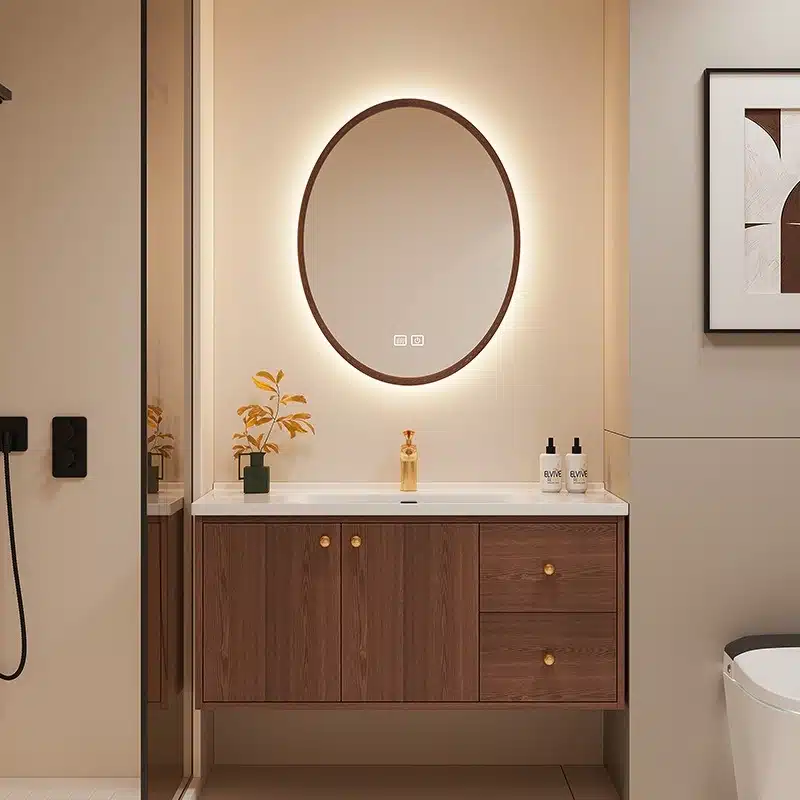
Material Selection: PVC vs. Plywood vs. Solid Wood
Most suppliers offer “low MOQ” as a marketing line. Real OEM flexibility for project testing starts at 10-20 units, not 200.
You are not buying for a single home. You are vetting a partner for a pipeline of projects. The difference between a trading company and a direct OEM vanity supplier becomes obvious when you ask about minimum order quantities. A trading company needs to fill a container to make their margin work, so they will push you toward a 200-300 unit commitment for a custom design. That locks your capital into a design you have not validated yet.
A direct manufacturer with automated CNC lines can afford to run a short batch. The machine setup time is the same for 10 units or 1,000 units, but the raw material cost is minimal for a small run. This is why elite suppliers offer OEM MOQs as low as 10-20 units. This allows you to test a new vanity design for a boutique hotel or a specific residential development before scaling to full production.
-
- Customization Depth: Look for suppliers offering 40,000+ combinations, including Pantone color matching, branded hardware, and custom drawer configurations. This ensures you can match architect specifications without paying for a full mold or tooling setup.
- Risk-Free Sampling: A low MOQ of 10-20 units means you can order a pilot batch for a single project floor. Install them, monitor for issues, and then sign off on the full 500-unit order with confidence.
- Capital Efficiency: Avoid suppliers that demand 50% upfront on a full container. A direct factory with low MOQ flexibility allows you to stage payments across multiple smaller orders, preserving your margin for other project costs.
Insider Warning: If a supplier claims “no MOQ” but cannot explain how they handle custom Pantone colors or branded hardware, they are likely a trading company planning to batch your order with other buyers. This introduces lead time risk and quality variance. A legitimate OEM vanity supplier with low MOQ will have a dedicated sample workshop and a clear pricing tier for small-batch production.
| Feature | Specification | Advantage |
|---|---|---|
| Factory Size | 10,000㎡ facility with automated CNC lines | High-volume precision for large-scale projects |
| Monthly Capacity | 5,000 vanity units & 50,000 mirrors | Reliable delivery for multi-unit developments |
| Customization Options | 40,000+ combinations (Pantone, hardware) | Meets unique architect specs without excess stock |
| Regional Compliance | UL/CSA (NA), CE/E1 (EU), AS/NZS (Oceania) | Eliminates project rejection due to code violations |
| Minimum Order Quantity | 10-20 units for custom OEM orders | Risk-free market testing for new designs |
| Material Options | PVC, Plywood, Solid Wood, Sintered Stone | Climate-specific durability (waterproof, heat-resistant) |
| Quality Control | Five-stage inspection (edge-banding, hardware) | Reduces first-year failure rates significantly |
| Climate Engineering | -30°C tested (NA), UV-resistant (Oceania) | Survives extreme environments without warping |
| Certifications | ISO 9001, ISO 14001, UL/CSA, CE | Verifiable quality for international tenders |
| After-Sales Support | Dedicated project manager & spare parts | Minimizes project delays and warranty disputes |
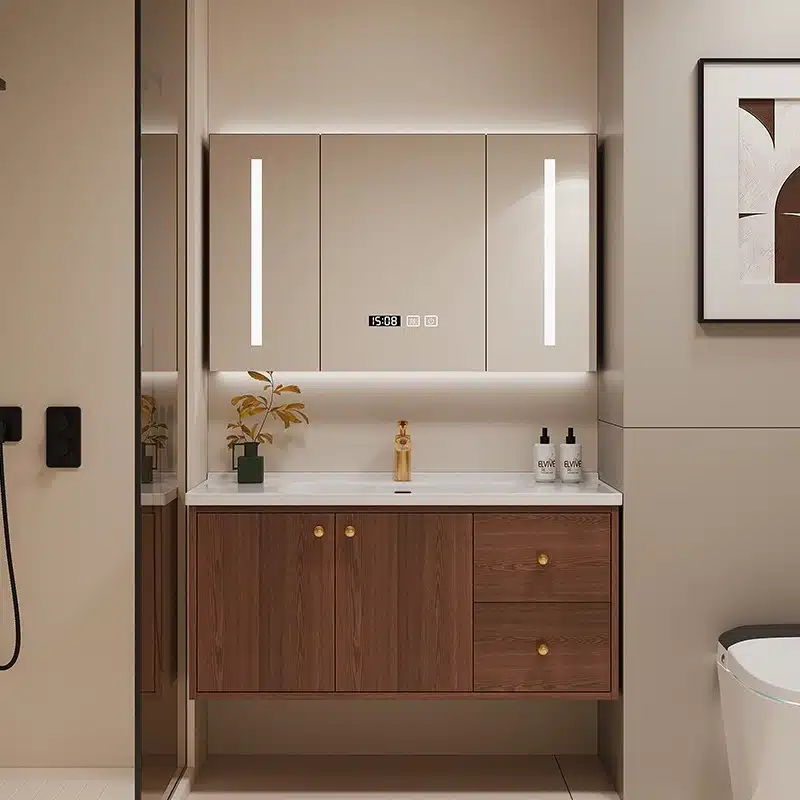
OEM/ODM Flexibility and MOQs
A supplier offering a 10-unit MOQ isn’t being generous; they are absorbing the setup cost to get you locked in. The real test is whether they can scale to 500+ units without changing the material or finish.
Most Chinese factories will tell you their MOQ is 200 units. That’s a hedge against their own inefficiency. They don’t want to stop the CNC line, change the program, and risk a setup error for a small batch. A legit OEM partner with automated lines has a different math. The setup cost is fixed, so a low MOQ is a signal of process control, not a favor. If a supplier can run a 15-unit custom order on Monday and a 1,000-unit production run on Tuesday, it means their changeover time is under 30 minutes. That’s the benchmark you need to verify during your factory audit.
Here is the reality of low MOQ OEM sourcing for commercial projects:
-
- True OEM flexibility starts at 10-20 units: This allows you to validate a new design for a boutique hotel or a spec house before committing to a full container. It also lets you swap out hardware or Pantone colors for a specific client without carrying dead stock.
- The 40,000+ combination trap: A catalog of options is useless if the factory cannot track the BOM for each variant. Ask for their ERP system name. If they use a paper-based system or a generic spreadsheet, your order will have a 15% error rate on hardware alignment alone.
- Color matching is a risk multiplier: A supplier that offers Pantone matching must have a spectrophotometer on site. Without it, the color will drift between batches. For a 300-unit hotel project, that drift is a redo of all the doors.
The suppliers that pass the OEM vanity suppliers with low MOQ test are the ones who treat your small order as a proof-of-concept for the production line, not a hassle. They will charge you a one-time setup fee that covers the CNC programming and the material waste, but the per-unit price should be within 10% of their bulk rate. If the gap is larger than that, they are padding the margin because they don’t trust their own process.
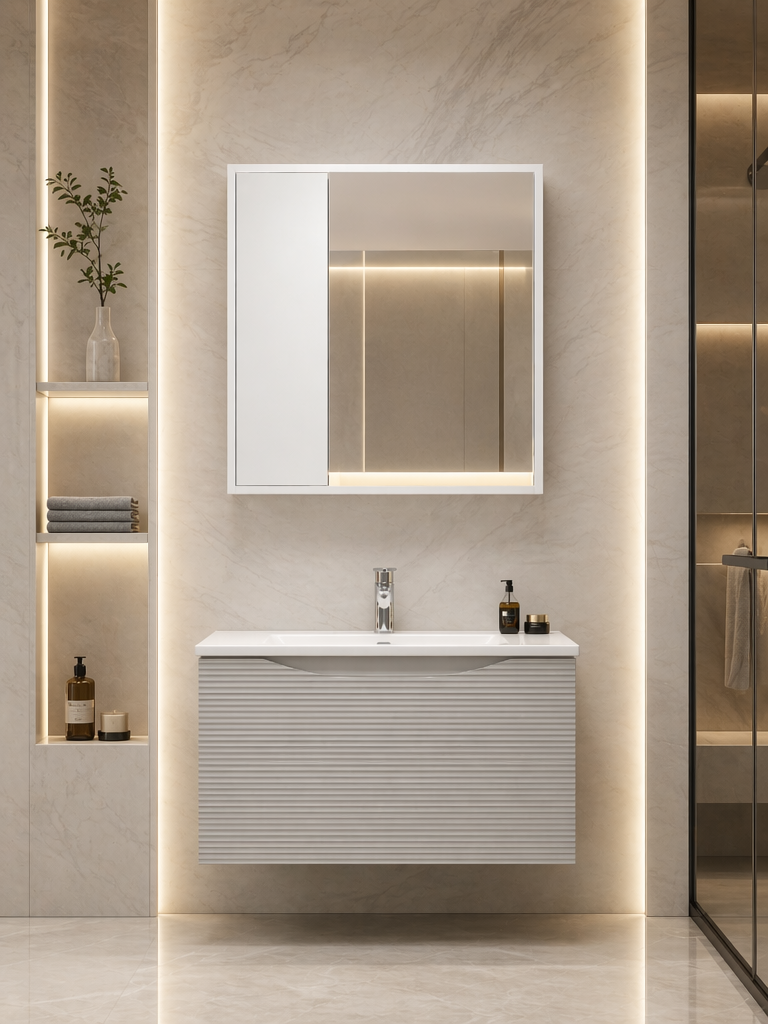
Quality Control and Post-Installation Support
A 10,000㎡ facility with ISO 9001 is table stakes. The real filter is whether they can engineer a vanity that survives a Canadian winter or a Singapore monsoon without warping.
You don’t need another list of names you could find on Alibaba in ten minutes. You need a vetting framework that kills risk before you sign a PO. A single batch failure on a 200-unit hotel project can wipe out your margin for the quarter. The difference between a reliable partner and a liability is not price — it’s whether the factory has the engineering depth to make your specific regional specs a non-issue.
Here is the criteria set I use when evaluating factories for multi-regional contracts. If a supplier fails any of these, move on.
-
- Facility Scale: Minimum 10,000㎡ with in-house CNC lines. No subcontracted cutting. You want direct control over tolerances, not a trading company stitching orders together from three different workshops.
- Monthly Capacity: Look for a minimum of 5,000 vanity units per month. If they can’t handle your peak volume without extending lead times, they are a bottleneck waiting to happen.
- Compliance Depth: Certificates are cheap. Engineering adaptation is expensive. Ask for specific test reports: UL/CSA for North America, CE/E1 for Europe, AS/NZS/WELS for Oceania. If they hand you a generic ISO certificate and call it done, they are not ready for your market.
- Material Options: They must offer a clear material strategy. 100% waterproof PVC for high-humidity zones (Southeast Asia, Middle East), E1-grade plywood for cost-sensitive residential, and solid wood with proper moisture seals for luxury hospitality. One-size-fits-all is a red flag.
- Customization MOQ: True OEM flexibility starts at 10-20 units. If they demand a 50-unit minimum for a custom Pantone color or branded hardware, you are dealing with a production line that cannot pivot. That rigidity will kill your ability to test new designs or fulfill boutique projects.
Here is the insider angle most sourcing guides miss: the “Region-Ready” strategy. An elite supplier does not just build a generic cabinet and ship it. They engineer for the destination. For a Canadian project, that means materials tested to -30°C to prevent cracking during transport and installation. For an Australian coastal site, it means UV-resistant coatings that won’t yellow after 18 months of sun exposure. For a European hotel, it means E1 formaldehyde levels verified by third-party lab reports. This is not marketing fluff — it is the difference between a vanity that lasts a decade and one that fails before the warranty expires.
The QC process is another non-negotiable. The “five-stage inspection” is a common claim, but dig into what it actually covers. The leading causes of vanity failure in the first year are edge-banding delamination and misaligned hardware. A real QC protocol includes specific checks for both at the cutting, assembly, and final packaging stages. If the supplier cannot describe their inspection points in detail, they are likely spot-checking at best.
When you are evaluating a shortlist, ask for a video walkthrough of their production line. Look for automated CNC routers, a dedicated finishing area with dust extraction, and a separate QC hold area for failed units. If the video shows a cramped workshop with hand tools and no separation between raw materials and finished goods, you are looking at a workshop, not a factory. Keep searching.
Conclusion
Sourcing vanities from China for 2026 projects is not a commodity purchase; it is a strategic partnership decision that directly impacts your project margins, timeline, and reputation. The suppliers that will protect your bottom line are those with direct manufacturing capacity, region-specific engineering, and transparent quality control—not trading companies offering generic products.
Review your current supplier shortlist against the criteria outlined here: factory size, compliance certifications for your target market, and demonstrated QC protocols. If your partner cannot provide a documented five-stage inspection process or a region-ready engineering adaptation for your project’s climate, it is time to evaluate alternatives that can.
Frequently Asked Questions
Who is the best supplier for bathroom vanities?
For 2026 projects, the best suppliers are direct manufacturers with 10,000㎡+ facilities and proven export compliance, not trading companies. Look for factories offering region-ready adaptations like UL/CSA for North America or CE for Europe. Verify factory certifications and regional compliance before committing.
How do I find legit suppliers in China?
Focus on manufacturers with ISO certifications, a physical factory address, and a track record of exporting to 20+ countries. Avoid trading companies by requesting a video tour of CNC production lines and verifying. Always audit the factory floor and request compliance documentation.
Which company makes the best bathroom vanities?
MFBATH is a top contender, offering four material paths (PVC, plywood, solid wood, sintered stone) with 40,000+ customization combinations and a low MOQ of 10-20 units for market testing. Their five-stage QC and. Request samples and regional compliance specs to validate fit.
What is the biggest online seller in China?
Alibaba.com is the largest B2B online marketplace for sourcing Chinese bathroom vanities, but it hosts many trading companies. For project-grade reliability, bypass general listings and contact direct factories like MFBATH that offer OEM/ODM. Use Alibaba for discovery, then verify factory credentials directly.
How to find direct suppliers in China?
Search for manufacturers with dedicated export teams and ISO 9001/14001 certifications, then request a factory audit and material samples. Direct suppliers like MFBATH provide OEM/ODM with 40,000+ customization options and. Confirm direct factory status by checking for CNC lines and in-house QC.



0 Comments