

When a bathroom vanity fails in the field, the fault is rarely in the door or the finish. It is inside the drawer box — the part that takes the heaviest daily use in the most humid room of the building. Towels, hair dryers, and cleaning chemicals sit in these boxes for years, and every open-close cycle loads the joints, the bottom panel, and the slides. Most B2B buyers spec the countertop, the sink, and the finish, but never ask how the drawer box is built. That omission shows up later as sagging drawers, seized slides, and warranty claims. This article explains 5-side vs 4-side drawer box construction, compares plywood, PVC, and solid wood, reviews joint types and slide load ratings, and closes with a factory inspection checklist you can use before you commit to an order.
Why the Drawer Box Decides Vanity Lifespan
A drawer box is the load-bearing container that rides on slides inside the vanity frame. Four side panels plus a bottom panel sound simple, but the way those panels are cut, joined, and attached to the slides decides how much weight the drawer carries, how long it stays square, and how it survives the humidity swings of a bathroom. A box that twists out of square by even a few millimeters scrapes against the frame, binds on its slides, and slowly tears the slide screws out of the panel. That is why manufacturers who compete on construction details treat the drawer box as the skeleton of the whole cabinet — and why buyers who skip this detail end up paying for it in field failures.
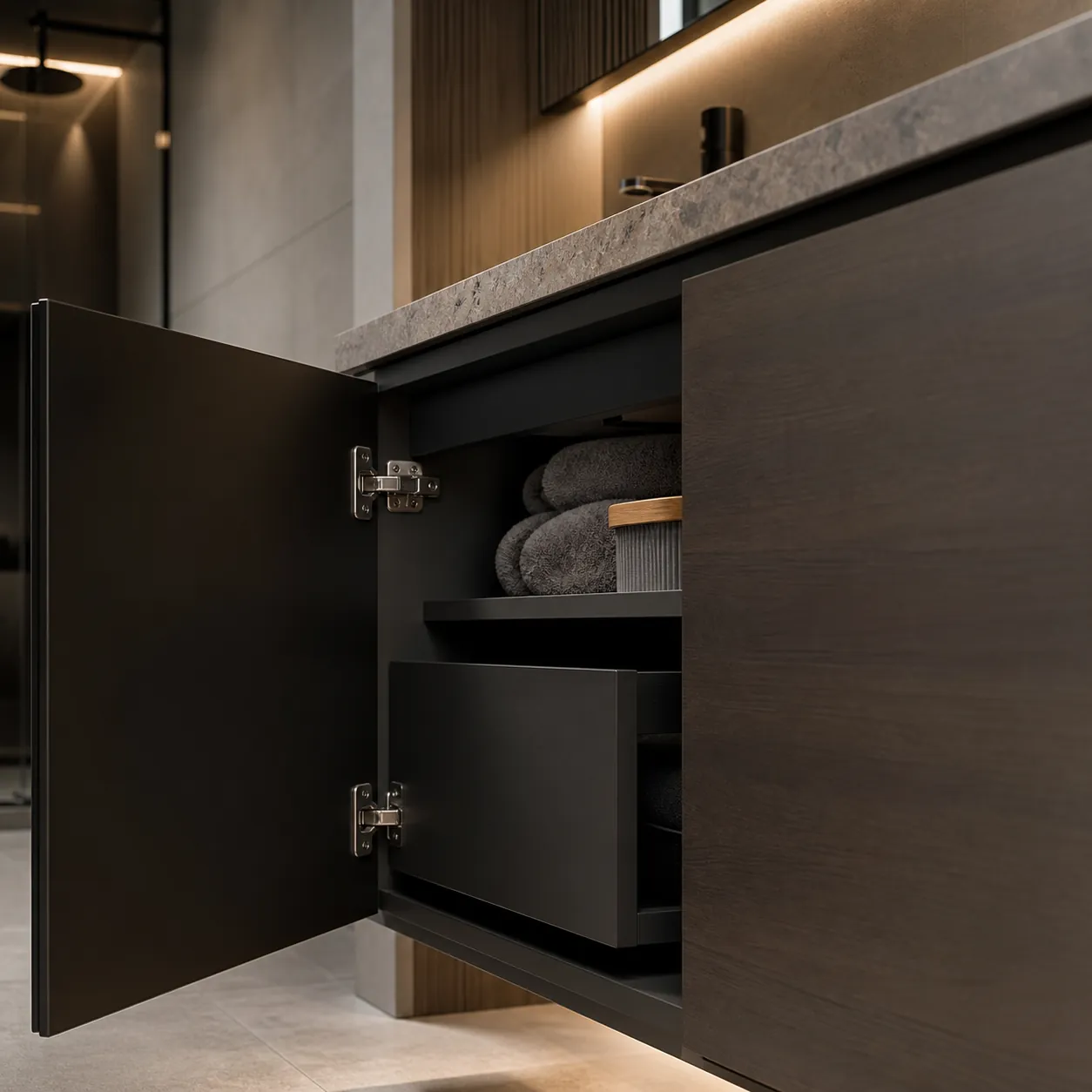
In a bathroom vanity, drawers carry the heaviest repeated loads in the unit: stacks of towels, full-size shampoo bottles, hair dryers, cleaning spray. They also see the widest temperature and moisture swings, because the bathroom is the only room in the building where steam is generated on purpose. Panels that absorb moisture swell, joints loosen, and bottoms sag. Buyers evaluating a vanity line should therefore look at the drawer box the same way they look at the countertop material — as a long-term performance decision, not a cosmetic one.
MFBATH builds its bathroom vanity collections with soft-close drawers, including its sintered stone lines, and soft-close adds a mechanical stress a static box never sees. Every closing cycle drives the damping mechanism against the rear of the box, and if the box is flimsy, that repeated force accelerates the failure. For importers, wholesalers, and hotel project buyers, the practical question is simple: can the supplier show you how the drawer box is built before you sign? Most spec sheets do not say, so you have to ask. The rest of this article tells you exactly what to ask about.
5-Side vs 4-Side Drawer Box Construction: What Actually Changes
Drawer boxes divide into two broad categories, and the difference is the bottom panel. A 5-side drawer box machines grooves or rabbets into the inside face of all four sides, then slides the bottom panel into those channels. The bottom is captured on all four edges, flush with the lower edge of the sides, and glued in place. A 4-side box is simpler: the four sides are joined into a frame, and the bottom panel is nailed or stapled onto the frame, usually on the underside or against the inside face. Nothing supports the bottom except the fasteners.
| Drawer box construction | 5-side box | 4-side box |
|---|---|---|
| Bottom panel | Captured in grooves or rabbets machined into all four sides | Nailed or stapled to the frame; fasteners carry the panel |
| Load path | Weight transfers through the grooves into the sides; bottom supported on all four edges | No edge support under the bottom; fasteners take the load |
| Sag behavior | Minimal sag under normal vanity loads over years of use | Visible sag and loosening over time under heavy loads |
| Joint compatibility | Works with dovetail, dowel, and CNC-machined joints | Usually paired with butt or staple joints |
| Durability | Higher; intended for long service life and commercial duty | Lower; a common first failure point on entry-tier lines |
| Typical cost tier | Mid to upper cost tier | Entry cost tier |
The load path is the whole story. In a 5-side box, weight on the bottom panel transfers into the side panels through the grooves, and the panel resists sagging because all four edges are supported. In a 4-side box, the fasteners take the load; over time, staples and nails work loose, the bottom drops, and the drawer starts scraping on the rails below it. The same difference shows up when you compare quotes: machining a captured bottom costs more, so entry-tier lines skip it. That is a legitimate cost-tier trade-off — as long as you know which construction you are actually buying.
When you compare drawer box construction across suppliers, also check what happens at the front of the box. A 5-side box usually carries a thicker front panel that can hold the mounting screws of the drawer front, and the joint between the front and the sides takes pull force every time someone yanks the drawer open. Look for mechanical reinforcement at that corner, not just glue. Ask for the box spec in writing: panel thickness, material, joint method, and whether the bottom is captured or fastened. If the sales sheet answers in vague terms, that is information in itself — the supplier who cannot describe its own box probably does not want to.
Drawer Box Materials: Plywood, PVC, and Solid Wood
Construction type decides how the box holds together; the panel material decides how it survives moisture, impact, and decades of use. MFBATH offers three material families across its vanity lines: plywood, PVC, and solid wood. Plywood is the default for most production vanities because it combines strength with weight control; PVC is specified for wet-zone applications where waterproofing is the priority; and solid wood appears on premium lines where buyers want natural grain. The right choice depends on the project environment, the load, and the cost tier of the product — so it pays to understand each family before you write your specification.
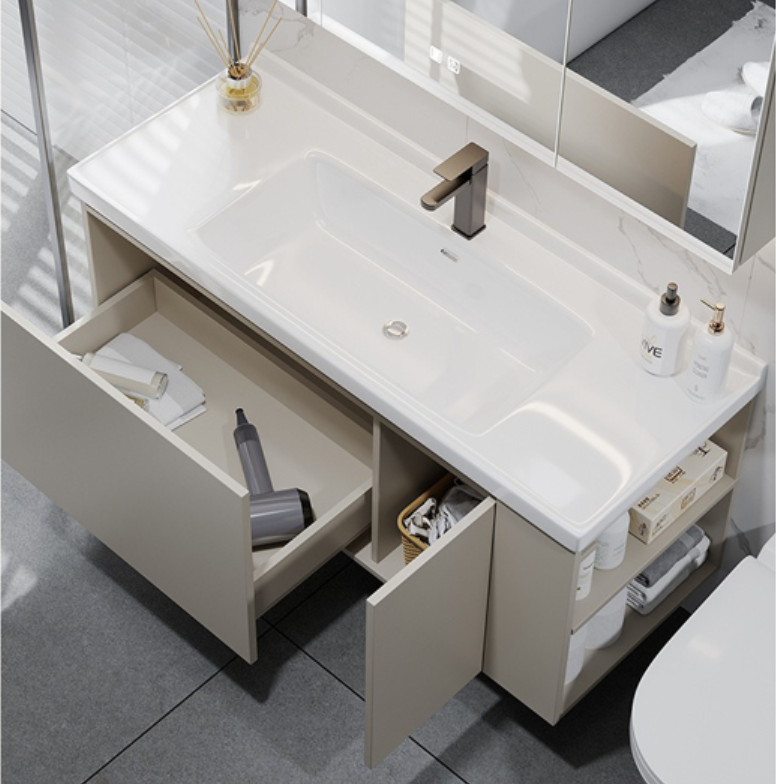
Plywood: the workhorse
Plywood is made by gluing thin veneer layers together with the grain of each layer running perpendicular to the last, which makes the panel strong in both directions and resistant to splitting at screw holes. The APA – The Engineered Wood Association publishes the grading and performance standards that engineered wood panels are evaluated against, and its plywood resources are a useful reference when a supplier hands you a generic grade name. For drawer boxes in humid rooms, the two things to verify are the glue line and the edge treatment. Multi-layer construction with water-resistant edge sealing stops the panel from wicking moisture at cut edges, and low-formaldehyde adhesives keep indoor emissions down. The U.S. Environmental Protection Agency (EPA) publishes guidance on formaldehyde in composite wood products, and its formaldehyde page explains why indoor emissions from panels deserve attention in occupied buildings.
Grade tiers: standard, BWR, and marine
MFBATH stocks plywood in three grades: standard, BWR (boiling water resistant), and marine. Standard grade suits dry interiors. BWR grade uses adhesives that hold up under repeated moisture exposure, which makes it the common choice for bathroom environments. Marine grade is engineered for prolonged water contact and carries a higher price. For a vanity, BWR is usually the sensible specification; marine adds cost that most projects never need. When you audit a supplier, ask which grade is inside the drawer box, not just which grade is in the cabinet frame — they are not always the same, and the drawer box is the part that faces the most moisture.
PVC: the waterproof option
PVC (polyvinyl chloride) panels are the answer for buyers who want to eliminate moisture risk entirely. MFBATH describes its PVC panels as 100% waterproof, with no absorption, no warping, and a scratch-resistant surface. Those properties matter in bathrooms where splashes, steam, and cleaning agents attack wood-based panels over the life of the vanity. The trade-offs are material cost and perceived quality: PVC does not look or feel like wood, so it is usually specified for high-humidity commercial washrooms rather than residential-style lines. When a quote specifies PVC, ask whether the panel is solid board or a thin skin over a wood core — the two behave very differently under load and over time.
Solid wood: the premium tier
Solid wood drawer boxes appear on premium vanities and on custom projects where the buyer wants the same material inside as outside. MFBATH offers oak, walnut, maple, and ash. Solid wood is strong and repairable, but it moves with humidity, so it demands proper drying and stable joinery. Buyers who specify solid wood should also confirm the moisture content range they will accept and ask how the supplier sources the lumber. Forest Stewardship Council (FSC) certification is the recognized benchmark for responsibly managed forestry, and its certification pages describe what a certified supply chain actually covers.
Joint types: dovetail, dowel, and CNC
Joints are where drawer box quality is won or lost, and three methods dominate production. A dovetail joint interlocks wedge-shaped fingers cut into the side and front panels; it is mechanically strong against the pull-out force that drawer fronts endure, and it needs no fasteners. Dowel joints align precisely drilled holes, insert glued dowels, and clamp the panels together; they are fast to produce and strong when the machining is accurate. CNC (computer numerical control)-machined joints use computer-controlled routers to cut precise finger or box joints at high repeatability, which is how mid-to-large factories keep quality consistent at volume.
For a 5-side box, the joint that matters most is at the front corners, where pull force concentrates, and at the bottom grooves, where the panel must seat tightly. Whatever the method, the joint is only as good as the glue and the moisture content of the panels. When you audit a factory, ask to see the corner of a finished box and look for gaps, glue squeeze-out, and rough machining marks. A clean corner is the most reliable proof of process discipline you can get.
Vanities With Durable Drawer Box Construction
Browse this product, solution, or service page to explore relevant offerings.

Slides, Load Ratings, and Factory Checks
The drawer box and the slide work as one system: the slide supports the box, and the box gives the slide a rigid, square surface to mount against. If the box panel is too thin or the material too soft, slide screws strip out and the drawer droops regardless of how good the slide is. That is why load ratings and slide type belong in the same conversation as the box itself. Undermount slides mount beneath the box and hide the hardware; side-mount slides attach to the side panels and are easier to service. Our undermount vs side-mount drawer slides guide walks through the trade-offs in detail, including which box construction each type suits.

Load ratings are stated per pair, and for typical bathroom vanity drawers they commonly fall in the 75 lb to 150 lb range depending on the slide class — figures you can confirm from the slide manufacturer’s data sheet rather than the assembler’s word. A vanity drawer rarely carries its full rated load, but the rating tells you the margin the hardware keeps at daily loads. Our guide to drawer slide load ratings explains how ratings are tested and what to compare across suppliers. Also ask whether the rating applies to dynamic use — opening and closing under load — or to static load only; they are different tests, and only one of them predicts real service life.
Soft-close mechanisms add the damping that stops drawers from slamming, and MFBATH fits soft-close drawers across its product lines, including its sintered stone vanities. The damping unit is a wear part, so its durability matters more than its initial feel. Our soft-close vanity hardware overview explains how the mechanisms work and what to test, and the 100,000-cycle hardware test article shows what extended cycling reveals about a mechanism’s lifespan. When you compare quotes, ask each supplier for the cycle rating of the damping unit, not just a sample of how the drawer feels in a showroom.
Factory inspection checklist for drawer boxes
When you audit a supplier — in person, by video call, or by requesting production photos — walk through this list:
- Drawer box construction 5-side vs 4-side: Which design is quoted? If it is not stated on the order, ask for it in writing before production starts.
- Construction type: Is the bottom panel captured in grooves or fastened on? If fastened, what fastener, and how many per edge?
- Panel spec: Confirm the material (plywood, PVC, or solid wood), the plywood grade (standard, BWR, or marine), the panel thickness, and the edge-sealing method.
- Joint method: Dovetail, dowel, or CNC. Look at a finished corner for gaps, glue squeeze-out, and machining marks.
- Slide and rating: Slide brand, type, and per-pair load rating from the manufacturer’s data sheet.
- Soft-close unit: Brand and cycle rating of the damping mechanism.
- QC records: MFBATH runs 5-stage QC (quality control) on every unit and welcomes third-party inspection by SGS or TÜV, and it has maintained ISO 9001 and ISO 14001 certification since 2017. Ask any supplier for the same level of visibility, including photos of the QC station.
- Capacity and terms: MFBATH produces 5,000 sets per month with a 95-person team; its MOQ (minimum order quantity) is 15 units per model, color, and size, mixed-container loading is supported, free samples ship in 10 working days, and bulk production takes 20–30 days. Shipments leave from Qingdao on FOB (free on board) terms, with a 30% deposit and the balance due within one week of the draft BL (bill of lading). Delivery to the US, Canada, and Mexico runs 4–6 weeks. Use these figures as benchmarks when comparing offers.
- Warranty and returns: MFBATH covers the complete cabinet for 2 years and reports a return rate below 1%. Ask the supplier to put its warranty terms and return history in writing.
The point of the checklist is not to interrogate the supplier; it is to make the drawer box specification explicit in writing, so the box you quote is the box you receive. Suppliers that answer these questions without hesitation are usually the ones with nothing to hide. For more of this kind of material, the product knowledge hub collects our guides on slides, hardware, and vanity construction.
Frequently Asked Questions
What is the difference between a 5-side and a 4-side drawer box?
A 5-side drawer box has a bottom panel that is captured in grooves or rabbets machined into all four sides, so the bottom is supported on every edge. A 4-side drawer box has the bottom nailed or stapled onto the frame, so the fasteners carry the load. The 5-side design resists sagging longer under heavy loads, which is why it is the construction to specify for commercial-duty vanities.
What thickness are drawer box sides usually?
There is no universal standard; typical production drawer boxes use panel thicknesses in the range of roughly 10 mm to 19 mm (about 3/8 in to 3/4 in), depending on the material and the load class. Thicker panels hold slide screws better, so match the thickness to the slide rating and the intended duty. Ask the supplier for the exact thickness and material in writing rather than accepting a range.
Which material is right for drawer boxes: plywood or PVC?
It depends on the environment. PVC is 100% waterproof, so it eliminates moisture-related absorption and warping in high-humidity washrooms. Plywood is stronger per unit of weight, easier to repair, and available in low-formaldehyde grades such as BWR. Many buyers choose plywood for residential-style lines and PVC for commercial wet areas; solid wood is the premium option where natural grain matters more than cost.
The Bottom Line
The drawer box tells you more about a vanity’s real quality than the finish does. Specify a 5-side box with a captured bottom, choose the panel material to match the environment — BWR plywood for most bathrooms, PVC where waterproofing is non-negotiable — and verify the slide rating and soft-close unit in writing. Use the inspection checklist before you order, and hold suppliers to documented QC and warranty terms. When you are ready to compare, browse the MFBATH vanity collections and ask for the drawer box specification on any model you are evaluating.





0 Comments